Get Full Government Meeting Transcripts, Videos, & Alerts Forever!
Get email alerts on the Fire Safety Inspections topic
No spam. Unsubscribe anytime.
Clark County fire marshals outline commercial fire, life‑safety inspection rules and fees
Summary
Clark County deputy fire marshals reviewed commercial fire and life‑safety inspection procedures, common code violations, permit types and inspection fees during a county learning lab, and answered business owners’ questions about responsibilities and compliance.
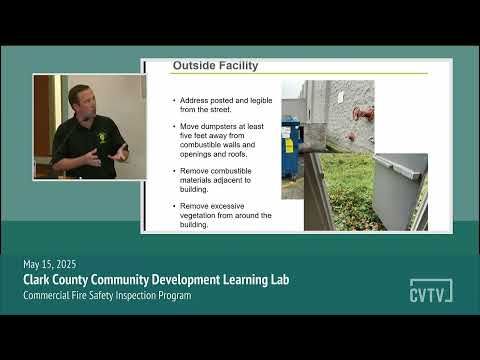
Senior Deputy Fire Marshal Jason Noble and Deputy Fire Marshal Jaren Wong presented Clark County’s commercial fire and life‑safety inspection program and common violations at a Clark County learning lab recorded by CVTV.
The marshals said the inspections aim to prevent catastrophic commercial fires, reduce insurance costs, and verify that fire protection systems and exit routes meet applicable codes. “It is a critical part of fire prevention. It helps protect people, business owners, property, and the community,” Jason Noble said, citing a 2022 commercial fire near Highway 99 as an example of the losses inspections try to prevent.
Noble and Wong described how inspections are scheduled and carried out. Inspectors perform previsit reviews of building history and system service records, check fire department access and hydrants, then walk through a business to document code violations and provide a written report. Inspectors typically return for a reinspection within 30 days to verify corrections.
The presenters cited specific code-based requirements and typical violations business owners should expect. Examples they gave include:
- Electrical safety: extension cords are intended only for temporary use (no more than 90 days); power strips must be plugged directly into a wall outlet and should not be daisy‑chained. A 36‑inch clear working space is required in front of electrical panels.
- Exiting and egress: illuminated exit signs and exit paths must remain unobstructed; exit hardware and doors must be maintained as designed. Blocking exit corridors or locking required exits was identified repeatedly as a common violation.
- Fire sprinkler and storage clearances: sprinkler heads require an 18‑inch clearance; in non‑sprinklered buildings, storage generally must maintain a 2‑foot clearance from the ceiling; sprinkler risers and related equipment need a 3‑foot working clearance.
- Commercial cooking and suppression systems: hood and suppression systems must be inspected and cleaned every six months (more often for high‑grease operations). Manual pull stations and Class K extinguishers must be accessible in kitchen areas.
- Compressed gases and flammable liquids: compressed gas cylinders must be secured and stored upright; more than 10 gallons of flammable liquid requires an approved flammable‑liquid cabinet. The marshals noted Clark County requires an operational permit and annual alarm/detection testing for carbon dioxide cylinders that exceed 100 pounds and said alarm detection must be tested annually.
- Portable heaters and extinguishers: space heaters must be UL listed for space‑heating and plugged directly into wall outlets. Portable fire extinguishers must meet a minimum 2A:10B:C rating, be placed so a user is never more than about 75 feet from one, have monthly visual checks, and be serviced annually by a qualified company.
The marshals explained the role of the county’s “compliance engine,” the online system used to track required testing and upload service reports for sprinklers, fire alarms, hood suppression and CO2 systems. Noble said a satisfactory inspection will not be issued until required system reports are uploaded into that system.
On fees and responsibilities, Noble gave a fee schedule for routine fire and life‑safety inspections: $150 for businesses under 30,000 square feet plus $50 per operational permit; $200 for 30,000–70,000 sq ft; $250 for 70,000–100,000 sq ft; and $300 for spaces above 100,000 sq ft. When asked who must ensure required system inspections and report uploads occur, the marshals said both landlords and tenants can bear responsibility; landlords commonly ensure building systems are inspected, but tenants remain obligated under inspection rules and lease terms to make sure services and uploads are completed.
Presenters advised business owners planning to move in to an existing commercial space to obtain a move‑in only permit through the Clark County permitting center; that route typically results in a post‑occupancy fire and life‑safety inspection at no charge. Noble recommended sharing complete information about occupancy type and operations (for example, restaurant vs. office) early with the building department and fire marshal’s office to reduce surprises at final inspection.
During a question‑and‑answer period, Noble and Wong emphasized that common violations the county sees include overloaded electrical circuits and space‑heater misuse, blocked exits and improperly secured compressed‑gas cylinders. “Storage. It shall be orderly,” Wong said, explaining clearances and the effect that blocked or piled storage can have on sprinkler activation and firefighter access.
No formal policy changes or votes were taken during the session; the presentation and Q&A provided guidance on existing inspection practices, permit types, testing frequencies and fee schedules. The presenters closed by thanking attendees and noting the county’s next learning lab on residential inspections scheduled for June 12 at 11 a.m.