Get Full Government Meeting Transcripts, Videos, & Alerts Forever!
Get email alerts on the Solar Energy Project topic
No spam. Unsubscribe anytime.
Shaker Heights council approves $1.8 million service center solar project, citing federal tax-credit window
Summary
Shaker Heights City Council approved a design-build agreement and appropriation to install rooftop solar at the city service center, with supporters citing federal tax credits and lifetime savings estimates and one councilmember raising concerns about the project's return and risks.
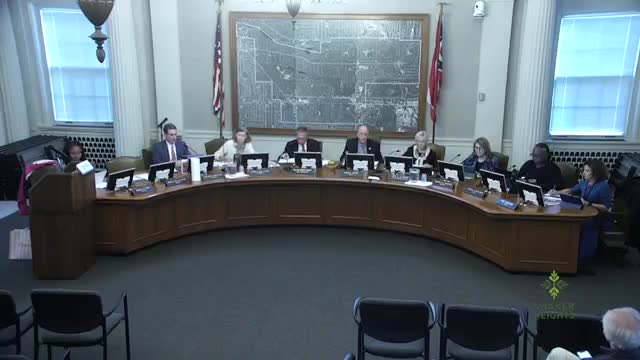
Shaker Heights City Council on Tuesday approved a contract with Compass Energy to install rooftop solar at the city service center and separately appropriated funds to pay for design, procurement and construction.
City staff presented the item as two companion measures: an ordinance to authorize a personal services design-build agreement with 21 C LLC doing business as Compass Energy in an amount not to exceed $1,596,254, and a companion ordinance appropriating $1,800,000 from the general capital fund to cover the project and contingency. Council approved both measures under emergency suspension of rules.
City staffer Mister Peters said the project had been negotiated over several months and described it as “an economic investment with a real economic return to the city,” adding the administration expects the installation to generate roughly 13,000,000 kilowatt-hours of emission-free electricity over the panels’ 25-year expected life. Peters told council the city could realize electricity cost savings over that period of roughly $450,000 to $800,000 depending on future energy prices and federal incentives.
Councilmember Bixenstein, speaking on behalf of the Sustainability Committee, said the city faced grid reliability and climate risks and urged quick approval to preserve eligibility for federal investment tax credits. “We have this narrow window of opportunity to take advantage of the investment tax credits of 30%,” Bixenstein said, noting that a House budget proposal would change how municipal credits apply and that safe-harbor rules could require early action to lock in credits.
Councilmember Moore, reporting for the Finance Committee, said the committee forwarded the project with two recorded dissenting views: one member who questioned a 25-year return and another who preferred a smaller initial project. Moore noted the sustainability and finance committees had reviewed the proposal and recommended approval despite the dissents.
Councilmember Malone, who registered the primary on-record concerns during debate, said he supported solar generally but questioned the return under several scenarios and highlighted possible additional costs. “It’s still not a great return to be completely honest with you from my perspective,” Malone said, noting scenarios in the project memo that show returns under 1% in some cases and one negative scenario if tax credits are lost. Malone also cited uncertain costs for roof warranty, insurance, electrical service upgrades and transformers, and noted that tax credits are not paid until 2027, requiring the city to advance costs until reimbursement.
Council members who spoke in favor said the project was the product of multi-department negotiation and committee review; supporters emphasized greenhouse-gas reductions, long-term fixed energy costs and compatibility with the city’s stated sustainability goals.
Votes at the meeting (roll calls recorded by the clerk) showed the ordinance authorizing the contract and the appropriation both carried on the suspension votes called that evening. The ordinances declared an emergency to permit prompt contract execution and to mitigate risks to expected federal credits.
If the project proceeds as planned, the administration said it expects to claim federal investment tax credits and to scale the panel count in response to cost changes if necessary, acknowledging that reducing panels to contain cost would also reduce the projected financial return.
Council did not vote on any amendments to the contract during the meeting; council and staff described existing contract safeguards intended to limit the city’s economic exposure.