Get Full Government Meeting Transcripts, Videos, & Alerts Forever!
Get email alerts on the Gas Utility topic
No spam. Unsubscribe anytime.
Richmond Gas Works adopts rate increase, seeks in-house crews to speed pipeline work
Summary
City staff presented a financial plan for Richmond Gas Works that includes adopted 5.25% rate adjustments, federal PHMSA grants to rebuild reserves, and a multi-year plan to hire internal construction crews to replace expensive contracting costs.
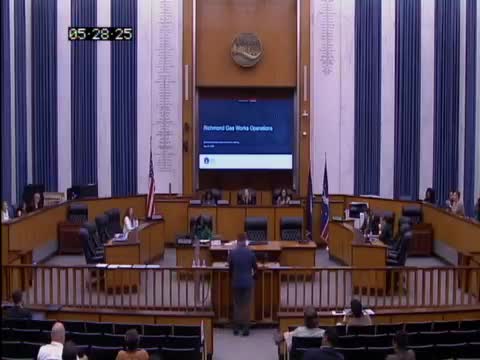
Dan Reifenberg, who presented Gas Works operations for the Department of Public Works, told the committee the utility’s adopted financial plan aims to rebuild capital reserves while avoiding a rate shock for customers.
He said the council-adopted rate adjustment effectively amounts to a 5.25% increase and that projected revenues under the adopted rates would begin to exceed expenditures, allowing the utility to grow its capital reserves. Reifenberg said the gas utility reported “$10,000,000 free cash flow” but has “very limited liquidity.”
Reifenberg told members PHMSA grants (federal pipeline safety grants) have covered roughly $65,000,000 of recent capital needs and that the grants, together with the adopted rates, should allow the utility to slowly rebuild operating and capital reserves. He also explained the seasonal nature of gas commodity prices (Henry Hub) and noted summer prices now spike for power generation demand.
A central operational change proposed is hiring internal construction crews to accelerate main replacement and leak repairs. Reifenberg said contractors’ renewal prices rose—from roughly $19,000,000 to $29,000,000—prompting a plan to hire internal crews. The staffing plan proposes starting two in-house crews per year and ramping to as many as 18 crews over nine years. He said the internal‑crew model breaks even around year two because up-front equipment purchases drive early-year costs; over time internal crews would be less costly than a full contract model.
Reifenberg reported system scale and condition: approximately 128,000 meters, about 106,000 service lines, nearly 2,000 miles of main and roughly 1,000 miles of service pipe. He said remaining replacement work focuses on older cast and ductile iron mains in dense, low‑pressure areas, and that completing replacement could extend many years (plans referenced a multi‑decade schedule).
Council members asked about reserve targets and rate impacts on customers. Reifenberg said the utility’s financial policy target is a $30,000,000 minimum operating reserve and a capital reserve target (presented in the slides) of about $900,000 in the near term, with the adopted rates improving debt coverage toward a 1.5x target. He also said the utility uses a cost-of-service study (normally every five years) to allocate charges by customer class.
Asked about alternatives and climate strategy, Reifenberg said operations will continue to repair leaks and abandon lines only when no customers remain on a segment. Council members discussed longer‑term questions about electrification, master planning, and whether a buy‑out or transition to electric appliances had ever been costed; Reifenberg said those options would require further study and outside expertise.
Staff follow-up requests recorded at the meeting included a request for the Gas Works main extension policy and additional documentation of maintenance and audits.
Reifenberg’s presentation and committee questions indicate the utility is balancing near‑term financial stabilization with long‑term infrastructure replacement, using federal grant support while planning to expand in‑house capacity to accelerate main replacement.