Get Full Government Meeting Transcripts, Videos, & Alerts Forever!
Get email alerts on the Insurance Fair Plan topic
No spam. Unsubscribe anytime.
California Fair Plan leaders describe $1 billion assessment, near-$600 billion exposure after January wildfires
Summary
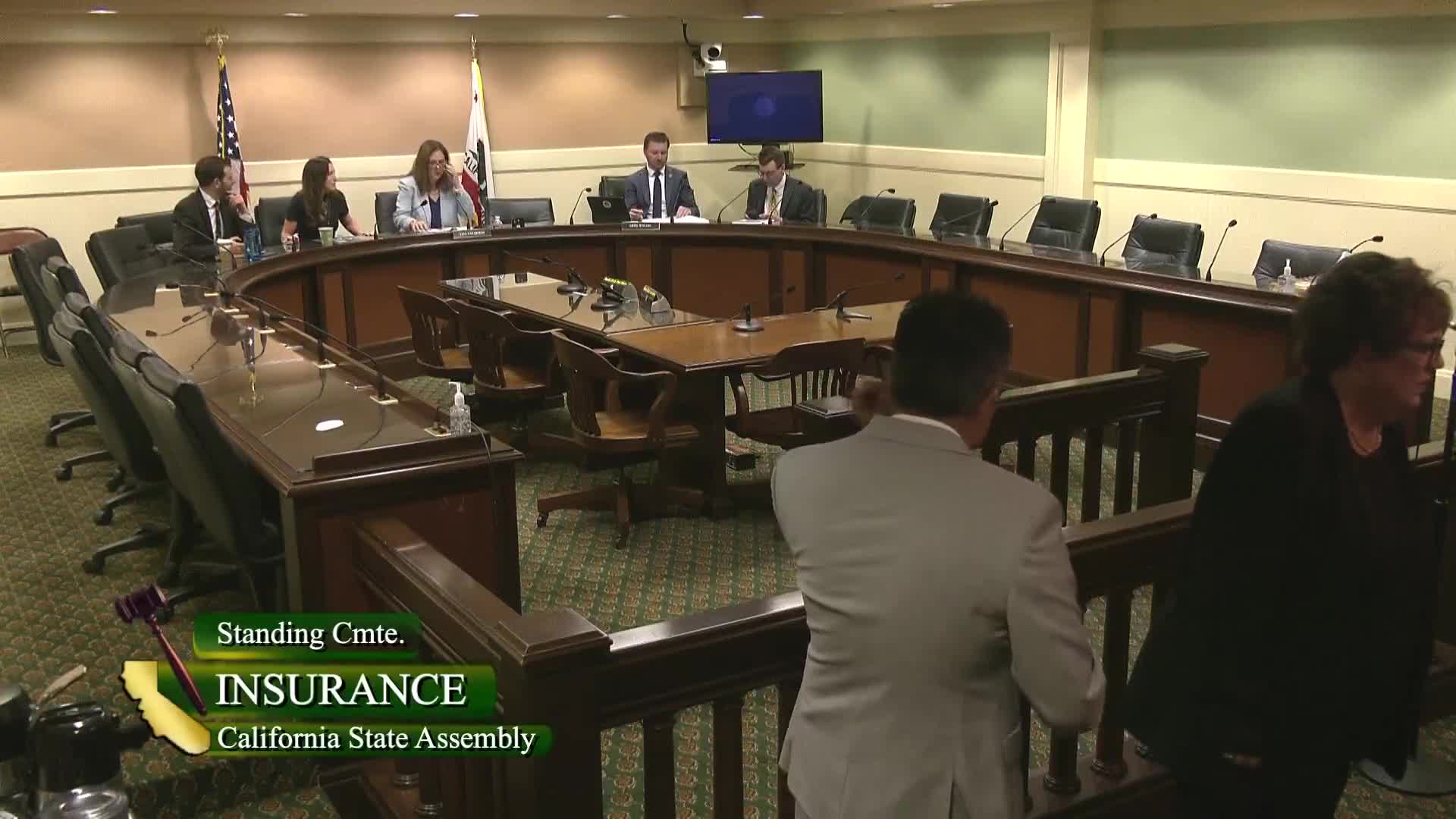
The California FAIR Plan’s president told the Assembly Insurance Committee that the FAIR Plan and its member companies moved this year to a $1 billion assessment after January wildfires and that the residual insurer now carries about 575,000 policies and roughly $599 billion in total insured exposure.
The California FAIR Plan’s president told the Assembly Insurance Committee that the FAIR Plan and its member companies moved this year to a $1 billion assessment after January wildfires and that the residual insurer now carries about 575,000 policies and roughly $599 billion in total insured exposure.
“By statute, we are the insurer of last resort,” Victoria Roach, president of the California FAIR Plan, told the committee. She and FAIR Plan staff described the association’s role, its recent growth and why it requested the assessment that was billed to member insurers earlier this year.
Why it matters: The FAIR Plan was created by the Legislature in 1968 to provide insurance when the admitted market is unavailable. Committee members heard that the FAIR Plan’s rapid growth — and concentration of risk in recent wildfires — raises the prospect of further assessments on insurers, a potential cost passed to the market and a gauge of the private market’s health.
Fair Plan role and recent growth
Roach said the FAIR Plan is a not-for-profit, privately run residual market — “we are not a state agency. We’re not state funded, and we’re not taxpayer funded.” She told lawmakers the plan’s purpose is to provide temporary coverage until consumers can find coverage in the admitted (private) market, but that the plan is increasingly becoming the primary carrier for many Californians rather than the insurer of last resort.
Roach and FAIR Plan staff reported the association’s policy count has risen sharply since 2018 and that exposure grew “exponentially” after major wildfire seasons. In 2023 the FAIR Plan’s policy count rose roughly 40% year over year and exposure rose about 60% year over year; through March of this fiscal year the FAIR Plan reported about 575,000 policies and close to $600 billion in exposure.
Armand Feliciano, a FAIR Plan spokesperson, described how the association is structured as an involuntary association of admitted insurers and how the assessment mechanism works when the plan projects it cannot pay claims from its own funds. He said the accounting committee of member companies recommended a $1 billion assessment, the FAIR Plan board unanimously agreed and the Department of Insurance processed the request. Member companies received bills and most remitted payment quickly, Feliciano said.
Assessment, reinsurance and funding tools
FAIR Plan officials described reinsurance layers and a new reinsurance tower that leaves the plan responsible for the first $1.25 billion of loss from a single event. Feliciano noted that because reinsurers treat events separately, multiple smaller events across a season can deplete available funds the same as a single large event.
Roach and Feliciano told the committee the FAIR Plan is pursuing several measures to reduce immediate assessment risk: rate filings to move toward actuarially sound premiums, the Clearing House (a platform to help move policyholders back to the admitted market), and legislation to expand tools such as a line of credit and access to bonds. They said the FAIR Plan supports AB 226 (an Assembly bill described at the hearing) to provide additional funding options.
Claims, smoke coverage and operational response
FAIR Plan officials told legislators they have received more than 5,500 claims from the January fires; roughly half were reported as total losses. The FAIR Plan said it had paid more than $2.9 billion to date and estimated final losses could approach $4 billion. The plan said more than 3,000 claims were closed and about 2,400 remained open at the time of testimony.
Roach summarized the FAIR Plan’s coverage position on smoke claims: the policy covers smoke and ash when there is direct physical loss or damage. “If there’s no direct physical loss, it’s not covered by our policy,” she said, while also describing steps the plan takes (adjuster inspections, deodorization payments and reassessment) when a claimant reports lingering smoke damage.
The FAIR Plan described operational steps it took after the fires: it said the organization increased field and desk adjuster capacity (bringing on roughly 300 additional staff at peak), extended customer service hours, held daily webinars for brokers, participated in FEMA recovery centers, and prioritized advancing partial payments for verified total-loss claimants (the FAIR Plan said it advanced 50% of dwelling Coverage A for total-loss claims when an initial estimate supported the payout).
Depopulation, market dynamics and pending legislation
Witnesses described ‘‘depopulation’’ — moving FAIR Plan policyholders back to admitted carriers — as essential to long-term stability but contingent on several factors: enough voluntary market capacity, actuarially sound FAIR Plan rates that are not lower than private-market alternatives, and operational mechanisms to move customers.
Feliciano and Roach described the Clearing House statutory framework (intended to help brokers and private carriers negotiate placements) and named other bills discussed at the hearing: AB 290 (renewal grace periods), SB 525 (replacement-cost coverage for manufactured homes, which FAIR Plan staff said could expand exposure if replacement-cost coverage were added), and AB 69 (a depopulation bill mentioned by legislators). FAIR Plan staff said they support AB 226 for access to a line of credit and bond-backed funding.
Public comment and market reaction
Industry commenters told the committee the FAIR Plan’s growth is an indicator of a troubled voluntary market. Dan Dunmore of the California Building Industry Association said the FAIR Plan’s expansion should be “a big red flag” about private-market health. John Norwood of the Independent Insurance Agents and Brokers of California said many independent agents lack markets to place homeowner business and that inadequate rates and reinsurance costs constrain carriers.
What lawmakers asked and next steps
Members asked FAIR Plan officials for more granular statistics, including policy counts, nonrenewals and premium-history trends. Roach said historical new-business numbers and some metrics are posted on the FAIR Plan website and said staff would follow up with additional data requested by members.
The FAIR Plan’s leaders told the committee they would continue to work with the California Department of Insurance and the Legislature on rate filings, depopulation tools and funding mechanisms meant to reduce the likelihood of future assessments.
The hearing record does not include any committee votes. FAIR Plan leaders described a board-approved $1 billion assessment of member insurers earlier this year and legislative proposals under consideration to increase the FAIR Plan’s financial flexibility.