Get Full Government Meeting Transcripts, Videos, & Alerts Forever!
Get email alerts on the Interim Goals topic
No spam. Unsubscribe anytime.
Board hears interim goals for 2025–26; grading-for-equity pilot draws questions from commissioners
Summary
Staff presented updated interim goals for 2025–26 (math, literacy, college-career readiness) and introduced a voluntary grading-for-equity initiative; commissioners pressed for benchmarks, evidence linking Star Math to SBAC, and protections for disadvantaged students.
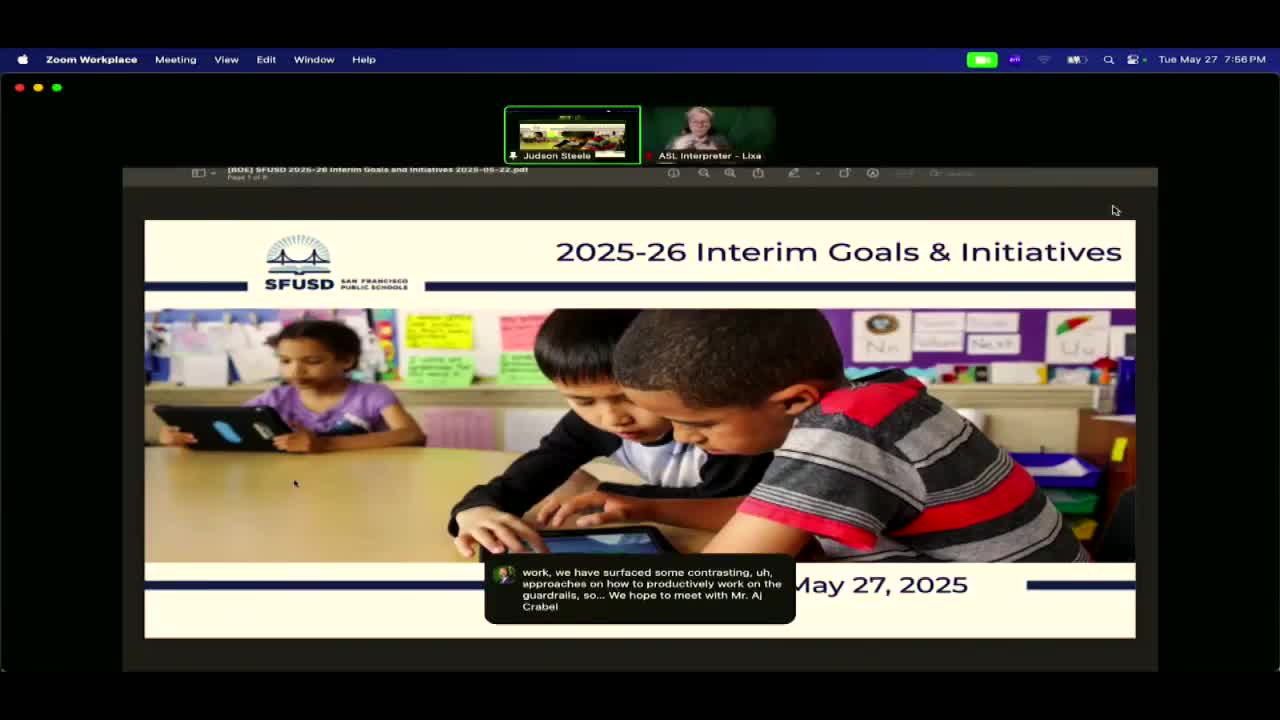
District staff presented updated interim goals for the 2025–26 school year and described associated initiatives—including a voluntary grading-for-equity pilot at some schools—during a board workshop focused on student outcomes.
Doctor Khanna (presentation lead) told the board the overall approach remains similar to current goals but noted two substantive changes in middle‑grade math: the interim goals now target sixth, seventh and eighth grades as separate markers. Staff said numerical targets are not yet set because they are still processing the final round of district assessment results and teacher survey responses.
Commissioners asked pointed questions about data, equity and implementation. Commissioner Ray urged staff to publish timeline estimates so families do not read placeholders (magenta Xs) as a lack of planning. Staff replied they planned to provide initial target estimates ‘‘within the next couple of weeks’’ and to follow up with the board.
Several commissioners expressed concern about a new grading-for-equity initiative described by staff as a voluntary, teacher-led practice that shifts emphasis from assignment-based grades to demonstration of mastery through multiple assessments, retakes and clearer rubrics. Divina Goldwasser, assistant superintendent for high schools and college‑career readiness, said the approach aims to reduce variance in grading practices and to provide multiple opportunities for students to demonstrate learning.
Commissioners and public speakers pressed specific concerns: - Commissioner Wiseman Ward described the programs she has seen in practice as helpful in giving students repeated practice and retake opportunities. - Commissioner Ray and others asked whether grading changes would reduce students’ practice of foundational skills (turning in work on time, class participation) and whether those behaviors would be de-emphasized to students’ detriment; staff replied the initiative focuses on assessing mastery and that classroom practice and supports (for example, built-in teacher office hours in the seven‑period day) would remain available. - Commissioners Gupta, Alexander and others requested stronger public reporting and explanation of the data‑to‑strategy logic: why the district selected specific grade levels and student subgroups for interim targets and how those indicators map to the district’s college-and‑career readiness objectives.
On assessments, staff explained that STAR Math is being used as an early indicator predictive of SBAC math performance, which in turn is one channel toward the state’s college‑and‑career readiness indicator. Staff cautioned that some state-level student‑level data are proprietary or delayed and that local estimates require additional processing.
Staff committed to provide: written criteria used to set targets, a clearer public explanation of the selection logic for interim indicators, and more detailed analysis linking interim measures to the district’s college and career readiness goals.
Ending: The board scheduled interim guardrails for a later meeting (expected in August) and asked staff to provide target-setting criteria and documentation to accompany the interim goals when numerical targets are released.