Get Full Government Meeting Transcripts, Videos, & Alerts Forever!
Get email alerts on the Economic Development Funding topic
No spam. Unsubscribe anytime.
County models Article 46 incentives amid flattening sales tax revenue; Durham Tech funding options raise trade-offs
Summary
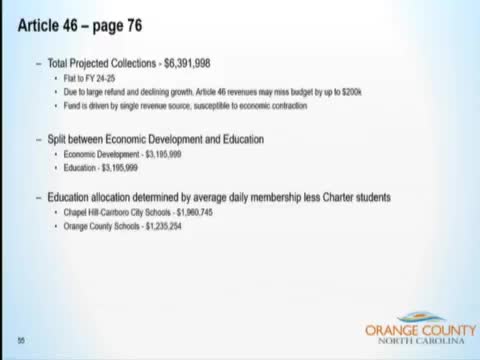
Budget staff presented scenarios for Article 46 (sales tax) funding of economic development and education programs, warning of incentive-payment timing pressures and options that could increase fund gaps in future years if sales-tax revenue remains flat.
Orange County budget staff presented modeling for Article 46 (a dedicated local sales-tax fund for economic development and education) and warned that flat or contracting sales-tax receipts could create near-term funding pressure for incentive payments and education grants.
Staff said Article 46 revenue is flat from FY2024–25 projections to the proposed FY2025–26 budget, and the fund’s single revenue source makes it more vulnerable to contractions than the general fund. The county’s model splits Article 46 revenue equally between economic development initiatives and education; staff allocates the education portion using ADM (average daily membership) less charter students.
A primary concern is several incentive payments scheduled to come due in the next years. Staff’s base model shows incentive payouts of about $1.0 million in the coming year and roughly $1.4 million the following year; the fund would face pressure if revenue does not grow. Staff said some incentive agreements (Medline, Wegmans, ABB, Morinaga referenced in the discussion) have differing structures and timelines — for example, Wegmans’ agreement ties only 25% of the incentive to property tax while others rely more heavily on property-tax-based refunds — and pandemic-era deferments also delayed some payments.
Staff discussed options to cover gaps: redirect underspent program funds at year-end, alter incentive schedules in conversation with recipients, or use general-fund backstops for one-time shortfalls. Commissioners and staff also discussed requests from Durham Tech, including a one-time operating gap and two student-liaison positions; options considered include funding some Durham Tech items from Article 46 (which would increase Article 46’s ongoing obligations) or keeping them in the general fund. Staff said the model assumes return to pre‑COVID growth after FY2025–26 but cautioned that a $300,000 gap could appear in FY2026–27 under conservative growth assumptions.
No formal board action was taken; staff presented the scenarios so commissioners could consider amendments and timing ahead of budget adoption.