Get Full Government Meeting Transcripts, Videos, & Alerts Forever!
Get email alerts on the Water Utilities topic
No spam. Unsubscribe anytime.
Metro Water presents FY26 tentative budget; proposes 5% rate increase, issues bonds for Cottonwoods work
Summary
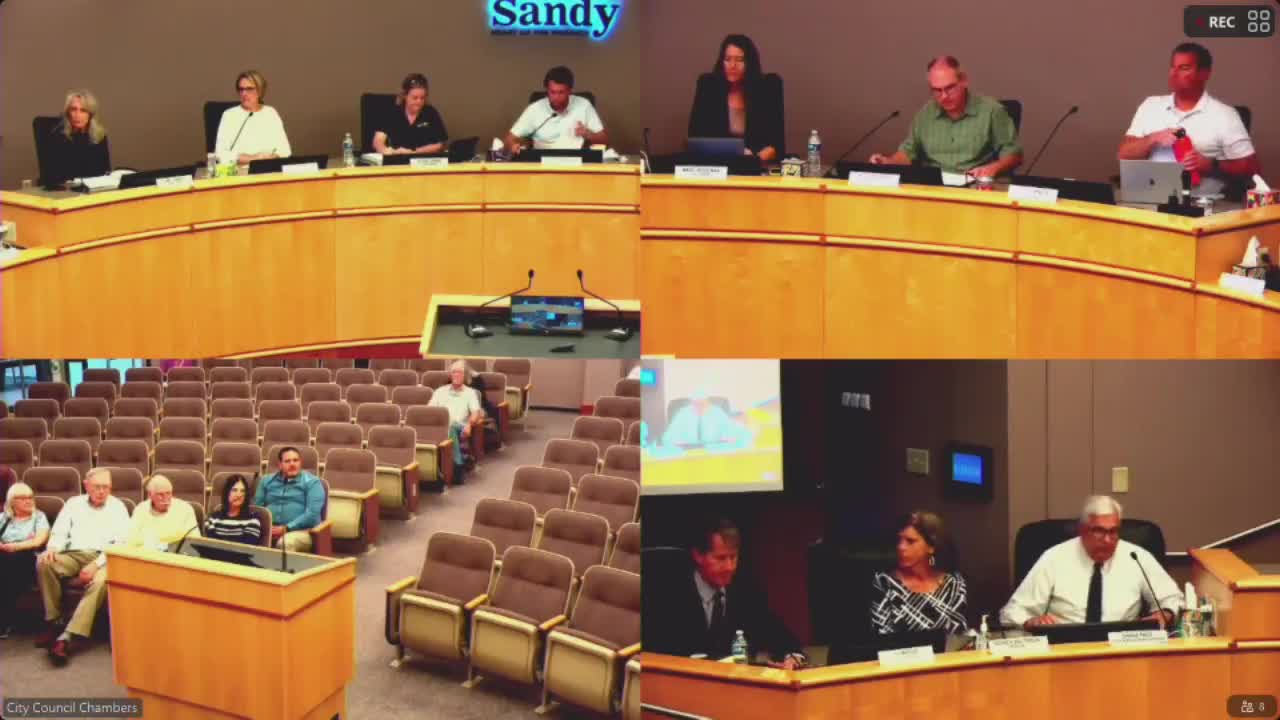
Ann Lee Muncy, general manager of the Metropolitan Water District of Salt Lake and Sandy, presented Metro’s tentative fiscal year 2026 budget to the Sandy City Council on May 27, 2025, outlining proposed revenue changes, planned bond borrowing and major capital work in the Cottonwoods and at the Little Cottonwood treatment plant.
Ann Lee Muncy, general manager of the Metropolitan Water District of Salt Lake and Sandy, presented Metro’s tentative fiscal year 2026 budget to the Sandy City Council on May 27, 2025, outlining proposed revenue changes, planned bond borrowing and major capital work in the Cottonwoods and at the Little Cottonwood treatment plant.
Metro’s tentative budget proposes a 5% increase in water rates for member cities and nonmember surplus sales; Muncy said that increase would generate roughly $342,907 in additional revenue for Sandy City. She told the council that the budget includes bond proceeds equal to about 27% of projected revenue, a capital program of about $37,000,000, and total uses and debt service that bring the budget package to approximately $111,000,000.
The budget matters to Sandy ratepayers because Metro funds capital work through a mix of water sales, property taxes, miscellaneous reimbursements and bond proceeds. “The proposed water rate increase to both member cities and nonmember entities is 5%,” Muncy said. She also told the council the tentative budget does not include an increase to Metro’s certified property tax rate; Metro’s current cap was described in the presentation as “triple 0 3 5” (0.0035).
Metro described three capital priorities that will be funded in part with the planned bond issuance: the Little Cottonwood Conduit Creek intake (a pipeline bringing Little Cottonwood Creek flow into the treatment plant), completion of the Cottonwoods Connection project (a replacement/redundancy segment of the Salt Lake Aqueduct), and design work for a rebuild of the Little Cottonwood Water Treatment Plant. Metro also highlighted ongoing O&M costs charged by partner agencies, including the Provo River Water Users Association and Jordan Valley Water Conservancy District.
Council members asked about risks and cost allocation. Council Member Zach Robinson asked whether recent federal funding cuts to Central Utah would affect Metro’s operations. “I don’t have exact numbers, and I can get those to you,” Muncy said, adding that she had met with Central Utah representatives who told Metro petitioners would likely not see immediate impacts to petitioner obligations this coming year because of repayment or crediting mechanisms at the state or federal level.
Council Member Cindy Sharkey asked how capital costs are apportioned between Sandy and Salt Lake City. Muncy said noncapacity replacement projects follow the interlocal split—about 28% Sandy and 72% Salt Lake City—and that capacity-driven costs (for larger pipes or added capacity) are charged to the city that requests or benefits from the extra capacity. She noted trustees appointed by the two cities discuss projects monthly and the board aims to balance infrastructure and affordability for both member cities.
Metro officials reviewed water supply sources — the Provo River Project (Deer Creek Reservoir), Little Cottonwood Creek rights, Central Utah Project allocations stored in Jordanelle and Strawberry Reservoir-derived (Utah Lake System) water — and described conveyance and storage assets including the Salt Lake Aqueduct and terminal reservoirs. Muncy said Metro owns two treatment plants (Little Cottonwood and part-ownership of Jordan Valley Water’s treatment plant in Bluffdale) and is a petitioner for Central Utah Project water.
Muncy summarized the budget revenue mix she presented: roughly 24% from water sales, 27% from bond proceeds, 20% from property taxes, and 17% miscellaneous (which includes reimbursements from Salt Lake City for Cottonwoods capital assessments). She also noted debt service principal and interest of about $24,000,000 in the plan and called out agency pass-through costs—Provo River Water Users Association O&M near $4.7–4.8 million and Central Utah-related costs in the multi‑million-dollar range.
No formal City Council action on the Metro budget was taken at the May 27 meeting; the presentation was provided for review and council questions. Muncy said Metro will return with more detailed figures as budgets are finalized and as certified property-tax rates are set later in June.
Looking ahead, the council will consider city budget hearings in coming weeks; Metro officials noted the agency will evaluate whether to increase or reestablish its certified tax rate in future years as capital needs — including the Little Cottonwood rebuild — materialize.