Get Full Government Meeting Transcripts, Videos, & Alerts Forever!
Get email alerts on the Elections topic
No spam. Unsubscribe anytime.
Weber County clerk previews ballot-mailing changes, signature and ID rules; public commenters raise access concerns
Summary
Weber County Clerk Ricky Hatch told North Ogden City Council that recent state law changes and routine audits alter how ballots are mailed, verified and processed; public commenters raised concerns about access and transparency in audits and voter records.
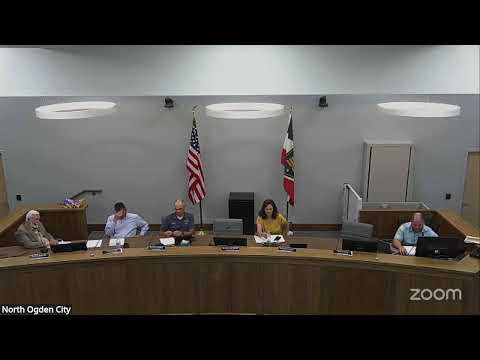
Ricky Hatch, Weber County clerk, told the North Ogden City Council on May 27 that recent state law changes and routine audits will change how the county mails and verifies ballots and that the county conducts multiple public audits before, during and after every election.
Hatch said mailed-ballot programs introduced in 2015 drove a large increase in turnout and described four “pillars of election integrity” that county staff audit in public meetings. He noted that “we began mailing every active registered voter a ballot, and that drove turnout,” and that the county conducts signature reviews, envelope-control-number checks and hash audits of tabulation equipment in public sessions.
The presentation came as the council heard public comment about election trust and access. Reid Miller, a North Ogden resident, said county and state offices had denied public access to election records after the 2020 election and criticized national registration database ERIC; Miller said, “Our state election system is anything but good.”
Why it matters: Hatch described operational changes that will affect how North Ogden residents receive and return ballots and how counties verify voter identity. Several new provisions discussed by Hatch take effect before 2029, and the changes could affect voters’ options for voting by mail and the methods counties use to verify ballots.
Hatch summarized two near-term legal and procedural changes that residents should expect. First, Utah is no longer a “postmark-plus” state: ballots must be in the county clerk’s office or in a drop box under county custody by 8 p.m. on election night to be counted, he said. Second, House Bill 300 (2025) creates a voters’ choice declaration process: through 2028 counties will mail ballots to active registered voters, but beginning Jan. 1, 2029, counties may stop mailing ballots to voters who have not indicated a preference for mail or in-person voting. Hatch described an associated eight-year renewal cycle tied to driver’s-license renewal.
Hatch also explained a coming switch in Idaho/Utah practice (as he described it) that will change the way the county validates a ballot on the return envelope. Before 2029, Hatch said, a voter could either provide the last four digits of a state ID or Social Security number or rely on signature verification; after 2029 the county will validate a provided numeric identifier (last four of license or Social Security) and will not validate signatures in the same way. He said counties are preparing a new envelope layout that shows where a voter would add the last four digits of a driver’s license or Social Security number and optional contact information for ballot tracking notifications.
Hatch described signature review and “cure” steps for challenged envelopes and said the lieutenant governor’s office audits counties’ list maintenance and provides quarterly reports. He said about 97% of voter verifications currently use a state driver’s license or state ID and that Weber County runs duplicate-registration checks against roughly two dozen other states.
Public commenters offered contrasting reactions. Council member Watson, who toured Weber County elections offices earlier, said the tour was “very informative” and praised staff assistance when her signature was once rejected. In contrast, Reid Miller told the council that he and others had been denied access to audit materials after the 2020 election and expressed skepticism about ERIC and other registration tools.
What the county asked the council to note: Hatch invited the public and council members to observe audits and processing in person, to request tours of the clerk’s facilities and to report potential vulnerabilities. He urged voters to keep their address information current at vote.utah.gov and to use ballot tracking notifications.
Details and clarifications gleaned from the meeting: Hatch said undeliverable ballot-return rates have fallen from about 20% in the county’s early experiments to about 1.9% most recently; that ballots and scanners are not connected to the internet and undergo hash audits; that envelope-control numbers are generated per envelope and that clerks must deactivate a spoiled control number before issuing a replacement ballot; and that signature reviewers receive annual forensic training and are monitored for unusual acceptance/rejection rates.
Ending: Council members thanked Hatch for the presentation. Council business moved on after a short question-and-answer period; no formal council action was required or taken on election administration during the meeting.