Get Full Government Meeting Transcripts, Videos, & Alerts Forever!
Get email alerts on the South South Cooperation topic
No spam. Unsubscribe anytime.
U.N. high‑level committee urges scaled‑up financing and stronger institutions for South‑South cooperation
Summary
Delegates at the 22nd session of the U.N. High‑Level Committee on South‑South Cooperation pressed for more predictable financing, stronger U.N. support and expanded triangular partnerships to help developing countries meet the 2030 Agenda, while designating a working‑group chair and scheduling follow‑up events.
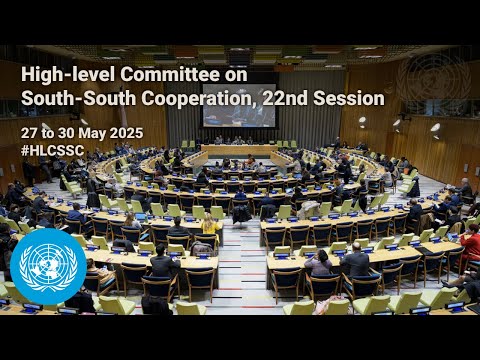
The 22nd session of the United Nations High‑Level Committee on South‑South Cooperation opened with calls from member states and U.N. officials for stepped‑up financing, deeper institutional backing for the U.N. Office for South‑South Cooperation (UNOSSC) and wider use of triangular cooperation to address development shortfalls.
Omar Hilal, Morocco’s permanent representative to the United Nations and president of the session, opened the proceedings by thanking U.N. leadership and participants and by underscoring the committee’s priorities for the coming two years. He welcomed the presence and support of the United Nations Development Programme and highlighted the session as an opportunity to translate commitments into “concrete results.”
The nut of the discussion centered on financing gaps and operational capacity. Achim Steiner, administrator of the United Nations Development Programme (UNDP), told delegates that official development assistance (ODA) was shrinking and that new approaches were required, but added that “we do not align ourselves with the view that ODA is dying or is dead.” Steiner cited several figures discussed in the session’s reports: a roughly 7% decline in ODA in 2024, South‑South trade valued at about $5.6 trillion in 2023, remittances to low‑ and middle‑income countries near $670 billion in 2024, and persistent shortfalls in adaptation finance. He highlighted practical outcomes funded or supported through South‑South channels, including projects under the India‑Brazil‑South Africa (IPSA) facility and UN managed trust funds that support solar irrigation and climate resilience, and assistance for 7,000 women farmers in Mali.
Dima Al Khatib, director of UNOSSC, introduced the committee documents (SSC/22/1 and SSC/22/2) and summarized the secretary‑general’s and UNDP’s reports, listing a set of recommendations that framed much of the debate. Those recommendations urged: deeper regional integration and expanded intra‑South trade; scaling Southern‑led financial mechanisms and exploring debt‑swap arrangements; accelerated digital transformation and capacity building; mobilizing greater climate finance for adaptation and mitigation; institutionalizing triangular cooperation; and commissioning a midterm review of the BAPA+40 outcomes to keep the agenda aligned with evolving priorities.
Delegations across regional groups echoed those themes. The Group of 77 and China reaffirmed South‑South cooperation’s role as a “tool to enhance North‑South cooperation” and called for increased voluntary contributions to the U.N. Fund for South‑South Cooperation and the Perez‑Guerrero Trust Fund. Representatives of least developed countries and small island developing states pressed for tailored support on graduation, connectivity and climate resilience, while middle‑income country coalitions emphasized the need for financing instruments and a system‑wide response plan for the specific challenges faced by middle‑income countries.
Several delegations highlighted concrete triangular and trust‑fund initiatives. The European Union, Portugal and other donors described existing triangular programs (for example, the EU’s Adelante program and Portugal’s triangular projects) and flagged upcoming coordination events. Multiple speakers noted upcoming global forums that intersect with South‑South priorities, including the fourth conference on financing for development (FfD4) in Seville and the World Summit for Social Development in Doha.
The committee also recorded two procedural outcomes at the close of the morning session. President Omar Hilal said he would defer the election of the rapporteur “to later dates due to ongoing consultations.” He also designated Eleonora Betancur Gonzales, director general of the Presidential Agency for International Cooperation of Colombia and vice president of the High‑Level Committee, as chair of a working group charged with negotiating the committee’s draft decisions. The bureau will facilitate the working group, which the president said will meet on Thursday, 29 May and conclude on Friday morning, 30 May; the group’s report will be taken up by plenary on Friday afternoon. The bureau also accepted a request to host a commemorative event marking the 30th anniversary of the U.N. Fund for South‑South Cooperation and the India‑Brazil‑South Africa Fund on Friday, 30 May at 15:00.
Background and context: statements and the committee documents repeatedly described the current global environment as marked by fiscal strain, high debt, widening digital divides and accelerating climate impacts. Delegations urged that South‑South and triangular cooperation be treated as complementary to, not a substitute for, traditional North‑South development assistance and emphasized country ownership, demand‑driven partnerships and strengthened monitoring and measurement of South‑South activities.
The committee reconvened in the afternoon for a continuation of the general debate and scheduled the working group sessions and the anniversary event as immediate follow‑up steps to negotiate draft decisions and showcase trust‑fund results.