Get Full Government Meeting Transcripts, Videos, & Alerts Forever!
Get email alerts on the Child Welfare topic
No spam. Unsubscribe anytime.
County report: 2,169 Marion children designated CHINS in 2023; average out-of-home stay nears two years
Summary
A presentation to the Indianapolis City-County Council Community Affairs Committee summarized a new Early Intervention Planning Council report showing 2,169 children in Marion County designated as children in need of services (CHINS) in 2023, a high rate of out-of-home placement, racial disproportionality and gaps in local data.
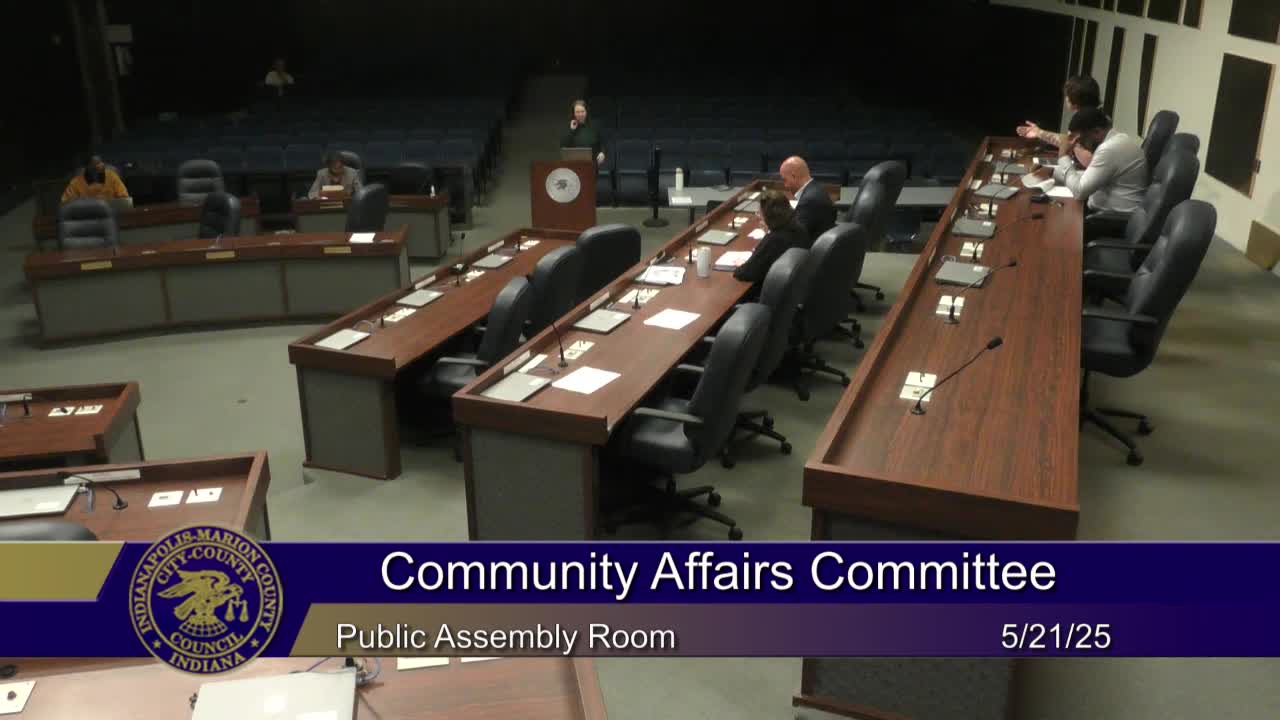
Kate Rawlicki, program director at the Marion County Commission on Youth, told the Indianapolis City-County Council Community Affairs Committee on a presentation night that a countywide review found 2,169 children designated as children in need of services, or CHINS, in Marion County during 2023.
The report by the Early Intervention Planning Council, convened by McCoy, found that about 77 percent of CHINS cases in 2023 resulted in out-of-home placements and that the average length of stay for children placed outside the home was roughly 719 days, or about 23.6 months. Rawlicki said 767 new CHINS cases required out-of-home placement in 2023; 43 percent of those placements were with relatives and about 37 percent were with nonrelative foster caregivers.
“This council has identified child permanency as a critical component in positive youth development and priority goal for early intervention and prevention,” Rawlicki said, summarizing the report’s aims and urging systemwide coordination. She also emphasized limits in available local data: “we don't have all of the data that could give us a more complete picture of child permanency in Marion County,” she said.
Nut graf: The Early Intervention Planning Council report frames permanency—stable, lifelong caregiving—as a county-level problem that intersects child welfare, housing and juvenile systems. The presentation highlighted racial disparities in CHINS designations, placement stability concerns, and multiple data gaps that, the council says, make it harder to design targeted prevention and reunification efforts.
Most important findings
- Scope and population: Rawlicki said Marion County accounts for 15.1 percent of Indiana’s child population (more than 240,000 children) and that the county had a disproportionately high share of CHINS cases relative to the state, with 2,169 CHINS in 2023 representing about 18 percent of the state total for that designation.
- Removals and trends: Close to 1,000 children were removed from their homes in Marion County in 2023, an increase of about 18 percent from 2022; Rawlicki said the local increase follows a statewide pattern in which removals rose 26 percent, but she noted the report does not identify specific causes for the rise.
- Placement types and location: The report classifies out-of-home placements as relative care, nonrelative foster care, residential programs and other settings (for example, hospitals or out-of-state placements). The largest share of new out-of-home placements in 2023 were with relatives (43 percent), followed by foster care (37 percent). Rawlicki said the county keeps a larger share of placements geographically close to a child’s community than the state overall, but that the proportion placed in the same county has declined over the past decade.
- Stability and duration: According to the presentation, children in nonrelative foster care spent longer on average in placement (about 81 days more) than children placed with relatives. The average length of stay across out-of-home placements in 2023 was about 719 days. The report cites a 2021 statewide figure that 31 percent of children in nonrelative foster care experienced more than two placements in a year.
- Permanency outcomes: Rawlicki said more than 900 CHINS cases were closed in 2023 with permanent outcomes, primarily reunification or adoption; Marion County closed relatively more cases by adoption and fewer by reunification compared with the statewide pattern presented.
Race, age and risk factors
Rawlicki said CHINS designations in Marion County reflected racial disproportionality: Black children made up 48 percent of CHINS cases while representing about 31 percent of the county’s child population. She also noted young children are overrepresented among out-of-home placements: children under age 7 represent almost half of out-of-home placements and those under age 3 account for about 25 percent of placements.
“The circumstances surrounding these CHINS designations and the removal are very complex and often multi-generational,” Rawlicki said, referring to interview material gathered for the report.
Data gaps and next steps
Committee members asked for additional detail on intersecting issues. Councilor Derek Cahill (District 23) asked how the system identifies and supports children with disabilities who may not yet have a diagnosis; Rawlicki said the report did not analyze disability status in depth and recommended follow-up with the Department of Child Services and possible data linkages to answer that question.
Rawlicki and council members also discussed the limits of available data on foster-family demographics, licensing details and provider capacity; Rawlicki said those were areas where more granular information would be useful for recruitment and matching strategies.
Rawlicki closed by listing four goals the council recommends: prioritize prevention, build better pathways to data and root causes, center positive youth development in interventions, and pursue shared systemwide goals. She said the Early Intervention Planning Council will continue presenting findings and engaging partners to refine data collection and prevention strategies.
Meeting outcome and procedural note
The committee convened without a quorum and could not take votes on agenda items. The chair said Proposal 48 will be moved to the June agenda for further consideration because a vote was not possible.
Ending: Rawlicki offered copies of the report and asked council members to share it with community groups; committee members thanked her and noted interest in further data and partnership.