Get Full Government Meeting Transcripts, Videos, & Alerts Forever!
Get email alerts on the School Safety topic
No spam. Unsubscribe anytime.
Tempe Union presents comprehensive school safety plan: drills, cameras, student voice and mental‑health supports highlighted
Summary
District staff presented a multi‑part update on the Tempe Union High School District’s comprehensive school safety plan, covering physical safety compliance, psychological safety and student wellness, facilities priorities and cybersecurity measures.
District staff presented a multi‑part update on the Tempe Union High School District’s comprehensive school safety plan, covering physical safety compliance, psychological safety and student wellness, facilities priorities and cybersecurity measures.
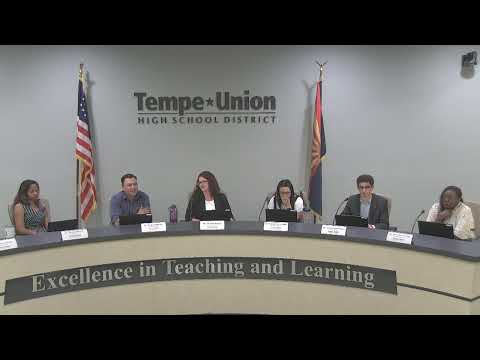
Sean McDonald led an overview of the plan and introduced staff presenters who described specific work in physical security, threat assessment, student mental‑health supports, facilities upgrades and IT protections. Charles Cobbs reviewed physical safety and compliance; Dr. Cliff Moon summarized student focus‑group findings about psychological safety; Ron Denney outlined student wellness and training work; Maria Gonzalez described the youth specialist program and the district’s Sandy Hook Promise and Say Something efforts; Tony Payan presented facilities priorities; and John Zump described cybersecurity training and phishing test results.
Physical safety. Charles Cobbs said the district follows state requirements for emergency drills and site assessments, noting, “The Arizona revised statute requires school sites to do 5 emergency drills every school year.” He reported most sites met compliance standards on items such as front‑office access, secured classroom doors, camera operation and radio communications. Cobbs said some schools completed four of the five required drills while others completed three, and he praised site administrators for conducting student threat assessments where appropriate. He also reported that all district sites had received five‑year vulnerability assessments from the Arizona Counter Terrorism Information Center.
Operational upgrades he described include weapon detection units used at large events (proms and graduations), the recent purchase and installation of Knox boxes (three per site) containing campus maps and master keys, and an RFP award to replace aging campus cameras. Cobbs said the district is expanding its district surveillance office (SOC) and has a real‑time operations connection with the City of Tempe that permits camera access when a 911 call originates from a campus.
Psychological safety and student voice. Dr. Cliff Moon said staff conducted student focus groups to gather qualitative input. He summarized recurring themes: the importance of student‑teacher relationships, visible and communicative principals, a well‑maintained physical environment, and attention to stress and academic pressure. He told the board, “A positive school culture and climate is not just about what the adults decide. It’s about actively listening to student voices and creating a space where we feel empowered to share our experiences.” Dr. Moon said students described psychological safety as tightly linked to academic engagement.
Student engagement and wellness. Ron Denney reported districtwide increases in athletics and activities participation (the district‑level participation rate rose to about 43.7% for athletics and 75.1% for activities/clubs). Maria Gonzalez said the youth specialist program served about 1,200 students last year and recorded nearly 10,000 interactions; specialists provide 1:1 supports, run support groups, make home visits over the summer and participate on school and city crisis teams. Gonzalez highlighted expansion of the Sandy Hook Promise program across district sites and a student‑led Say Something campaign. District staff said they have been discussing adoption of Sandy Hook Promise’s anonymous reporting system (a 24‑hour hotline managed externally) for next school year.
Training, grants and partnerships. Staff described a range of trainings completed this year: collaborative problem‑solving workshops, suicide prevention and intervention refreshers, team mental‑health first aid piloting with students, and an initiative to make the district a “grief‑sensitive” district with support from New York Life. Denney and others listed community partnerships and grants that support mental‑health work, including a school‑based mental‑health grant that fully funds five youth specialists, an MOU with the Help Institute at Chandler to enable warm handoffs for families needing specialized crisis care at Perry High School, and local partners such as LUCA Counseling, Tempe Community Council and Billy’s Place.
Facilities and IT. Tony Payan said the facilities office is prioritizing mechanical systems, roofing and energy efficiency work, funded in part with state building renewal grants and bond money, and is improving preventive maintenance scheduling. John Zump summarized cybersecurity training and phishing‑test results; district phishing vulnerability rates have fallen after repeated training, and IT will expand student cybersecurity training next year.
Executive session request and next steps. Staff asked the board to consider an executive session to discuss confidential safety matters that require closed consideration. The board asked for additional disaggregated participation data for athletics and activities and for continuing updates on the camera replacement timeline, vaping sensor pilot evaluation and Sandy Hook Promise reporting tools. Staff said the district will provide the Panorama survey results and follow‑up plans at future meetings.
Board members expressed support for student voice initiatives and for expanding training and partnerships. No formal action was taken on program funding or capital projects during the presentation.