Get Full Government Meeting Transcripts, Videos, & Alerts Forever!
Get email alerts on the Affordable Housing Rehab topic
No spam. Unsubscribe anytime.
Committee approves $1.1 million CDBG loan for Villa Aurora water‑intrusion repairs
Summary
The City of Miami Housing Commercial Loan Committee approved up to $1,100,000 in Community Development Block Grant funds for exterior and water‑intrusion rehabilitation at Villa Aurora, preserving 76 city‑assisted units under a 30‑year affordability term and with loan terms to be clarified on default interest language.
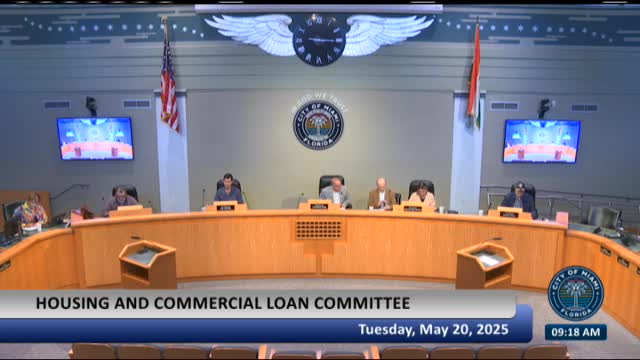
The City of Miami Housing Commercial Loan Committee on May 20 approved a recommendation to allocate up to $1,100,000 in Community Development Block Grant (CDBG) funds to the Villa Aurora rehabilitation project at 1398 Southwest First Street in East Little Havana.
The funding will be provided as a deferred‑interest loan to the borrower for the duration of a 30‑year affordability period, staff said. Villa Aurora is a 12‑story mixed‑use building with 76 units; 39 units are reserved for formerly homeless families and 37 are for low‑income families and elderly households at or below 60% of area median income (AMI).
The allocation responds to cost increases since the project’s initial rehabilitation scope. The Housing Department told the committee that an earlier $800,000 CDBG allocation approved on Sept. 26, 2023, covered a portion of exterior repairs. Rising material prices and a higher construction bid to account for Davis‑Bacon wages increased the total rehabilitation budget to roughly $1,480,000. The proposed financing combines the city’s up to $1,100,000 loan with approximately $377,492 in building reserves, staff said.
Staff presented a lien and financing priority schedule for the property, which the materials list as: a state sale loan of roughly $3,000,000 in first position, county supportive‑housing debt of roughly $1,300,000 in subsequent positions, the city’s original HOME loan of $646,000 in a later position, and a $50,000 note from Enterprise. The city’s new CDBG rehab loan would be provided behind those liens as structured in the memo. Staff also reported the city’s loan cost per unit would be $14,473.68 based on the proposed allocation.
Stephanie Berman, identified as president of Carrefour Supportive Housing, and Salvatore Russo, vice president of property operations, answered committee questions about insurance, latent construction defects and the scope of repairs. Committee members asked whether adding city funds would extend the property’s affordability term; staff confirmed that the additional funding would result in a new 30‑year affordability period tied to the loan.
Committee members also asked the department to tighten the wording of a default‑interest provision (item 21 of the staff memo) so borrowers and partners clearly understand the applicable rate in the event of default. The committee’s motion approved allocation of up to $1,100,000 in CDBG funds to the Villa Aurora rehabilitation and asked staff to revise the default‑interest language. The motion passed with no member recorded as opposed.