Get Full Government Meeting Transcripts, Videos, & Alerts Forever!
Get email alerts on the Traffic Safety topic
No spam. Unsubscribe anytime.
Traffic safety plan: Santa Barbara shows spike in 2024 severe-injury collisions; high-injury network targets small portion of streets
Summary
City Public Works staff reported a five-year collision analysis and draft Safe Streets for All plan chapters, saying 2024 showed a sharp rise in severe and fatal collisions concentrated on a small portion of city streets.
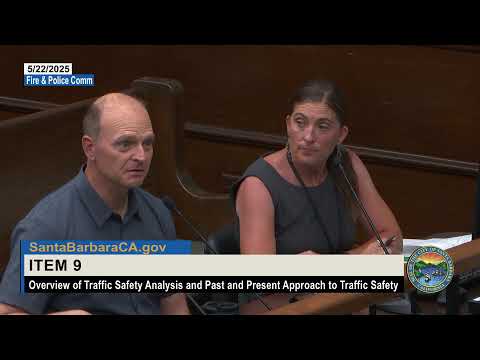
Public Works staff presented a five-year traffic safety analysis and draft "past and present" chapters of a Safe Streets for All action plan to the Fire and Police Commission on May 22, saying collision severity rose in 2024 and that most severe and fatal crashes are concentrated on a small portion of city streets.
Jessica Grant, supervising transportation planner, and Derek Bailey, the city traffic engineer, described the federal Safe Streets for All planning grant the city received and the work the city is doing to identify countermeasures. Grant said the city received $799,000 under the federal program with a 20% city match to produce an action plan that identifies infrastructure and policy steps to prevent traffic fatalities and severe injuries.
Staff analyzed collisions from 2020 through 2024 to support grant applications and countermeasure selection. Grant said severe and fatal injuries are overrepresented among cyclists, pedestrians and motorcyclists and that the highest number of injury collisions occur between noon and 6 p.m., while the greatest share of severe and fatal collisions occur overnight (midnight–6 a.m.). Top contributing factors for severe and fatal collisions were listed as unsafe speed, driving under the influence (DUI), improper turning and right-of-way violations.
The presentation introduced a high-injury network: staff said 5% of city street mileage (red tier) accounts for roughly 45% of severe and fatal injuries and 35% of all injury collisions; the following 15% of mileage (orange tier) accounts for much of the remainder. Grant noted adopting a high-injury network would also allow the city to lower speed limits by five miles per hour on those streets under state guidance.
Staff showed a heat map tying DUI-related collisions to the downtown and State Street area, and noted the higher density of on-site alcohol sales in that area. "Those black dots are where we have on-site alcohol sales," Grant said when showing the DUI map. Commissioners asked about the city’s relative ranking in California; Grant said a prior comparison showed the city ranked high among comparable California cities for bicycle-related severe-injury collisions and for alcohol-involved severe collisions in a selected year.
The presentation also highlighted an increase in e-bike collisions in recent years and said officers and record-keepers have only two solid years of e-bike-specific data; older reports sometimes recorded e-bike-like vehicles as motorcycles. Grant said the city and county are tracking the difference between class 1–3 e-bikes and higher-speed, motor-class vehicles.
Commissioners questioned whether engineering projects produce measurable change and staff said meaningful evaluation requires waiting three to six months after an infrastructure change for travel patterns to settle, and in many cases multiple projects across a corridor are needed to change travel behavior. Staff also described enforcement and education work, including targeted enforcement for speeding, distracted driving and DUIs, and outreach and school-based education delivered through partners such as Move Santa Barbara County.
On roundabouts, staff said roundabouts generally reduce collision severity even if minor collisions persist; they noted the Cliff Drive–Las Positas roundabout has shown higher collisions influenced by DUI-related crashes. Staff said curb extensions (bulb-outs) improve sight lines and shorten pedestrian crossings but are less effective alone as a speed-control measure.
Grant said the plan will include countermeasures, equity analysis and policy recommendations; staff plans a citywide traffic-safety survey, outreach with school districts and a draft action plan in April 2026 with city council review planned for June 2026.
No formal commission action was taken; commissioners provided questions and feedback on the draft chapters.