Get Full Government Meeting Transcripts, Videos, & Alerts Forever!
Get email alerts on the State Budget Prop98 topic
No spam. Unsubscribe anytime.
May revision shifts $492 million from community colleges to K‑12, Chancellor’s office warns of multi‑year risks
Summary
California Community Colleges officials told the Board of Governors that the May Revision rebench of the Proposition 98 guarantee shifts roughly $492 million away from the community college side to K‑12 for Transitional Kindergarten, and that a $531.6 million deferral and lower COLA create material multi‑year fiscal risk for colleges.
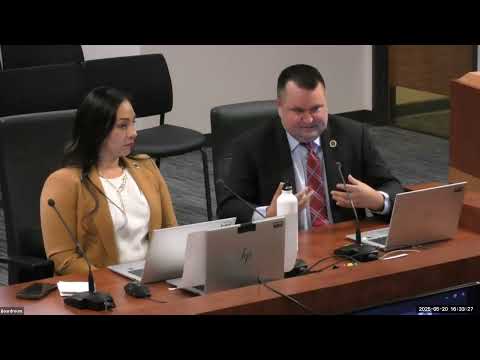
Executive Vice Chancellor Chris Ferguson told the Board of Governors on the May agenda that the May Revision of the state budget reduces the overall Prop. 98 guarantee and reallocates funding tied to Transitional Kindergarten, moving roughly $492,000,000 from the community college side of the guarantee to K‑12.
“The MABRA vision reflects a roughly $12,000,000,000 deficit,” Ferguson said during the board presentation, adding that the administration has rebenched the Prop. 98 guarantee and shifted dollars connected to Transitional Kindergarten to the K‑12 side. He summarized the immediate effects as two core issues: the guarantee declines in the budget year, and a three‑year window shift of roughly $492,000,000 away from community colleges, of which about $233,000,000 is ongoing.
Why it matters: the chancellor’s office said the package nonetheless funds growth and a student‑centered funding formula (SCFF) COLA, and preserves some statewide priorities such as progress on a common cloud data system and credit‑for‑prior‑learning policies. But the office warned that the mix of reappropriations, withdrawals from the state’s reserve, and a $531,600,000 deferral increases out‑year risk for the system.
Ferguson explained that the $531.6 million deferral “does mean that there’s a level of risk in the out years for our system.” He described how deferrals work in practice: colleges receive some apportionment payments one year later, giving the state short‑term budget relief but shifting cash timing risk to districts.
The chancellor’s office also highlighted smaller changes in core investments: the SCFF COLA was reduced modestly (from 2.43% to about 2.3% in the presentation), and categorical COLA funding was trimmed. System investments in collaborative enterprise resource planning (ERP), credit for prior learning, and career‑passport one‑time funds were also reduced relative to prior proposals.
Facilities and student housing: staff reported changes to the governor’s proposed facilities list—two projects proposed in the governor’s budget were withdrawn by campuses and one project (Davies Hall at American River College) was added. For student housing, the administration signaled it would not provide additional state funds to cover local cost overruns for existing grantees and would not reallocate funds from two rescinded projects in the current year; those funds might be reconsidered in a later year.
Board members pressed staff on what the shift means for district fiscal health. Ferguson and Executive Vice Chancellor staff noted that districts hold widely varying reserves—some have roughly six weeks of reserves while others have many months—and that their office will continue fiscal monitoring and intervention where needed. "Depending upon the size of your reserves will depend upon your ability to either self‑fund a deferral or need to access the market," Ferguson said.
Ending note: staff emphasized that the May Revision remains subject to the legislative process and that assumptions (including federal policy and tariff impacts) create substantial uncertainty. The office said it will continue to brief districts, model cash needs, and work with campuses to mitigate the effects of deferrals and shifted Prop. 98 treatment.