Get Full Government Meeting Transcripts, Videos, & Alerts Forever!
Get email alerts on the Utilities topic
No spam. Unsubscribe anytime.
Brigham City staff outline PPAC removal, rate details and recycling fee increase in mayor's proposed budget
Summary
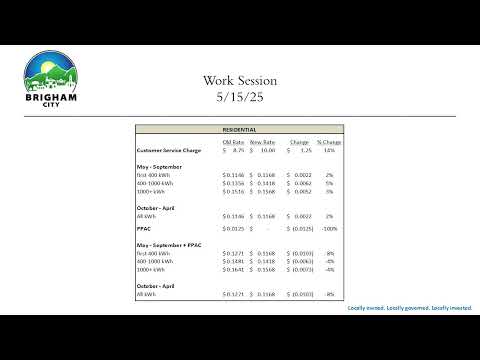
At a Brigham City Council work session, staff detailed proposed changes to the city's utility rates in Mayor Bott's proposed FY2026 budget, including a proposal to set the power purchase adjustment clause (PPAC) to zero and a recommended increase in the outsourced recycling "blue can" fee to $9.50.
At a Brigham City Council work session, staff detailed proposed changes to the city's utility rates in Mayor Bott's proposed fiscal year 2026 budget, including a proposal to set the power purchase adjustment clause (PPAC) to zero and a recommended increase in the outsourced recycling "blue can" fee to $9.50.
City staff said the PPAC — a pass-through adjustment for wholesale energy costs introduced after a 2022 rate study — had peaked at 4.5 cents per kilowatt-hour when wholesale markets spiked, was at 1.25 cents in the current budget, and is proposed at 0 cents per kilowatt-hour in the mayor's FY2026 proposal. A staff presenter said the PPAC is designed as a two-part mechanism: a look-back to recover undercollections and a look-forward to adjust anticipated future costs. "The PPAC is off," the presenter said, noting the rate stabilization fund balance and an adopted policy that prevents PPAC charges when that fund meets its target.
Why it matters: the PPAC directly changes monthly electric bills when wholesale prices move; the presenter said the city's long-term approach aims to smooth those swings while keeping locally owned utilities competitive with investor-owned providers. As an example, staff compared a 1,000 kWh residential bill and reported Rocky Mountain Power at about $146 and Brigham City's current bill at about $148.45; staff said the mayor's proposed rates would change that difference by roughly $4–5.
Rate stabilization fund and transfers: staff reported the city held about $6.6 million in the electric rate stabilization fund in March and that the council adopted a policy setting a 120-day (5,600,000) reserve target. The presentation said the policy specifies that when the stabilization fund balance is at or above the target, the PPAC shall not be charged. The city administrator reported the proposed transfer to the general fund in the mayor's budget is $4,300,000 from the utility fund plus $35,000 from storm drain; staff estimated that raising the transfer to 12.5% would increase the amount to about $4,500,000 and that the roughly $200,000 delta would need to come from a capital project within the utility fund.
Portfolio and procurement context: staff summarized Brigham City's wholesale power mix, noting allocations from the Colorado River Storage Project (CRSP), participation in UAMPS (Utah Associated Municipal Power Systems) contracts, and smaller amounts from projects such as Horse Buttes and short-term resources. Presenters warned the city's favorable forward contract (often referred to as the 'shell' contract) will expire in about one to two years and that staff are actively seeking replacements, noting forward contracts under UAMPS reduce exposure to volatile market purchases.
Customer service fee and bill clarity: council members asked about the line item labeled variously as "customer charge" or "customer service fee." Staff said that fee is an electric-only fixed charge intended to cover a portion of fixed operating costs and personnel, that it is recorded on a separate general ledger line and is not included in the 12% transfer calculation. Staff said the mayor's budget includes about $1,000,000 of anticipated revenue from the customer service fee in FY2026 but emphasized that $1 million does not cover the electric department's full fixed costs. A council member said covering full O&M without capital would likely require a substantially higher monthly base charge; the member prefaced that as an estimate.
Recycling ("blue can") program: staff reported that Brigham City's recycling service is fully outsourced to Econowaste, which supplies and collects the blue cans; the city handles billing. Participation has fallen since the program began in 2018 and tipping fees charged to the city have risen because of higher fuel costs and increased contamination of recyclables. Staff said the program ran an $18,000 loss last year and is forecast to run a $12,000 loss this year. To cover higher costs the mayor's proposed budget would raise the subscription price for a blue can to $9.50 (a roughly 23% increase), and staff cautioned that higher fees could reduce participation further. Staff also warned that continued declines could make the service uneconomical for the contractor unless the city negotiates a longer-term contract that would shift financial risk.
What staff said next: staff noted the city will resume a new rate study in the coming year; consultant Dave Berg (the rate consultant who produced the prior multi-year plan) is expected to present recommendations on usage tiers and other structural options, including possible alternatives to a tiered rate structure for EV charging and changing household usage patterns.
Details and limitations: council members asked for clearer bill labeling and suggested a short "definitions" notice at the start of the billing cycle explaining line items such as PPAC, customer service fee, and storm-drain charges. Staff agreed to consider adding "electric" or "power" to the customer service fee label and to make clearer explanatory material available on the city website. Staff repeatedly emphasized that the mayor's budget is a proposal and that formal changes will be decided by the council during the regular budget process.