Get Full Government Meeting Transcripts, Videos, & Alerts Forever!
Howard County task force proposes 'buyout' fees for schools, adds multimodal and ADA tests; public divided
Summary
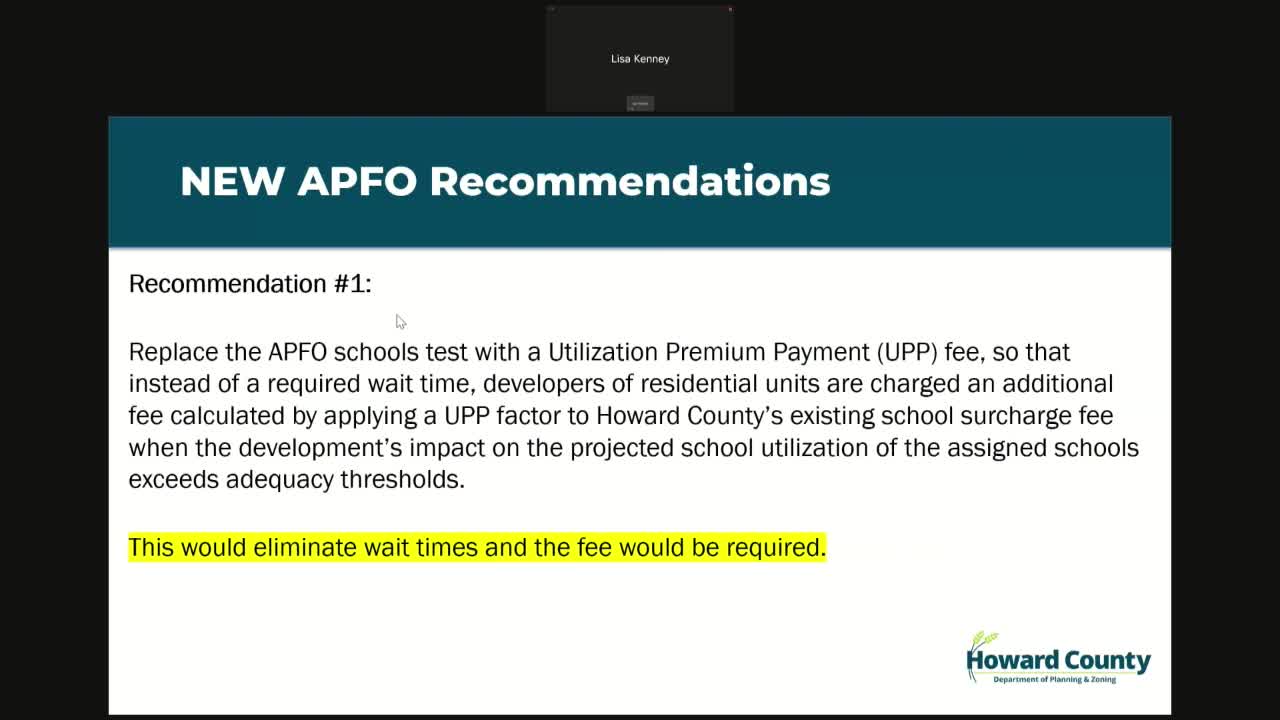
Howard County planning staff presented proposed changes to the Adequate Public Facilities Ordinance (APFO) at a May 20 public hearing, including a plan to replace the current school-capacity waiting system with a tiered utilization premium payment (UPP), rename the APFO roads test to a multimodal transportation test and add pedestrian and ADA access requirements, and adopt a county-specific affordable-housing definition.
Howard County planning staff presented proposed changes to the Adequate Public Facilities Ordinance (APFO) at a May 20 public hearing, including a plan to replace the current school-capacity waiting system with a tiered utilization premium payment (UPP), rename the APFO roads test to a multimodal transportation test and add pedestrian and ADA access requirements, and adopt a county-specific affordable-housing definition. Linda Eisenberg, director of the Department of Planning and Zoning, led the presentation and outlined the task force recommendations.
The recommendations would retain the county's annual allocations chart that limits the number and geography of new housing units but would replace the current school "open/closed" tests and the four-year waiting bin with a fee-based UPP buyout. "The recommendation is to replace the APFO schools test with the utilization premium payment," Eisenberg said, describing tiers at roughly 105%, 110% and 115% utilization and corresponding premium multipliers the task force proposed to apply to the existing school surcharge.
The nut graf: the proposal aims to allow development to proceed without waiting while generating additional revenue for schools and infrastructure, and to broaden APFO's transportation test beyond automobiles. Supporters said the change would unlock more housing and revenue; opponents said the fees would not come close to paying for school seats and that removing the waiting requirement risks overcrowding and more frequent redistricting.
Details of the proposal
Eisenberg said APFO would still use the county's allocation chart to pace growth by geography and typology (examples given: Downtown Columbia, activity centers, other character areas and the rural West). She described an allocations total of roughly 1,500 units per year and an affordable-housing typology pool of up to 340 units annually, and she summarized exemptions already in the code (single-lot rural subdivisions, replacement units, age-restricted units, some affordable-housing projects by…
Already have an account? Log in
Subscribe to keep reading
Unlock the rest of this article — and every article on Citizen Portal.
- Unlimited articles
- AI-powered breakdowns of topics, speakers, decisions, and budgets
- Instant alerts when your location has a new meeting
- Follow topics and more locations
- 1,000 AI Insights / month, plus AI Chat