Get Full Government Meeting Transcripts, Videos, & Alerts Forever!
Get email alerts on the School Capacity And Development Fees topic
No spam. Unsubscribe anytime.
Howard County task force proposes 'buyout' fees for schools, adds multimodal and ADA tests; public divided
Summary
Howard County planning staff presented proposed changes to the Adequate Public Facilities Ordinance (APFO) at a May 20 public hearing, including a plan to replace the current school-capacity waiting system with a tiered utilization premium payment (UPP), rename the APFO roads test to a multimodal transportation test and add pedestrian and ADA access requirements, and adopt a county-specific affordable-housing definition.
Howard County planning staff presented proposed changes to the Adequate Public Facilities Ordinance (APFO) at a May 20 public hearing, including a plan to replace the current school-capacity waiting system with a tiered utilization premium payment (UPP), rename the APFO roads test to a multimodal transportation test and add pedestrian and ADA access requirements, and adopt a county-specific affordable-housing definition. Linda Eisenberg, director of the Department of Planning and Zoning, led the presentation and outlined the task force recommendations.
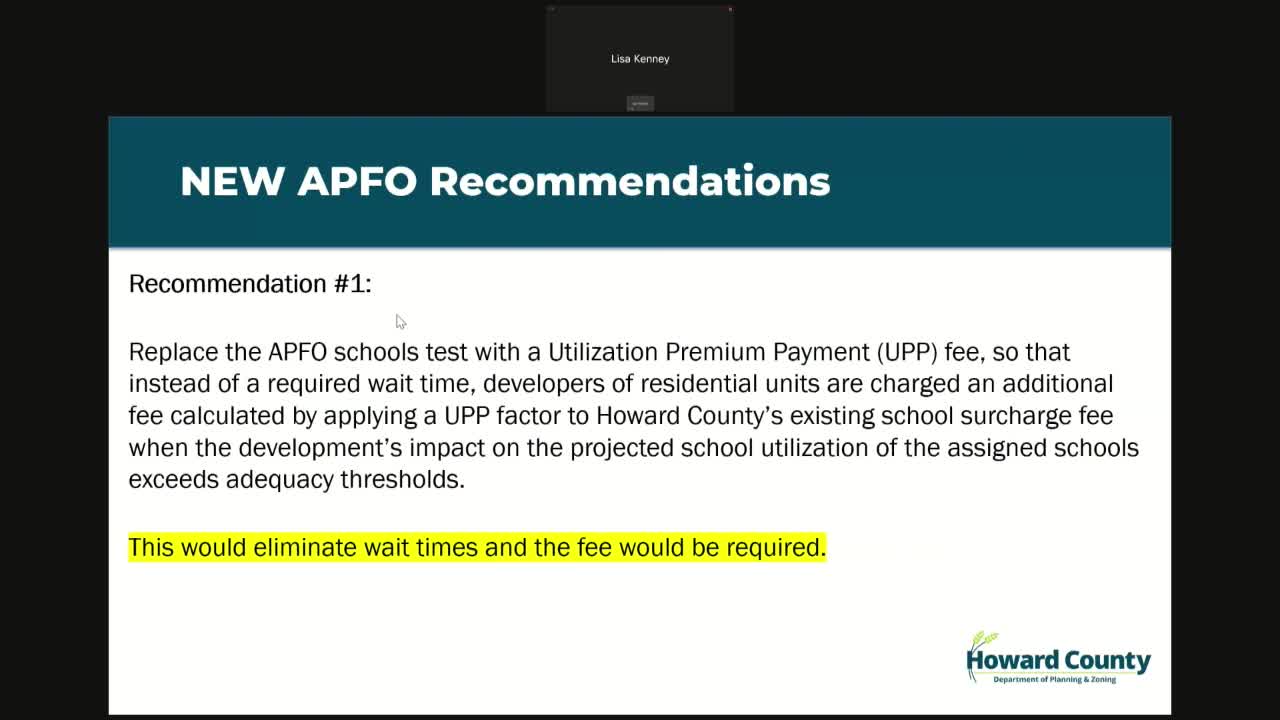
The recommendations would retain the county's annual allocations chart that limits the number and geography of new housing units but would replace the current school "open/closed" tests and the four-year waiting bin with a fee-based UPP buyout. "The recommendation is to replace the APFO schools test with the utilization premium payment," Eisenberg said, describing tiers at roughly 105%, 110% and 115% utilization and corresponding premium multipliers the task force proposed to apply to the existing school surcharge.
The nut graf: the proposal aims to allow development to proceed without waiting while generating additional revenue for schools and infrastructure, and to broaden APFO's transportation test beyond automobiles. Supporters said the change would unlock more housing and revenue; opponents said the fees would not come close to paying for school seats and that removing the waiting requirement risks overcrowding and more frequent redistricting.
Details of the proposal
Eisenberg said APFO would still use the county's allocation chart to pace growth by geography and typology (examples given: Downtown Columbia, activity centers, other character areas and the rural West). She described an allocations total of roughly 1,500 units per year and an affordable-housing typology pool of up to 340 units annually, and she summarized exemptions already in the code (single-lot rural subdivisions, replacement units, age-restricted units, some affordable-housing projects by resolution).
Under the UPP model, a development whose assigned schools exceed adequacy thresholds would pay an added surcharge calculated by applying a UPP factor to the existing school surcharge. Eisenberg gave an example using the county's current base school charge (quoted as $8.15 per square foot in the presentation) and an illustrative premium of about 9.23% in a tier-1 scenario; she said the proposal would eliminate the wait-bin option in favor of mandatory payment. The task force also recommended applying the same multiplier to senior- and market-rate housing surcharge rates and to adjust fees annually for inflation per county code.
Transportation and accessibility changes
The task force recommended renaming the APFO roads test to the "APFO multimodal transportation test" to explicitly require consideration of walking, biking and transit. Two specific new tests were proposed: a pedestrian crossing adequacy test that would examine accessible pedestrian signals, crosswalk markings and ADA-compliant curb ramps at impacted intersections; and an ADA access test for existing nearby bus stops requiring, when feasible, concrete pads, sidewalks and curb ramps within a quarter-mile of a development's frontage. Eisenberg said both tests would include dollar caps tied to project size and an exclusion for developments that generate five or fewer peak-hour trips.
Public response at the hearing
Public commenters expressed a wide range of views. Several education and community groups urged the task force to retain the current school-capacity test. Terry Marcus, president of the PTA Council of Howard County, said the APFO's purpose is "to ensure that there are sufficient public facilities as our population grows" and warned against weakening the current protections. "Hands off eliminating the meager protections our current APFO laws provide," Marcus said.
The County Council's District 4 member, Councilwoman Deb Young, testified that construction costs and the state's funding schedule limit the county's ability to translate any developer fees into timely school construction. She provided construction-cost figures presented at the hearing, citing roughly $495 per square foot as the state-approved per-square-foot cost for school construction and noting recent elementary, middle and high school costs discussed in the session.
Speakers who favor the UPP model said the waiting moratorium (the "wait bin") has blocked housing supply and that fees could deliver revenue for school capacity. Dana Soar of Bridges to Housing Stability and the Housing Affordability Coalition supported replacing the delay with targeted fees but asked that affordable housing be exempted from additional surcharges. "I support this committee's recommendation to end the waiting period for new housing and replace it with higher fees on new housing developments in areas where schools are over capacity," Soar said, while asking the committee to "exempt affordable housing from those additional fees." Jackie Eng (Housing Affordability Coalition) echoed that request and endorsed the committee's recommendation to adopt the proposed affordable-housing definition.
Concerns about adequacy of revenue and accountability
Multiple speakers questioned whether the proposed fees would generate enough revenue, and whether additional revenue would be dedicated to school capital needs. Megan Bronner, a Bellows Elementary parent and PTA delegate, criticized the example used in the presentation and said the extra charge shown would not cover even one student's annual cost. "That 25K additional, that's not even covering one student for one year in Howard County," Bronner said.
Other commenters noted that impact fees and surcharges currently flow to the county general fund rather than directly to the Howard County Public School System (HCPSS) capital budget, and they urged stronger guarantees that any new revenue would be used to expand school capacity where development occurs. Several speakers pointed to deferred maintenance and hundreds of portable classrooms in the system as evidence that current revenues have not kept pace with need.
Affordable housing, missing middle and equity considerations
Speakers advocating for more housing urged the county to prioritize the "missing middle" (duplexes, townhomes, small multifamily) and to pair APFO reforms with incentives to produce permanently affordable rental housing. Joe Phillips of the Howard County Association of Realtors asked the committee to "prioritize and streamline approvals for development proposals that include townhomes, cottage courts, duplexes, and other moderate density options." Housing-affordability advocates urged either an exemption or other incentives so that additional fees do not further raise costs for low-income renters.
Next steps and committee timeline
Eisenberg said the task force began meeting in August 2024, has held 17 meetings and covered 21 topic areas, and that the first public hearing was Nov. 6, 2024 (26 attendees, 96 comments). The committee planned to review written and oral testimony and reconvene on June 4; the committee must forward recommendations to the county executive and county council in August under county code. The record for written testimony was left open through May 23, per the presentation.
Why it matters
The APFO governs how the county times and pays for schools, roads, utilities and other capital facilities as new housing is built. The county's choices affect school crowding, the pace of homebuilding, housing costs, and where developer-paid funds are spent. The task force's proposal would replace a capacity-based pause with a fee-based approach that proponents say would increase housing supply and raise revenue, and opponents say would fail to provide the seats and services required to protect school quality and community infrastructure.
Closing note
No formal votes were taken at the May 20 hearing; the session was a public comment opportunity and presentation. The task force will review testimony and continue its deliberations before issuing final recommendations to the county executive and county council.