Get Full Government Meeting Transcripts, Videos, & Alerts Forever!
Get email alerts on the Telecommunications topic
No spam. Unsubscribe anytime.
Committee amends and forwards Hawaii County telecommunication siting bill after public testimony; 600‑foot setback added
Summary
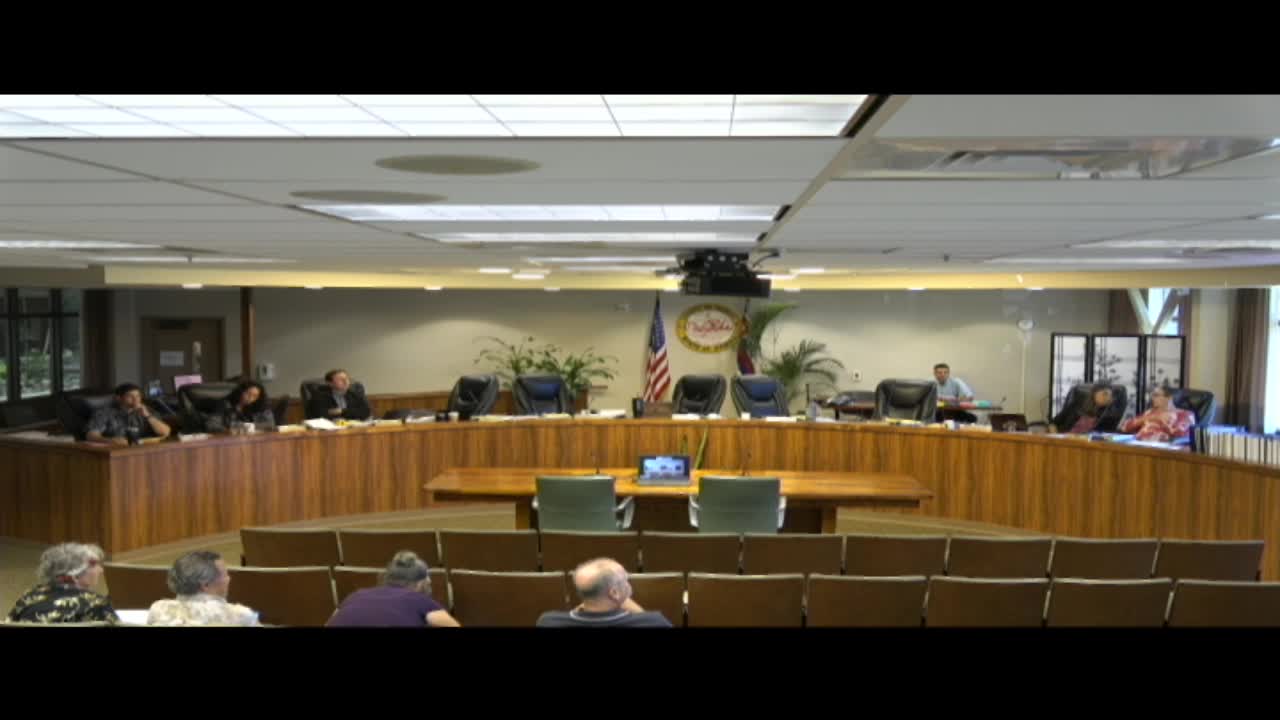
The Hawaii County Council Policy Committee on Planning, Land Use and Economic Development on May 20, 2025, voted to forward Bill 24, as amended, to the full council with a favorable recommendation after public testimony urging setbacks and after the committee adopted technical amendments addressing notification and small wireless facilities.
The Hawaii County Council Policy Committee on Planning, Land Use and Economic Development on May 20, 2025, voted to forward Bill 24, as amended, to the full council with a favorable recommendation after a series of public testimonies and two committee amendments. The bill amends Chapter 25 (articles 1, 2, 4, 5 and 7) of the Hawaii County Code to revise standards for telecommunication antennas and towers and was described at the meeting as planning‑department initiated.
Why it matters: Bill 24 governs where county residents may see new antennas and towers and how the county reviews siting applications. Public speakers urged the committee to adopt setbacks from residences and schools and to preserve opportunities for community input; planners said the amendments clarify application requirements and align the code with federal law where required.
Public testimony focused on calls for a minimum setback from homes and schools and expressed concerns about health, aesthetics and property values. Deborah Green, testifying for SafeTech Hawaii, urged the committee to “include a setback of at least 600 feet for residences and schools” and warned that the current draft removes contested‑case hearings and limits public input. Naomi Milamed of SafeTech Hawaii said the updated framework “effectively excludes any public participation” and asked the council to restore setback protections. Multiple other residents and community leaders testified in opposition to allowing towers without a setback near homes and schools.
Planning staff presented two written amendment packages (identified in committee materials as communications 110.117 and 110.118) and the committee considered a set of changes summarized by staff. Key elements of the amendments approved during the meeting include:
- Adding “small wireless facilities” to the definitions so the county’s rules explicitly address that category of equipment; - A submittal checklist that specifies what applicants must provide for plan approval; - A verification requirement that notification letters be sent to property owners and lessees of record within 500 feet of the perimeter of the building site (planning staff clarified that “perimeter boundary of the building site” is interpreted as the parcel boundary); - Language to align county references to federal regulation (Title 47, the federal Telecommunications Act) and to support planning in aligning local processes with federal and state law; - Clarification that the county cannot require industry to maintain redundant on‑site power supplies but can encourage such practices.
During deliberations Councilmember Rebecca Villegas introduced an amendment to add a minimum 600‑foot setback from residences and schools; planning department staff said the department had previously recommended an even larger setback and expressed support for the 600‑foot figure as a revised compromise. The committee clarified that facilities developed by government agencies “primarily to protect public health, safety and welfare” — including police, fire and other emergency dispatch services — are exempt from the setback provisions in code section 25‑4‑12(b); members asked for further clarification that FirstNet‑supported facilities used for emergency communications will be covered by exemptions or otherwise accommodated.
Councilmember Holika Inaba made the motion to forward Bill 24 on first reading, and after the committee adopted the two amendment packages (communication 110.117 and 110.118) and the 600‑foot setback language, the committee voted to forward the bill to the full council with a favorable recommendation. The committee recorded the outcome as passing with nine aye votes.
What was not decided: The committee did not adopt a county policy that purports to regulate health effects of radiofrequency emissions; planning staff repeatedly noted that local land‑use rules must be framed to avoid conflicts with federal preemption under the Telecommunications Act. Committee members and staff discussed concerns about how the code handles existing towers that are nonconforming and whether replacement or substantial reconstruction should be treated as requiring compliance with new setbacks.
Next steps: Bill 24, as amended, will be considered by the full Hawaii County Council. The amended draft includes new application standards, a required 500‑foot notification radius for nearby property owners, and the committee‑adopted 600‑foot minimum setback from residences and schools, with exemptions for government emergency facilities.