Get Full Government Meeting Transcripts, Videos, & Alerts Forever!
Get email alerts on the Workforce Calarx Diapers topic
No spam. Unsubscribe anytime.
HCAI outlines BH Connect workforce plan, CalRx adjustments and diaper access concept in May Revision
Summary
HCAI representatives told the Assembly on May 23 that the May Revision seeks to implement the BH Connect workforce initiative through a major multi-year funding package, redirect a portion of CalRx funds toward high-priority drugs like school albuterol access and pilot a universal newborn diaper supply distributed through hospitals.
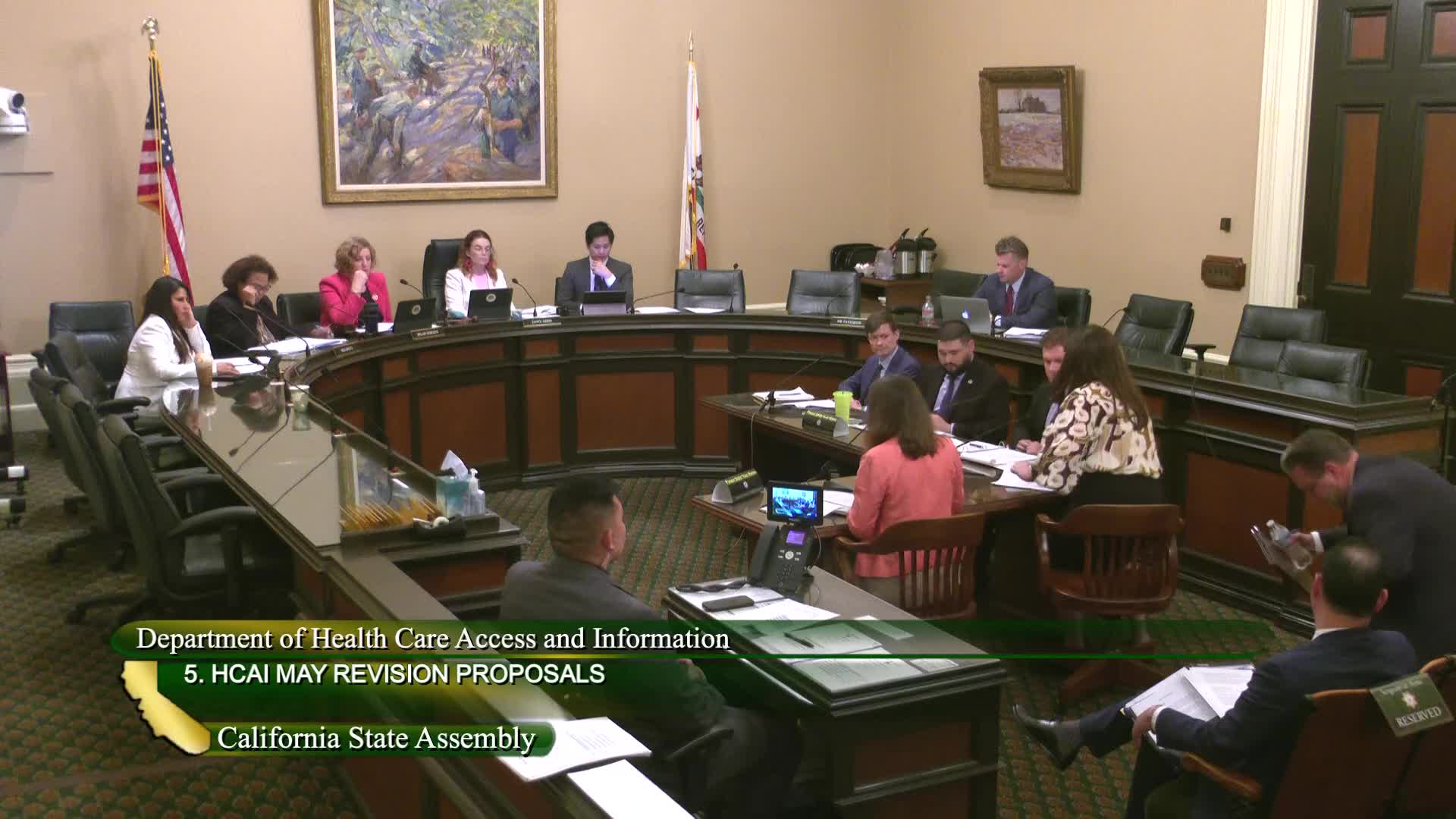
The Department of Health Care Access and Information told the Assembly Budget Subcommittee No. 1 on Health on May 23 that its May Revision includes a multi-element proposal: the BH Connect workforce initiative (tied to SB 326 and Proposition 1), a recalibration of CalRx funding with $5 million redirected to high-priority drug initiatives, and a diaper access pilot intended to improve family access to diapers.
HCAI Deputy Director Libby Abbott said the BH Connect workforce package would implement Behavioral Health Community-Based Organized Networks of Equitable Care and Treatment (BH Connect) workforce programs and Senate Bill 326/Proposition 1 workforce investments by requesting reimbursement and expenditure authority of up to $1.9 billion over five years and 57 positions to administer the programs. The request would include statutory authority to use third-party administrators and a contract-exemption for specific public-private awards to meet tight program timelines.
On CalRx, HCAI said the May Revision proposes redirecting $5 million of previously deferred CalRx funding toward other public-health priority drugs at risk of market failure—HCAI cited school albuterol access as a near-term target—and reverting about $45 million of the prior allocation for an in-state insulin manufacturing facility after a feasibility review concluded a state build was not practical. HCAI said CivicaRx remains the primary vehicle for low-cost insulin procurement and that the manufacturing facility work continues outside California.
HCAI also described a diaper access initiative proposing a universal, three-month newborn diaper supply distributed through hospitals with a two-year phase-in (proposed $7.5 million in 2025–26 and $12.5 million in 2026–27). HCAI officials said they issued a request for information (RFI) and have heard from diaper banks about storage and distribution capacity; HCAI offered to coordinate consolidated purchasing and explore partnerships with existing diaper-bank infrastructure.
The Legislative Analyst’s Office told the committee the diaper proposal might be more cost-effective or better targeted if it leverages existing programs—such as CalWORKs subsidies and local diaper banks—and suggested alternatives for achieving diaper access goals without a universal distribution model.
Advocates representing diaper banks urged the committee to preserve the existing diaper-bank network and ongoing funding while any new program is designed. HCAI and DOF officials said they would continue to gather RFI input and consider operational concerns expressed by hospitals and diaper banks.
Ending: The committee asked HCAI to provide additional details on the BH Connect funding and federal match assumptions, the CalRx reallocation plan and timelines for drug availability, and a clear operational plan for diaper distribution that avoids unintended interruptions to current diaper-bank operations.