Get Full Government Meeting Transcripts, Videos, & Alerts Forever!
Get email alerts on the Pharmacy Transparency Pbm Licensure topic
No spam. Unsubscribe anytime.
Administration proposes PBM licensure and PBM data reporting to HCAI; DMHC to enforce compliance
Summary
The Governor's May Revision would require pharmacy benefit managers that contract with health plans or insurers to obtain a state license and to report detailed pricing and financial data to the Healthcare Payments Data program, officials from HCAI and DMHC told an Assembly budget subcommittee on May 23.
The May Revision proposes a two-part approach to increase transparency in prescription drug pricing: requiring pharmacy benefit managers (PBMs) that contract with California health plans or insurers to obtain licensure and authorizing expanded data reporting to the Health Care Payments Data (HPD) program administered by the Department of Health Care Access and Information (HCAI).
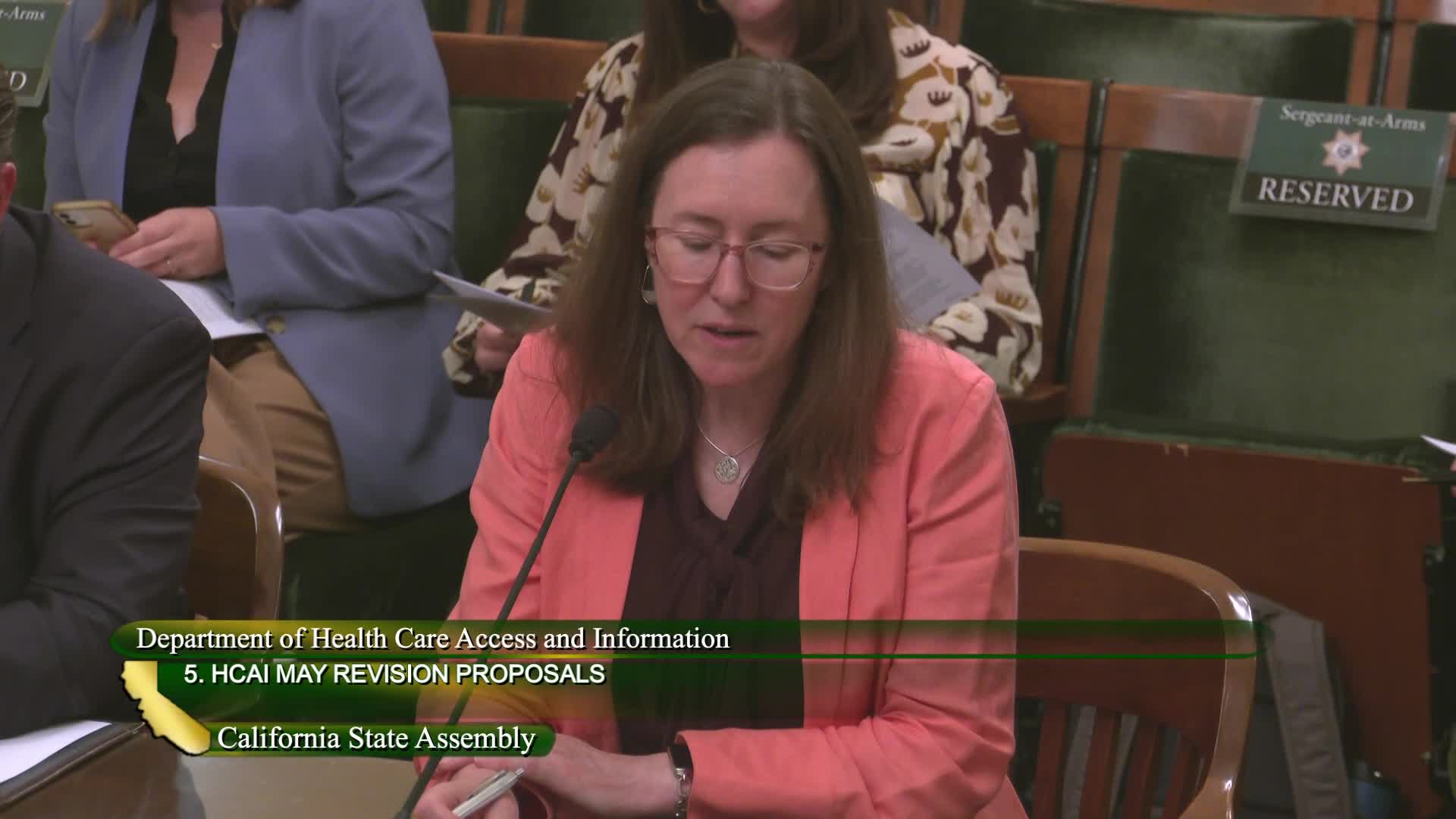
Elizabeth Landsberg, HCAI director, told the Assembly Budget Subcommittee No. 1 on Health that the agency would require PBMs to become mandatory submitters to the HPD, which would collect PBM-specific data such as wholesale acquisition costs, average wholesale price, national drug codes, fees and rebates paid across the supply chain, and counts by plan and pharmacy ownership. HCAI sought six positions and funding to implement the reporting and data-analysis workload.
Mary Watanabe, director of the Department of Managed Health Care (DMHC), described complementary licensing language in the May Revision that would replace the current PBM registration with a licensure mandate. Under DMHC’s proposal, PBMs contracting with DMHC-regulated plans or California Department of Insurance-regulated insurers would be required to obtain a DMHC license, submit quarterly financial statements and other information, and face audit authority and civil enforcement by DMHC. DMHC said it expects to recover enforcement and program costs through assessments on licensed PBMs.
HCAI and DMHC officials framed the combined proposal as necessary to gather authoritative, auditable data on the vertically integrated market in which insurers, PBMs and pharmacies may be part of the same corporate family. Landsberg said HPD already receives claims and manufacturer price data and that PBM data are the missing piece for comprehensive analysis.
The Legislative Analyst’s Office advised caution in advancing significant policy changes in the May Revision. LAO staff Mark Newton said that substantive policy questions with limited budget impacts are typically better considered in the policy process outside the budget deadline and recommended the legislature consider whether to defer or decouple the statutory policy decisions from the near-term fiscal decision.
DMHC requested six positions and roughly $2.3 million in 2025–26 to stand up licensure and oversight activities; HCAI requested staff and one-time funding for data ingestion, analysis and HPD expansion. Both agencies said the proposals are structured to be revisited in the annual budget process as the program’s resource needs become clearer.
Ending: The subcommittee did not take final action. Members asked for more detailed cost estimates and implementation timelines. Legislators raised questions about enforcement, the overlap of authority between HCAI and DMHC, and whether the administration could reduce staffing costs by phasing in responsibilities.