Get Full Government Meeting Transcripts, Videos, & Alerts Forever!
Get email alerts on the Behavioral Health Commission Funding topic
No spam. Unsubscribe anytime.
Behavioral Health Services Fund proposal would eliminate $20 million in Mental Health Wellness Act grants, commission warns
Summary
The Governor—s May Revision proposes eliminating roughly $20 million in Mental Health Wellness Act grant funds that support local partnerships and pilot programs; the Behavioral Health Services Oversight and Accountability Commission said the cut would terminate three launch-ready grants and imperil the commission—s future grantmaking capacity.
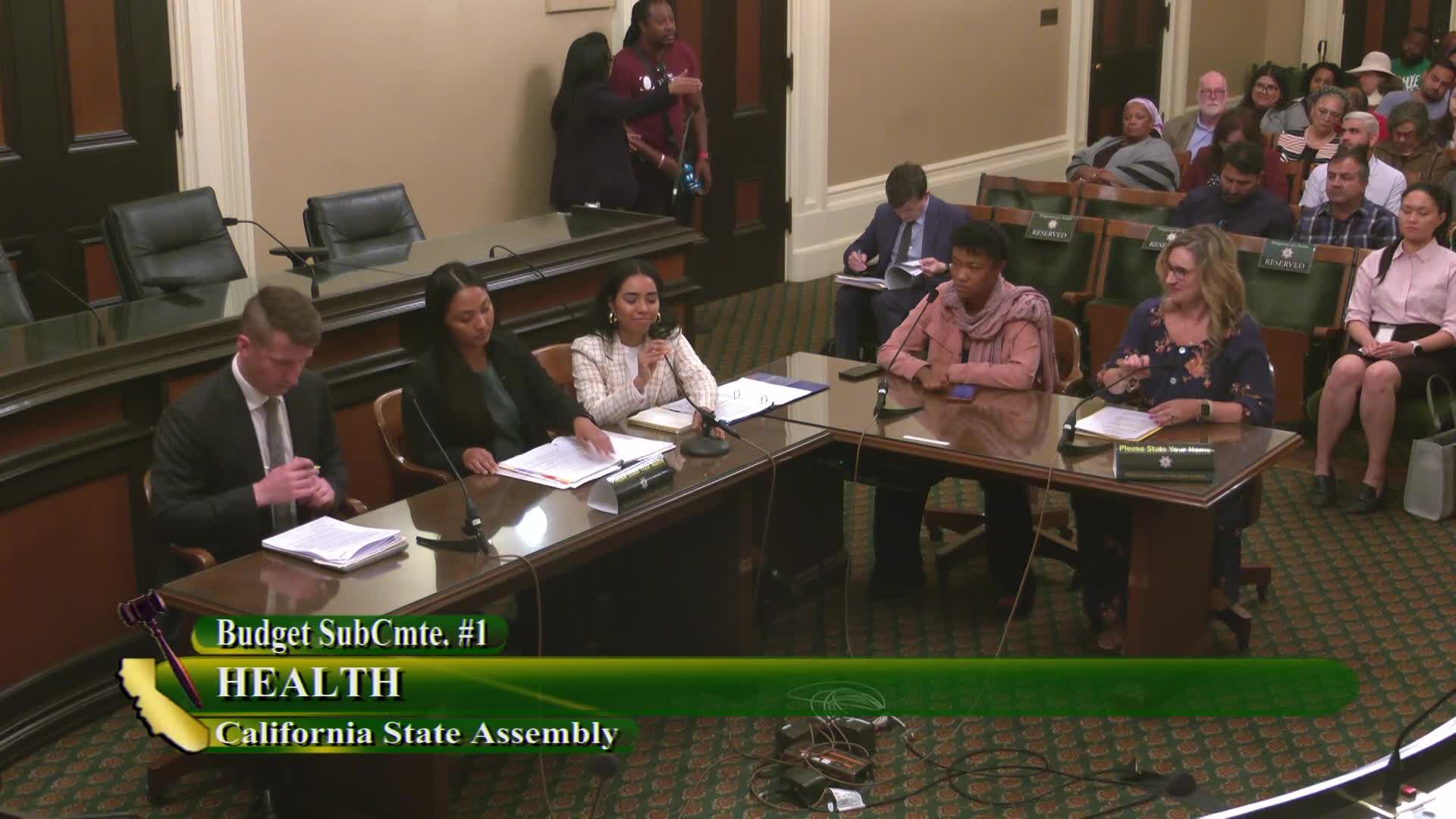
The Assembly Budget Subcommittee No. 1 on Health heard on May 23 that the Governor’s May Revision proposes eliminating $20 million in Mental Health Wellness Act funds administered by the Behavioral Health Services Oversight and Accountability Commission, a change the commission said would eliminate immediate, locally based programs and undermine longer-term grantmaking capacity.
Elizabeth Castillo of the Department of Finance told the committee the May Revision temporarily eliminates the $20 million funding to utilize the Behavioral Health Services Fund to offset general fund costs amid a projected $12 billion structural shortfall. Castillo noted that the Behavioral Health Services Act (2023) authorizes up to $20 million in Innovation Partnership Fund awards for five years beginning in 2026–27, but that those innovation funds are time-limited and have a different statutory scope than the Mental Health Wellness Act grants.
Brenda Greilish, executive director of the Behavioral Health Services Oversight and Accountability Commission, told the committee the commission administers the Mental Health Wellness Act as its largest ongoing local assistance grant and that cutting the $20 million would immediately eliminate three launch-ready projects and, over time, effectively end the commission’s ongoing grantmaking capacity beyond fiscal year 2030–31.
Greilish detailed the three affected grants: a $20 million grant focused on services for children ages 0–5 (to be awarded to six community-based organizations and a technical assistance provider), a $20 million full-service partnerships grant intended to support performance-based contracting, and a $20 million peer respite grant that would launch later this year. The commission said those funds were developed with county, state and community partners to address gaps in crisis prevention, early intervention and crisis response.
Commissioner Rachelle Chambers, speaking as an appointed consumer representative, described peer respite services as voluntary, nonclinical alternatives to hospitalization that help people avoid emergency room visits and that such services often appeal to Black and Brown communities and birthing people. “This money will help mothers like me,” Chambers said, describing personal experience with postpartum trauma and reliance on community-based support.
Will Owens of the Legislative Analyst’s Office said the Behavioral Health Services Fund stems from the millionaires’ tax revenue that the state can allocate to behavioral health activities. Owens said LAO is awaiting further documentation on the total available amount in that fund and could not yet provide a definitive analysis of the administration’s proposal.
Ms. Greilish and commissioners told the committee that if the $20 million is cut, existing launch-ready programs would have to compete for Innovation Partnership Fund dollars beginning in 2026–27 against public, private and nonprofit entities, adding that the innovation fund carries “innovation” requirements that differ from the existing wellness act scope.
Public commenters representing disability, provider and advocacy groups echoed the commission’s concerns, urging the legislature to preserve the $20 million to maintain full-service partnerships, peer respites and early psychosis interventions. Several groups said the proposed cut would directly harm local crisis response goals and ongoing behavioral health system transformation efforts.
Ending: The subcommittee did not adopt a final budget action at the hearing. Members asked the Department of Finance and the commission to return with additional detail on alternatives and on the differences in scope and timing between the Mental Health Wellness Act funding and the Proposition 1 Innovation Partnership Fund.