
City convenes Capital Improvement Advisory Committee to begin five-year water and wastewater impact fee update
Get AI-powered insights, summaries, and transcripts
Subscribe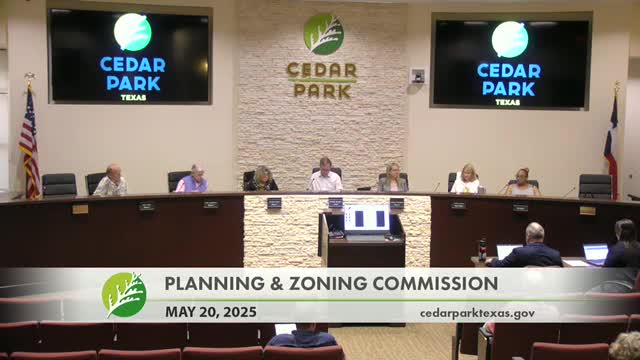
Summary
Cedar Park convened its Capital Improvement Advisory Committee to begin the statutorily required five-year update of water and wastewater impact fees, reviewing land use assumptions, projected growth (about 4,900 LUEs over 10 years) and a timeline that would bring an ordinance to City Council this autumn.
Cedar Park opened a Capital Improvement Advisory Committee (CIAC) session during the May 2025 Planning & Zoning meeting to begin the required five-year update of water and wastewater impact fees. City staff, the consultant and committee members reviewed the study process, preliminary growth assumptions and the schedule for the impact-fee update.
Eric Ross Schubert, Director of Public Works and Utilities, explained that state law (Chapter 395 of the Texas Local Government Code) requires periodic updates and that the study will cover a 10-year capital improvement plan and the calculation of water and wastewater impact fees that offset the capacity cost of serving growth. Nanette McCartin, senior utility business operations manager, will act as project manager for the city and staff identified a Freese & Nichols consultant team to prepare the update.
Consultant staff presented preliminary land use assumptions and growth projections. The team said the study limits its analysis to the city's service area (city limits and the city's CCN) and converts projected connections into living-unit equivalents (LUEs). Preliminary assumptions used conversion factors (for example, single-family = 1 LUE; multifamily = 0.5 LUE) and forecasted about 4,900 additional LUEs over the 2025'2035 period. For water demand the consultant used a planning criterion of about 425 gallons per LUE per day for average-day demand and a peaking factor of about 1.95 to estimate maximum day demand; on the wastewater side the team used about 195 gallons per LUE per day for average flows.
Next steps outlined to the committee include developing the impact-fee capital improvements program and performing the capacity and cost calculations, with a CIP and impact-fee calculation review scheduled for a July meeting, a final advisory meeting in August, and a City Council public hearing and first reading planned in September with a possible second reading in November. Staff emphasized that impact fees are one-time charges on new development and do not alter monthly water rates.
Committee members and staff asked clarifying questions about allowable uses of impact fee revenue, the reasonableness and benchmarking of calculated fees, quorum requirements for the committee and the distinction between impact fees and utility rates. No formal action was taken; the CIAC will meet again to review the CIP and fee calculations.