
Port Arthur updates EMS ordinance to align standards, sets council as final appeals authority
Get AI-powered insights, summaries, and transcripts
Subscribe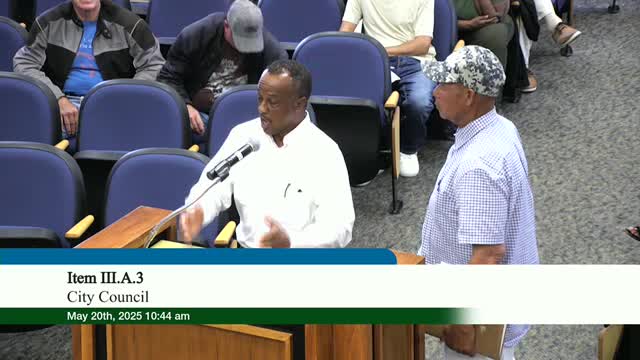
Summary
The council adopted an amended emergency medical services ordinance to clarify definitions, require minimum EMS units, extend a short additional dispatch time and add an appeals process that names the council as final arbiter. The changes were framed as aligning with NFPA standards and improving transparency in liquidated-damage claims.
Port Arthur City Council approved amendments to the city’s emergency medical services ordinance (proposed Ordinance 73‑23) May 20, adjusting response-time definitions, adding equipment requirements and changing how contract compliance disputes will be appealed.
Deputy Fire Chief Antonio Mitchell summarized the proposed edits in a presentation to council: the ordinance adds a formal definition for dispatch facilities, adjusts the allowable turnout time to 80 seconds (to align with an NFPA standard used by the fire department), requires a minimum of four EMS units in service at baseline, moves a monthly data submission deadline from the 15th to the 5th of the month, and adds detailed language about liquidated damages, record reviews and an appeal process.
“Giving them an extra 20 seconds” of dispatch time, Mitchell told the council, reflects the practical fact that the city’s 9‑1‑1 PSAP must sometimes hold or process calls before they are rolled to the EMS contractor; the time clock for turnout starts when the PSAP receives the call. Mitchell said the edits are intended to make the city’s ordinance reflect operational reality and make compliance/verifications more transparent.
Council members pressed staff about consultation with the current ambulance provider and the practical effect of enforcement. Andre (vice president, Port Arthur ambulance service) told the council the provider already staffs a minimum of six units on many days and said the provider can offer additional operational data, including GPS-based location tracking, if the city requests it. Andre said he supports an appeals mechanism and suggested staff-level dialogue and a work group to refine terms.
Council discussion focused on one procedural change: Councilman Doucette recommended that if a liquidated-damages determination cannot be resolved between the fire chief, city manager and the ambulance supervisor, the final appeal should be decided by City Council rather than solely by staff. City staff agreed to insert council as the final appellate authority; the council voted to adopt the ordinance with that amendment.
The ordinance will be applied to future procurement and amendments; city staff said portions will be grandfathered for the incumbent provider until a new contract or RFQ process is completed. The changes were presented as preparatory to future requests for proposals and as a tool to align city policy, the fire department’s needs and contractor performance expectations.
Ending — Next steps: City staff will circulate the finalized ordinance text reflecting the council’s modification and will hold a workshop to review implementation details with the ambulance provider and other stakeholders prior to the next contract cycle.