
Utah Court of Appeals hears dispute over daycare, "right of first refusal" and 50/50 parenting time in Duffin v. Duffin
Get AI-powered insights, summaries, and transcripts
Subscribe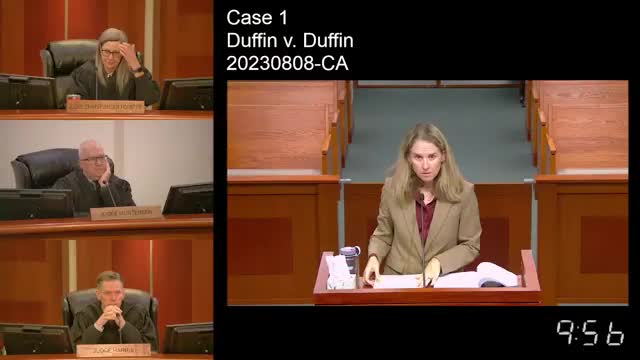
Summary
The Utah Court of Appeals heard oral argument in Duffin v. Duffin about whether a trial court improperly allowed the children's mother to place them in daycare without treating that placement as a major legal-custody decision and whether the father should receive expanded, equal parenting time.
The Utah Court of Appeals heard oral argument in Duffin v. Duffin (case name used in court record) in which appellant James ("Jimmy") Duffin challenges aspects of a trial-court custody and parent-time order, focusing on whether the trial court erred by allowing the children's mother to place them in daycare without treating that placement as a major legal-custody decision.
Julie Nelson, appellate counsel for James Duffin, told the panel that "the heart of this case is that my client dad would like to spend more time with his children," and argued that the trial court had nonetheless favored daycare over expanding the father's time. Nelson said her client has a flexible, full-time job and that his mother would provide care when he could not, and she cited advisory guidance in the Utah code that, she said, prefers parental care over surrogate care and also accounts for lower-cost childcare options.
The appellant urged the court to overturn two related aspects of the decree: the physical custody/parent-time allocation (currently described in the record as roughly 35.1% parent time for James) and the trial court's narrowing of the right of first refusal to "only on overnights." Nelson said those two changes together keep children in daycare more often than necessary and that, under the equal-parent-time statute she cited, her client meets the statutory criteria for expanded time.
Appellee counsel (referred to in the record as Mr. Hinkins) responded that the trial judge, Judge Bates, had examined the statutory factors and found the children were "thriving" under the status quo; that the judge had specifically considered a broad list of best-interest factors; and that Judge Bates had found a broader daytime right of first refusal would be "unworkable" given pickup-and-drop-off problems and existing communication difficulties between the parents. Hinkins told the panel that the original decree already required the parties to "share equally the reasonable work-related childcare expenses" and that provision was not challenged in the initial decree.
The panel and counsel debated whether decisions about daycare qualify as major legal custody issues (education, medical, religion) or are instead day-to-day physical custody choices. Nelson argued the question is comparable to decisions about schooling — saying, for example, that choosing daycare versus parental care changes the children's ongoing structure and can implicate educational and medical aspects relevant to legal custody. Hinkins countered that daycare in this record did not provide specialized services unique from other providers and that the ABA therapists who treated the children came to the daycare or to the home; he argued the trial court credited the practical problems that would arise if a daytime right of first refusal were imposed.
Counsel also discussed contempt proceedings: Nelson described filings seeking to hold Brandy Duffin in contempt over unilateral daycare decisions; the record shows a commissioner certified the issue but Judge Bates later characterized the daycare decision as day-to-day rather than a legal custody question and declined to hold Brandy in contempt. During argument the parties indicated a portion of the appeal about contempt (referred to in briefing as Issue 3) may be moot because contempt was, as counsel described it, purged and the order replaced.
Panel questions highlighted the trial court's emphasis on parental communication as a precondition for equal parent time. The trial court's order included a finding that, while communication had improved, it was not at the level the judge viewed as necessary for a 50/50 schedule; counsel for the appellant asked whether the appellate court should regard the communication requirement as an unlawful barrier to equal time or as a lawful factor within the judge's discretion.
The record excerpts presented and discussed at argument include: (1) the decree's right-of-first-refusal language limiting that right to overnight periods; (2) a finding that the children were "thriving, happy, and well adjusted" under the existing arrangement; (3) a paragraph in the decree (identified in argument as paragraph 32) directing the parties to follow the Utah Code regarding sharing of reasonable work-related childcare expenses; and (4) fact findings that the parties had a high-conflict divorce with limited co-parenting skills at the time of the original decree.
Counsel and the panel also discussed factual details in the record: the children remain young enough that after-school care and summer daycare remain relevant; one child was identified in argument as being 7 years old. Counsel disagreed about whether the record contains specific evidence that the daycare provided specialized, medically-adjacent services (appellant's counsel said therapy was taking place at the daycare and was a reason the decision should be treated as a legal-custody matter; appellee's counsel replied the daycare did not itself provide ABA therapy, but that ABA therapists attended the daycare or the home).
No final ruling by the appellate panel is recorded in the oral-argument transcript provided. The argument included a recorded suggestion that an issue concerning contempt had become moot; counsel agreed to clarify preservation questions about whether the petition below sought modification of the daycare-cost allocation. The panel told counsel how to communicate filings under the appellate rules and recessed argument.
The appeal centers on whether (1) the trial court abused its discretion in declining to expand James Duffin's parent time to an equal-parent-time schedule and (2) the court erred in treating daycare placement as a day-to-day decision rather than a legal-custody decision that would trigger consultation or a right-of-first-refusal remedy. The transcript shows the appellate panel questioned both the scope of appellate review of trial-court discretion and whether a line should be drawn by case law about when day-to-day practical decisions rise to the level of legal custody.
A decision by the Court of Appeals in this case would clarify how Utah trial courts should treat daycare placements when parents dispute day-to-day care, who bears childcare costs when parents disagree about placement, and how communication between parents affects eligibility for equal-parent-time allocations.