
City flags rising software and insurance costs, outlines AI guardrails and police tech investments
Get AI-powered insights, summaries, and transcripts
Sign Up Free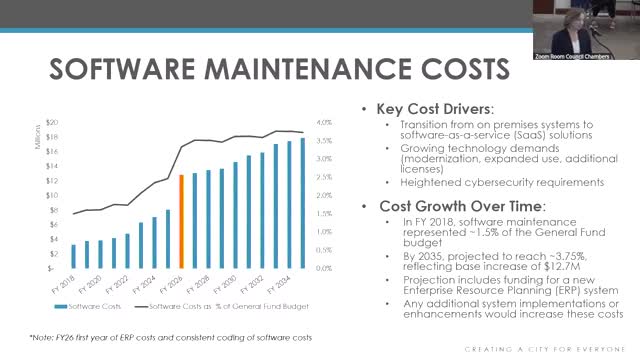
Summary
Finance and IT staff told the council that software subscription costs have roughly doubled since 2018 and that increased cyber and software spending, along with rising insurance claims and workers' compensation, are major budget drivers; the city said it already has an organization-wide AI policy and is piloting licensed generative-AI tools.
City staff told the Boise City Council at a budget workshop that growing software and insurance expenses are major drivers of budget stress and outlined current technology and risk-management work including an AI policy and investments in police technology.
Software and subscription costs: Alicia and Eric said software and maintenance costs have risen materially — from about $7 million in FY2018 to a projected more than $14 million in FY2026 and an estimated $18 million by 2035 under currently planned systems. Staff said the shift to cloud and subscription licensing, additional departmental modernization needs and cybersecurity investments are main contributors. The FY2026 budget includes the first-year costs for a new ERP system and associated staff.
AI policy and pilots: Kyle Patterson (director of organizational effectiveness) told the council the city established a generative-AI policy more than a year ago. Key guardrails he summarized: staff may not use confidential or sensitive data with generative AI, they may only use preapproved tools vetted by IT, they are responsible for work produced with AI and must cite AI tools in certain circumstances. Kyle said a pilot distributing 50 licensed ChatGPT seats to staff reported an average time savings of almost four hours per week among participants.
Police technology and risk funds: Eric and other staff said targeted investments in police technology optimization (including tasers and virtual‑reality training) are intended to reduce injuries, litigation and workers' compensation claims. Separately, Alicia said the budget proposes a $1.5 million annual increase in the risk and workers' compensation fund contribution (on top of current contributions) to stabilize rising claims; staff said the current fund is roughly $7 million and that the extra contribution would bring FY2026 funding for the fund to about $8.5 million.
Ending: Staff framed software, cyber and insurance pressures as structural budget factors requiring continued investment; council members asked for more detail about how technology initiatives link to operational savings and how risk‑fund increases would be sustained over time.