
House panel presses for transparent plans to spend roughly $90 million in opioid settlement funds
Get AI-powered insights, summaries, and transcripts
Subscribe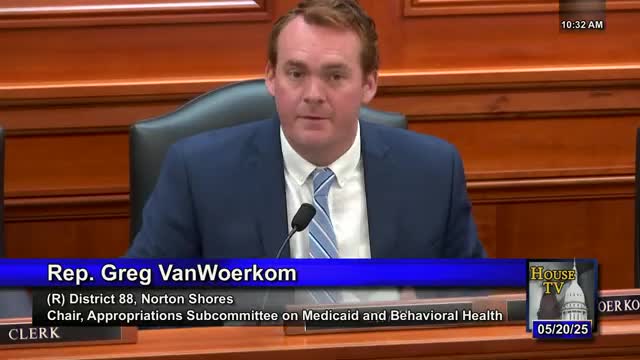
Summary
Members of the Michigan House Appropriations Subcommittee on Medicaid and Behavioral Health heard a daylong set of presentations on proposed uses of about $90 million in unspent opioid settlement proceeds, with witnesses urging a mix of competitive grants, local technical assistance and safeguards against earmarks.
The House Appropriations Subcommittee on Medicaid and Behavioral Health heard a series of presentations Tuesday on how to spend roughly $90 million in unspent opioid settlement funds and debated whether the state should use competitive grants or direct earmarks to distribute money.
Chair Representative Andrew Van Werkom opened the hearing saying, “there is about, $90,000,000 worth of settlement dollars that have not been spent,” and framed the committee’s role as ensuring “these funds are used for appropriate purposes” and improving transparency.
Why it matters: Committee members and providers said decisions now will shape prevention, treatment and recovery services statewide. Witnesses argued that the process — competitive requests for proposals versus direct appropriations to specific providers — will affect geographic reach, accountability and public trust.
Presenters included the Michigan Association of Counties, statewide provider coalitions, recovery community organizations and individual local programs. Jimmy Johnson, governmental affairs specialist for the Michigan Association of Counties, described MAC’s role helping counties manage settlement dollars and presented survey data on county planning and spending. MAC reported that, since creating a technical-assistance role in November 2022, it has worked with 72 of Michigan’s 83 counties and completed 409 technical-assistance requests. MAC’s survey found that in calendar year 2023 about 50% of responding counties had spent settlement funds; in 2024 that share rose to about 60% among respondents, with recovery support services and warm-handoff programs rising as top spending areas.
Several provider witnesses, including leaders of statewide coalitions and local organizations, urged open, competitive processes for awarding state-level dollars. Sam Price, representing the Provider Alliance Substance Use Disorder Subcommittee, warned that earmarks “ignore the needs of the rest of the state, especially in rural and underserved communities,” and urged a statewide competitive procurement process to ensure demonstrated outcomes and transparent budgets.
Other testimony stressed local accountability. Johnson explained that half of the settlement money goes to local governments through an escrow administrator, BrownGreer, and that local governments report to BrownGreer for non-remediation expenditures. He said the state’s share is held in the Opioid Healing and Recovery Fund.
What was not decided: The committee did not vote on any appropriations or make formal allocations. The hearing was intended to gather information and solicit proposals from providers and local governments.
Outlook: Committee members signaled interest in a transparent process to balance statewide priorities with local needs. Several witnesses said they would follow up with written proposals or more detailed budget requests to the subcommittee.