Get Full Government Meeting Transcripts, Videos, & Alerts Forever!
Get email alerts on the Animal Control topic
No spam. Unsubscribe anytime.
West Valley Humane Society asks Caldwell for $540,000, warns it may end contracts if not funded
Summary
West Valley Humane Society told the Caldwell City Council it needs a large increase in municipal funding for fiscal 2026 — asking Caldwell for $540,000 as part of a $1.5 million municipal request — and said it could terminate contracts if partners do not agree to increases.
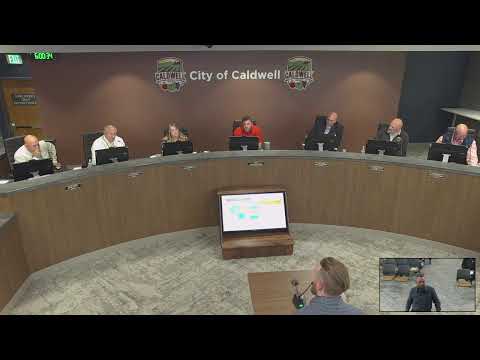
Tyler Byers, board treasurer for West Valley Humane Society, told the Caldwell City Council at a May workshop that the nonprofit is seeking major municipal funding increases for fiscal 2026 and warned it may end municipal contracts if partners do not agree to new funding levels.
Byers said West Valley — which he described as “the second largest animal shelter here in the state of Idaho behind only Idaho Humane Society” — has experienced recent financial losses and staffing shortages and now projects an operating budget for fiscal 2026 of about $2.4 million. “They've lost about $600,000 in in a couple months span,” Byers said of the shelter’s recent cash problems. He said the shelter’s board has had outside accounting help and a reviewed financial statement for 2024 and is presenting those materials to municipal partners.
Byers summarized the shelter’s funding request and current support: West Valley is asking Caldwell for $540,000, Nampa for $720,000 and Canyon County for $240,000, for roughly $1.5 million in total municipal funding; the shelter’s total budget is $2.4 million, and the organization projects roughly $950,000 in revenue from donations and adoptions. He said Canyon County also provides the shelter facility under a dollar-per-year lease and contributes roughly $100,000 in maintenance funds.
Why it matters: The shelter told council members its live outcome rate remains at or above 90%, a benchmark often associated with “no-kill” status, and that continuing operations depend on larger municipal contributions. Byers said the group’s cash-burn rate has been about $57,000 per month and that, without additional municipal funding, the shelter projects it could be forced to close or request emergency funding outside the normal budget cycle by about February 2026. "If we don't address that, in a meaningful way, we're projecting around February of 20 26. We would either have to close the shelter or come to you with a very, with a special, funding request outside of normal budgeting season," he said.
Discussion and council questions: Council members pressed for details about legal responsibilities, cost drivers and alternatives. Councilor Stoddick asked whether smaller cities such as Parma, Greenleaf, Star or Melba (transcript: “Silva” was mentioned) pay the shelter; Byers replied the shelter currently has contracts with Caldwell, Nampa and Canyon County but not with those smaller cities and that some jurisdictions choose to provide their own solutions.
City attorneys and several councilors sought clarification of statutory duties. A city attorney on the record cited Title 50, chapter 319 of Idaho code — the municipal “animal at large” statute — and said the city also has a complementary city code ordinance. Council members asked staff to provide a clearer written summary of what the state statute and the city ordinance actually require the city and county to do, and whether smaller cities may legally refuse to participate in a joint funding arrangement.
Costs, staffing and operations: Byers said the shelter’s largest expense is labor and that the organization is understaffed. He said veterinarians had been paid about $50 an hour and the shelter had raised that to about $60; local market rates are closer to $80 an hour, he said. He described multiple unfilled positions, no executive director, a board of volunteers performing executive duties and growing pressure from increased intakes as the region’s population grows.
On intake numbers, Byers said Caldwell had become the shelter’s largest source of intakes. He cited two figures in the workshop materials: “As of 2024, the City of Caldwell became our largest number of intakes” and “we're about 41% on average, of our total intakes are coming from the city of Caldwell.” At another point in the presentation he described using a per-capita framing and cited a breakdown that placed Caldwell’s share of intakes in the mid-30s percentage range; council members noted those two percentages in the discussion and asked staff for more precise intake-location data.
Funding alternatives and outreach: Byers described recent one-time grants and donations that temporarily reduced the projected shortfall — including a roughly $35,000 donation from Treasure Valley Subaru and last year’s $467,000 in emergency grants from Best Friends Animal Society — but said such funds are not sustainable substitutes for regular municipal support. He also described operational steps the shelter is pursuing to reduce costs or increase placements: pursuing PetSmart Charities adoption space in Boise, contracting with a third-party foster-placement service (“Dubert Connect”), conducting a strategic plan with an outside firm, and proposing ordinance updates intended to shorten average animal length of stay (Byers said the average length of stay had fallen from about 32 days to 10.2 days).
Possible outcomes: Byers told councilors West Valley is asking municipal partners to join either under separate contracts or in a joint contract model similar to arrangements used by Idaho Humane Society in Ada County; he said the shelter is willing to consider a single, joint contract if partners agree. He also said the board is prepared to terminate municipal contracts if partners do not reach the requested funding levels. "If we don't get to that $540,000 we are, willing to walk away from our contracts and let you find another partner to provide those services," Byers said.
Next steps and unresolved items: Councilors asked staff to return with a clearer legal summary of the city's obligations under state statute and local code, requested more precise intake-location and cost-per-intake data, and suggested coordinating on grant-writing or other fundraising assistance. Several councilors said the ask is difficult to accommodate within the current city budget and asked the shelter and county to continue negotiations with Nampa and Canyon County. No formal motion or vote occurred at the workshop.
Ending: The council recessed to continue its regular meeting; staff and West Valley representatives indicated further follow-up and budgeting conversations are expected in the coming months.