Get Full Government Meeting Transcripts, Videos, & Alerts Forever!
Get email alerts on the Traffic Safety topic
No spam. Unsubscribe anytime.
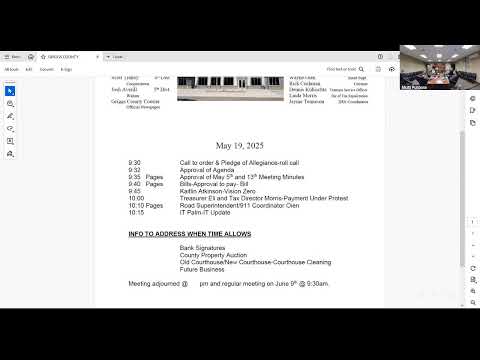
Vision Zero coordinator briefs Griggs County on local crash data, outreach for younger drivers
Summary
At the May 19 Griggs County Commission meeting, Vision Zero regional coordinator Caitlin Atkinson presented county-specific crash data showing zero fatalities from 2019–2023 but several serious injuries, and described education and enforcement programs aimed at reducing severe crashes among younger drivers.
At the Griggs County Commission meeting on May 19, Vision Zero regional coordinator Caitlin Atkinson presented county- and state-level crash data and described education and enforcement programs aimed at reducing motor-vehicle fatalities and serious injuries.
Atkinson, who said she is housed in the Grand Forks County sheriff’s office and funded through federal DOT subgrants, told commissioners that Griggs County recorded zero traffic fatalities from 2019 through 2023 but had several serious-injury crashes during that period. She said state totals for 2024 were 89 fatalities, the lowest in more than two decades, but stressed that every fatality represents families affected and work yet to be done. “If I can work myself out of a job, I will take it,” Atkinson said.
Atkinson walked commissioners through county-level patterns in the data. She said about 70 percent of Griggs County’s severe crashes in the five-year window were road departures or rollovers rather than vehicle-to-vehicle collisions; about 80 percent occurred on dry roads and most happened in clear weather. She also said roughly 60 percent of crash-involved drivers were age 33 or younger.
Those patterns, Atkinson said, point to driver behavior—distracted driving, drowsiness, speeding and alcohol—as common contributors. To address those behaviors she described a mix of the DOT’s enforcement and education tools: overtime enforcement grants for seat-belt and impaired-driving campaigns, simulators and “drunk goggles” used in school and community events, and a peer-to-peer Vision Zero Schools program that the DOT subsidizes for a two-year commitment.
Atkinson also cited two policy changes she said are influencing local outcomes: the primary seat-belt law enacted in 2023 and related enforcement campaigns; and a legislative change expected to take effect Aug. 1 that will require more citations to be reported to insurance companies. She said the seat-belt law and targeted overtime enforcement have contributed to declines in unbelted fatalities.
Commissioners and staff asked factual questions about specifics such as whether collisions with animals were counted and how crashes on tribal reservations are reported; Atkinson said animal-related crashes are included where reported and that reporting from sovereign reservations can be inconsistent and therefore can leave gaps in statewide totals.
Atkinson offered county officials free or low-cost resources—pedal carts, simulators, banners and PSAs—and said Vision Zero staff will support school and community events. She asked commissioners to alert her to local events and concerns where the program might help.
Ending: Commissioners thanked Atkinson for the briefing and staff noted they would follow up about scheduling local events and bringing Vision Zero activities to county schools and community gatherings.