Get Full Government Meeting Transcripts, Videos, & Alerts Forever!
Get email alerts on the State Legislation Labor Workforce topic
No spam. Unsubscribe anytime.
Minnesota conference committee adopts jobs and workforce policy agreement, defers several items
Summary
The bipartisan Jobs Policy and Workforce Conference Committee adopted a package of agreed policy provisions May 16, 2025 in St. Paul, approving technical fixes and program changes while tabling several items for further negotiation.
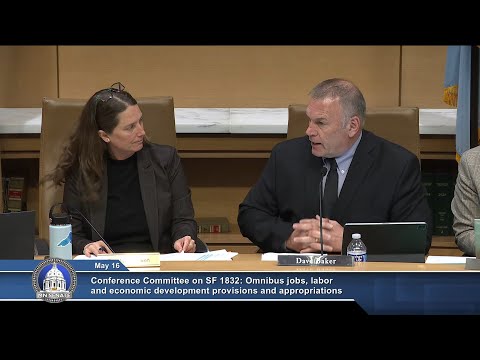
The Jobs Policy and Workforce Conference Committee of the Minnesota Legislature adopted a set of labor and workforce policy provisions on May 16, 2025, in St. Paul, approving a package of technical clarifications and program changes while deferring several contested items for further negotiation.
Committee members said they would adopt the set of provisions assembled by House nonpartisan staff and confirmed by Senate counsel, and they approved the package by voice vote after a motion by Senator Bobby Champion to adopt the provisions articulated by staff.
The adopted language includes administrative and program-level changes across multiple workforce and economic development programs. Staff told members the package reflects agreements to: add tribal economic development entities and community development financial institutions to certain eligible lenders; remove federal-matching language from the Minnesota Forward Fund; increase allowable grant and project cost caps (the House language allows up to a 15% increase over direct costs for partnership and pathways programs); count degrees toward workforce outcomes; create a special revenue fund account for an emerging entrepreneur program; clarify parking revenue reporting; and make technical corrections to 2023 appropriations for the Expanding Opportunity Fund and Promise Grants. The committee also adopted the Senate position to extend the availability of Minnesota Forward Fund appropriations through fiscal 2030 and the House position to extend a 2023 appropriation for Ramsey County through the end of fiscal 2027 while removing Youthprise as a subgrantee.
A discrete motion before the committee adopted the Senate language clarifying that plant-processing projects (not only livestock processing) are eligible for the Business Development Public Infrastructure Program. Sharlene, House nonpartisan staff, said the Senate version includes a delayed effective date to 2027 for that change; Chair Pinto moved adoption of the Senate language for that item, and members approved it by voice vote.
The committee also approved several labor provisions brought up later in the meeting: it adopted House-only language narrowing the definition of “nursing home” so that veterans and tribal homes are not included in the nursing home workforce standards board; and it approved a House correction to the name of an accrediting body. Commissioner Nicole Lisonbee of the Minnesota Department of Labor and Industry told the committee she and the department are continuing to work with stakeholders on manufactured-housing language and fee changes, which the committee elected to hold for further negotiation.
Not all items were finalized. The committee parked a number of sections for further work: manufactured-housing provisions and related fee increases; an exemption for well contractors from Department of Labor and Industry plan/spec reviews and inspections; proposed changes to rest- and meal-break remedies; class 4 electrical circuit items; and other labor provisions that require more stakeholder negotiation or funding decisions. Members also discussed a proposed misclassification fraud impact report and noted the House spreadsheet includes an appropriation of $163,000 per fiscal year to carry out that study; committee members said they would reconcile funding before final adoption.
On a separate but related item, staff said the underground telecommunications installer provision (Senate File 908) has passed both bodies and was expected to be sent to the governor for signature. The committee did not need to act further on that item in the session.
Quotes from the meeting included Commissioner Nicole Lisonbee introducing herself to the committee: “My name is Nicole Lisonbee. I'm the commissioner of the Minnesota Department of Labor and Industry. To this provision, we are actually still working with stakeholders to come to language that we think will be acceptable.” Senator Champion moved adoption of the staff-articulated package, saying, “I move adoption of the provisions articulated by staff.” Chair Pinto moved adoption of the Senate language on plant processing (R1), and members approved it by voice vote.
Why it matters: the conference agreement aligns House and Senate language on technical and programmatic workforce and economic-development provisions that affect grant programs, appropriations availability, and definitions used in labor rules. Several items that could affect regulation, fees or funding remain unresolved; committee members left them parked for additional stakeholder work or fiscal reconciliation.
What’s next: committee chairs said they planned to reconvene as needed; the committee scheduled further work for the following day and adjourned after completing the items it could agree on during the session.
Votes at a glance: - Motion to adopt packet of provisions articulated by staff — mover: Senator Bobby Champion; outcome: adopted by voice vote; no roll-call tally recorded. - R1 (Business Development Public Infrastructure Program: include plant processing) — mover: Chair Pinto; outcome: adopted by voice vote; transcript notes a delayed effective date to 2027 in the Senate language. - R77 (narrowing “nursing home” definition to exclude veterans and tribal homes from nursing home workforce standards board) — mover: Chair McKeown; outcome: adopted by voice vote. - R80 (correction to accrediting body name) — mover: member (not specified in transcript); outcome: adopted by voice vote. - R113 / Senate File 908 (underground telecommunications installer) — status noted as passed both bodies and awaiting governor’s signature; no committee vote required.
Items parked for further work: manufactured-housing provisions and fee increases (R82/R86), well-contractor plan/spec exemption, class 4 electrical circuits, rest- and meal-break remedy provisions, misclassification fraud impact report (House spreadsheet shows $163,000 per fiscal year), and other outstanding labor provisions.
Speakers quoted or identified in the transcript: Senator Bobby Champion; Chair Pinto; Chair McKeown; Chair Baker; Senator Dryden; Senator Graham; Senator Uma; Representative Graves; Representative Freeman; Commissioner Nicole Lisonbee, Minnesota Department of Labor and Industry; Sharlene (House nonpartisan staff); Ms. Deseng (fiscal staff).