Get Full Government Meeting Transcripts, Videos, & Alerts Forever!
Get email alerts on the Library Go topic
No spam. Unsubscribe anytime.
Saint Paul Public Library highlights Library Go expansion, LSTA grant and usage gains
Summary
The Saint Paul Public Library told the Library Board that Library Go, its student e-card program, has grown to about 87,000 records and received an LSTA grant of more than $27,000 to boost outreach, especially on the East Side; the board discussed outreach, language access and how students access accounts.
Dionysia Solis, youth services team lead at Rondo Community Library, told the Saint Paul Public Library Board that Library Go — a virtual e-card tied to students' lunch or student ID numbers — has expanded since it began in 2017 and now shows roughly 87,000 records as of March 2025.
Library Go allows students to check out physical items, ebooks, audiobooks and access databases without carrying a physical library card, Solis said. The board heard usage figures and outreach plans, and asked how the program enrolls students and which schools participate.
Library Go began in 2017, Solis said. She reported the system had “a little bit over 42,000 Library Go accounts” at the program’s start and “a little over 87,000 Library Go records” as of March 2025. For the 2025 year-to-date figures presented, staff reported roughly 64,000 physical checkouts, about 119,000 ebook/audiobook downloads via Libby, and about 12,000 other non‑book digital accesses. At the start of the year staff reported about 101,000 Library Go records systemwide; Solis and board members clarified that the program includes Saint Paul Public Schools plus participating charter and private schools.
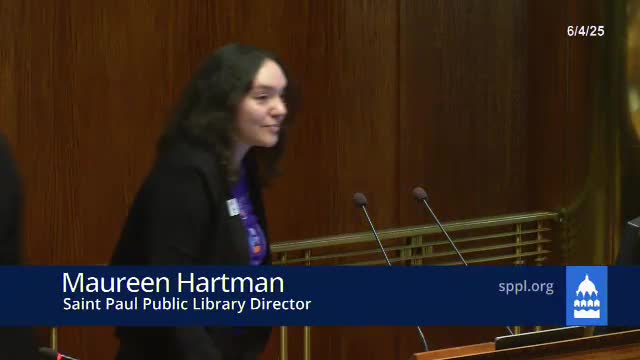
Director Hartman clarified that all Saint Paul Public School students “automatically get a Library Go card” when they receive their student ID number; charter and private schools enroll their students after a school-level application on the library website. When Council President Iger asked whether the totals included students from other districts, Solis said the program is limited to Saint Paul-area schools though it does include local charter and private schools.
Solis described outreach funded by a Library Services and Technology Act (LSTA) grant “of over $27,000” that targeted underuse on the East Side. Library Go family nights at Hayden Heights and Sunray libraries connected families and educators with staff and community partners, offered food and activities, and provided educator trainings. Solis said those events increased families’ understanding of how students can use Library Go at school and in the public library, and that staff encountered families whose first languages include Hmong, Karen and Spanish.
Board members raised operational questions the library is addressing: younger students (kindergarten–second grade) sometimes cannot reliably access or remember ID numbers; some families are unsure how Library Go differs from a physical card; and students occasionally need reminders that they have an account. Solis said new classroom posters, wallet-size cards, iPad clings and postcards for incoming kindergartners are being finalized to improve awareness.
Solis also noted that Library Go removes a financial barrier for families: the program does not charge parents for lost or damaged items and staff use incidents as teaching moments about responsibility. She encouraged educators who want to enroll a school to use the Library Go landing page and onboarding form on the Saint Paul Public Library website.
The board did not take formal action on Library Go during the presentation; the item was a staff report and discussion.