Get Full Government Meeting Transcripts, Videos, & Alerts Forever!
Get email alerts on the Transportation Sales Tax topic
No spam. Unsubscribe anytime.
Ramsey County board adopts initial eligible-project list for transportation sales tax, ties investments to All Abilities plan
Summary
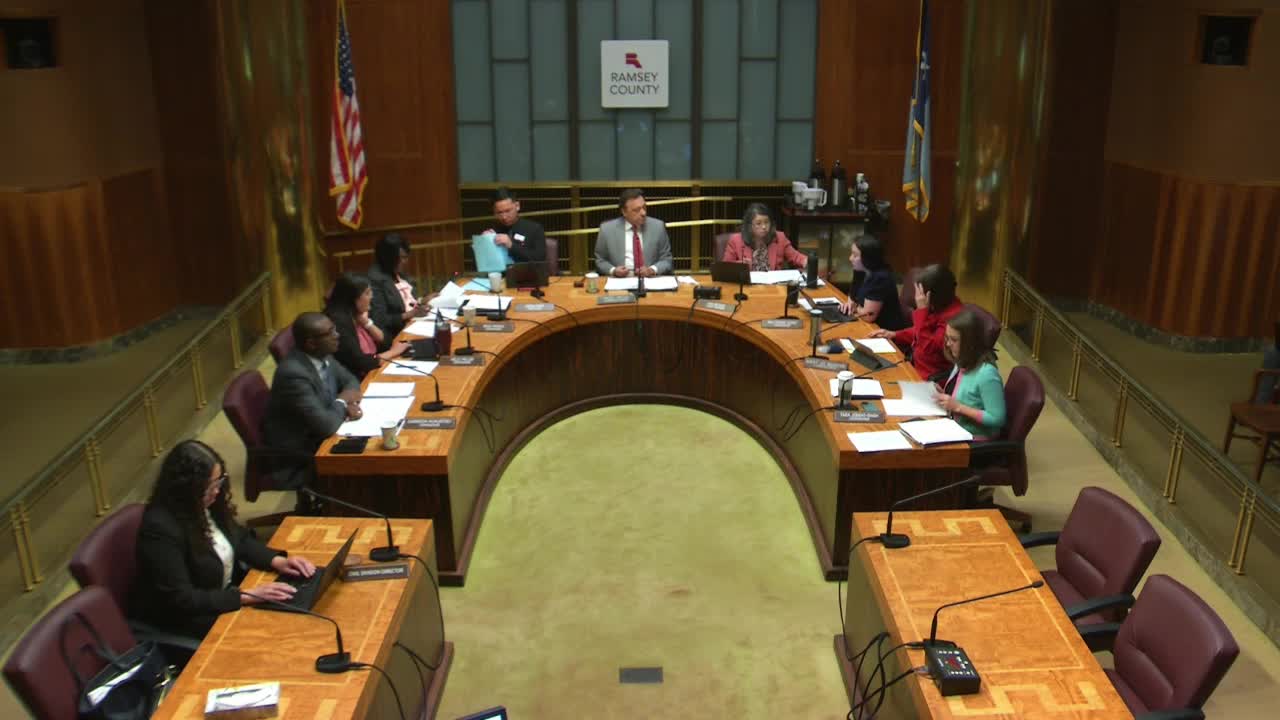
Ramsey County’s Board of Commissioners on June 10 adopted an initial list of projects eligible for funding from the county transportation sales and use tax, prioritizing work that advances the county’s All Abilities transportation plan and prepares corridors for arterial bus rapid transit.
The Ramsey County Board of Commissioners voted on June 10 to adopt an initial list of eligible projects for funding from the county’s transportation sales and use tax, directing the county to prioritize improvements that align with the county’s All Abilities transportation plan and other guiding documents.
Deputy and senior public works staff told commissioners the plan targets corridors and isolated locations that will make roads “transit ready” and support more frequent bus service, including arterial bus rapid transit (arterial BRT). Staff used Rice Street — where roadway reconstruction aims to support future arterial BRT (the G Line) — as an example of how road investments by a road authority can make corridors more competitive for regional transit investments.
Staff described a continuum of bus rapid transit models from exclusive, dedicated lanes (higher cost, e.g., Gold Line example) to arterial BRT that uses targeted roadway and station upgrades to improve transit speed and reliability on existing corridors. Staff said project selection was guided by several county planning documents: the All Abilities transportation plan (2050), the county’s resiliency and climate plans, the economic competitiveness and inclusion plan, and the county transit and transportation investment plan. Staff emphasized the eligible-project list is initial and that the county will add projects in future iterations.
Commissioners pressed staff on whether the list removed county participation in projects on state roads such as West Seventh Street; staff said it did not remove the county from future conversations but noted West Seventh is a state road that typically requires state involvement and funding. Commissioners also asked for specifics about projects inside St. Paul; staff pointed to Maryland Avenue and White Bear Avenue among locations on the initial list and said additional downtown and Union Depot-area work is planned but not fully fleshed out in the initial list.
Several commissioners highlighted the plan’s equity and safety metrics. Staff and commissioners said the county is using an equity scoring matrix that incorporates measures for people with disabilities, seniors, nondrivers, low-income communities, and safety indicators such as crash and injury data. Commissioners reiterated the county’s intention to use the plan to prepare corridors so the county and its partners can attract regional or state transit investments.
Action details: A motion to adopt the eligible-project list and related capital investment approach was moved, seconded and approved by roll call (Commissioner Jevan Singh — aye; Commissioner Maguire — aye; Commissioner McMurtry — aye; Commissioner Miller — aye; Commissioner Moran — aye; Commissioner Zhong — aye; Chair Ortega — aye). The board discussed and recorded that this list is an initial, living list and emphasized ongoing engagement with cities and partners when adding projects.
Why it matters: The measure creates a locally controlled fund stream to prioritize multimodal upgrades — pedestrian, bicycle and transit improvements — with the explicit aim of advancing county goals for accessibility, safety, climate resilience and economic competitiveness. County officials said the action increases Ramsey County’s readiness for regional arterial BRT and other transit investments.
Next steps: Staff said the county will continue annual or periodic project selection cycles that engage cities and community stakeholders, add projects to the list and incorporate projects into the Transportation Improvement Program for programming and construction.