Get Full Government Meeting Transcripts, Videos, & Alerts Forever!
Get email alerts on the Jttf Reporting Transparency topic
No spam. Unsubscribe anytime.
Portland council committee presses PPB for clearer JTTF reporting; public urges tighter oversight
Summary
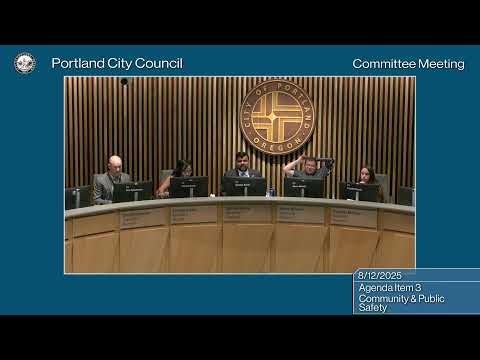
Portland police leaders and members of the Community and Public Safety Committee met Aug. 12 to review how the Portland Police Bureau reports Joint Terrorism Task Force activity and to consider changes aimed at greater transparency and stronger guardrails on federal collaboration.
Portland police leaders and members of the Community and Public Safety Committee met Aug. 12 to review the annual Joint Terrorism Task Force (JTTF) report and discuss how the Portland Police Bureau (PPB) should convey information about joint federal investigations to the city and the public.
Chief of Police Bob Day and Sergeant Mark Friedman told councilors that the bureau is in ongoing communication with the FBI and that, since the February council briefing, there have been no significant changes to the PPB’s methods for capturing and reporting JTTF-related information. At the same time, the committee and public speakers pushed for clearer post-investigation reporting and stronger guardrails on federal collaboration.
“We are in communication with the FBI,” Chief Bob Day said, noting recent discussions with the FBI’s special agent in charge about improving the annual product presented to council. Sergeant Mark Friedman described the PPB’s current role as limited and said the bureau now works “under a very… narrow scope of cases” with federal partners, focused on terrorism and imminent threats to life.
Councilors asked for improvements to the written annual report and for a clearer, staged approach to notifying elected officials when federal and local investigations intersect. Several committee members requested that future reports provide case-level follow-up when investigations are closed — including whether charges were filed, how a case was concluded, and whether referrals to behavioral-health resources occurred — and suggested a multilevel briefing protocol that differentiates between mayoral, council and public notifications depending on case severity.
Public testimony at the committee hearing reflected divergent community views. Philip Chachka of Portland Copwatch urged greater oversight and a city-designated representative with access to communications between PPB and federal partners, asking: “If the JTTF just changes its name, is it okay for PPB to collaborate without city council oversight or transparency?” Michelle Chachka, a special-education teacher, and Debbie Iona of the League of Women Voters of Portland asked for stricter limits on sharing information that could affect immigrants or people exercising First Amendment rights.
Councilor Jo Ann Hardesty (voice in prior records) and Councilor Carmen Rubio were not on the committee’s roll call for this session; committee discussion reflected mixed views. Councilor Maria Murillo warned that federal surveillance has historically targeted minority communities and urged continued caution in expanding collaboration. “We need to be even more deliberate and judicious about when we’re engaging with the federal government,” Councilor Maria E. Murillo said.
Other councilors voiced a different emphasis. Councilor Smith said she supports Portland having a place at the table in federal task-force work to detect and stop threats, arguing that absence from the task force limits city insight into federal practices.
Sergeant Friedman clarified that many cases discussed in annual JTTF reporting are also Portland police cases with a clear local nexus, and that several categories of prior JTTF investigations have been moved to the FBI’s new Threat Assessment Group in Portland. Chief Day said he would explore producing comparative data on the bureau’s involvement during periods when the city was an active JTTF participant versus its current, more limited cooperation.
Committee members suggested several concrete report improvements: include case-level outcomes for closed matters (charges, convictions, referrals or no criminality); clarify how each case met the statutory nexus to criminal conduct (not protected First Amendment activity); spell out what information PPB shares with federal partners; and state explicitly in the governing resolution that PPB will not cooperate in matters involving profiling or immigration-enforcement activity.
Testimony from civil‑liberties and community groups urged codified limits in the city’s resolution governing federal collaboration and called for stronger reporting requirements. The League of Women Voters of Portland recommended that the resolution require PPB to include in annual reports the FBI-originated information the bureau used and to specify whether a closed case resulted in charges or no criminality.
The committee did not take a formal vote on changes to the resolution or on re‑joining the task force. Members agreed to continue work on report format and timing, and Chief Day said the bureau would return with more detailed requests and comparative information in the months ahead. The committee also agreed to accept written testimony already filed and to hold further discussions in advance of next year’s annual report.