Get Full Government Meeting Transcripts, Videos, & Alerts Forever!
Get email alerts on the Community Health Chat topic
No spam. Unsubscribe anytime.
Portland’s CHAT mobile teams expand MOUD, report ED and ambulance diversions
Summary
Portland Fire & Rescue’s Community Health Assess and Treat (CHAT) program reported results from a MOUD pilot and outlined sustainability needs — including Medicaid billing pathways and ongoing city funding — after diverting patients from emergency departments and reducing expensive ambulance transports.
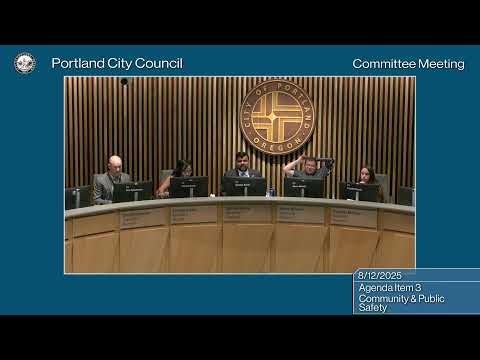
Portland Fire & Rescue officials told the Community and Public Safety Committee on Aug. 12 that the city’s Community Health Assess and Treat program, known as CHAT, has diverted hundreds of low-acuity 911 calls from emergency departments and is expanding onsite medication for opioid use disorder as part of a pilot.
CHAT leaders presented 18-month pilot outcomes for prehospital medication for opioid use disorder (MOUD), described partnerships with health-care coordinated care organizations and detailed barriers to longer-term sustainability, including limited-term staffing and challenges in obtaining Medicaid billing authorization.
The program, created in November 2021, dispatches specialized teams to low-acuity 911 medical and overdose calls to “send the right responder to the right call,” Deputy Chief Cory Wilson of Portland Fire and Rescue said. CHAT operates two service lines — response and aftercare — with overdose response teams and aftercare units that follow up with clients within 24 hours.
“Does every 911 call really need a transport to an emergency department?” nurse program manager Michelle Lavinia asked the committee during her presentation, spelling out CHAT’s goal to treat in the field when clinically appropriate and to reduce unnecessary ED admissions.
CHAT’s MOUD pilot uses buprenorphine (referred to in the presentation as “Bup” or “BUPE”) administered at the scene when patients meet protocol criteria. Lavinia described the medication as one that “activates them just enough to prevent withdrawal symptoms and reduce cravings without causing the same high,” and said national research shows buprenorphine can reduce fatal overdose risk.
Program data presented to councilors included: 36 patients enrolled in the MOUD pathway during the pilot, drawn from approximately 330 overdose-response incidents the teams attended; 86% of those 36 clients identified as houseless; 81% were diverted from emergency department transport; 68% received a warm handoff to clinic providers; and aftercare teams logged more than 730 hours of engagement for those 36 enrolled clients. The presentation stated that overall since 2021 CHAT has diverted 39% of 911 calls it handled from EDs and that taxi transfers rather than ambulance transports accounted for a 20% ambulance-diversion figure.
HealthShare of Oregon, a Medicaid collaborative covering roughly 450,000 lives in the Portland metro area, committed $1.1 million in one-year funding beginning this month, Jeremy Kohler, director of integrated services at HealthShare, told the committee. Kohler said HealthShare’s board intends to support CHAT’s expansion and that CHAT is collecting encounter-level data to prepare for potential Medicaid claims submission.
Tom Miller, a community health policy analyst working with CHAT, briefed the committee on opportunities related to the statewide opioid settlement. He noted that per Oregon’s allocation formula, municipalities receive a share of settlement funds and suggested the city could seek some of the state-discretionary portion to support CHAT work.
Committee members asked about staffing, hours of service and coordination with other services. Wilson said the full program is 24 positions with 22 responders and that three positions were vacant at the time of the presentation. CHAT currently operates response units Monday–Thursday and aftercare units Monday–Saturday, and program leaders said they hope to expand MOUD and aftercare to seven days a week if funding is secured.
Councilor Nick Fish (present as Co‑Chair Novick in the transcript) and others described ride-alongs and urged continued collaboration with county sobering services and hospitals. Councilor Eric Zimmerman pressed CHAT on whether its teams could use the county’s Pathway Center sobering beds; CHAT staff said they had toured the Pathway Center but that many patients the teams encounter exceed the center’s acceptance criteria based on vital signs and medical acuity.
CHAT and partners emphasized the program’s potential cost savings. The presentation included an estimated combined savings from ED and ambulance diversions of more than $11,000,000 since 2021, while noting that figure does not include downstream social-service costs or avoidable ED admission losses.
Program leaders repeatedly raised sustainability as a near-term priority: converting limited-term positions to ongoing roles, finalizing Medicaid billing pathways in coordination with the Oregon Health Authority and continuing to seek partner investments. “If we could make these regular positions, it allows the people that really dig in to the work that they do…to not have to look over their shoulder,” Deputy Chief Wilson said when councilors asked how ongoing funding would affect staff morale.
Looking ahead, CHAT officials said they will pursue additional CCO, hospital and state partnerships and continue submitting encounter-level data to support a pathway for Medicaid reimbursement. HealthShare’s initial investment is targeted at program expansion and aftercare supports, Kohler said.
The committee took no formal vote on CHAT funding during the Aug. 12 meeting. The presentation and related public discussion were followed by questions from council members and a request that staff provide high-resolution maps and additional data for council review.
The CHAT presentation, MOUD pilot results and the funding discussion will be available in the committee record and are scheduled for further follow-up as city budget and Medicaid-billing conversations continue.