
Connecticut correctional ombuds reports backlog, staffing shortfall and new statutory powers after legislative session
Get AI-powered insights, summaries, and transcripts
Subscribe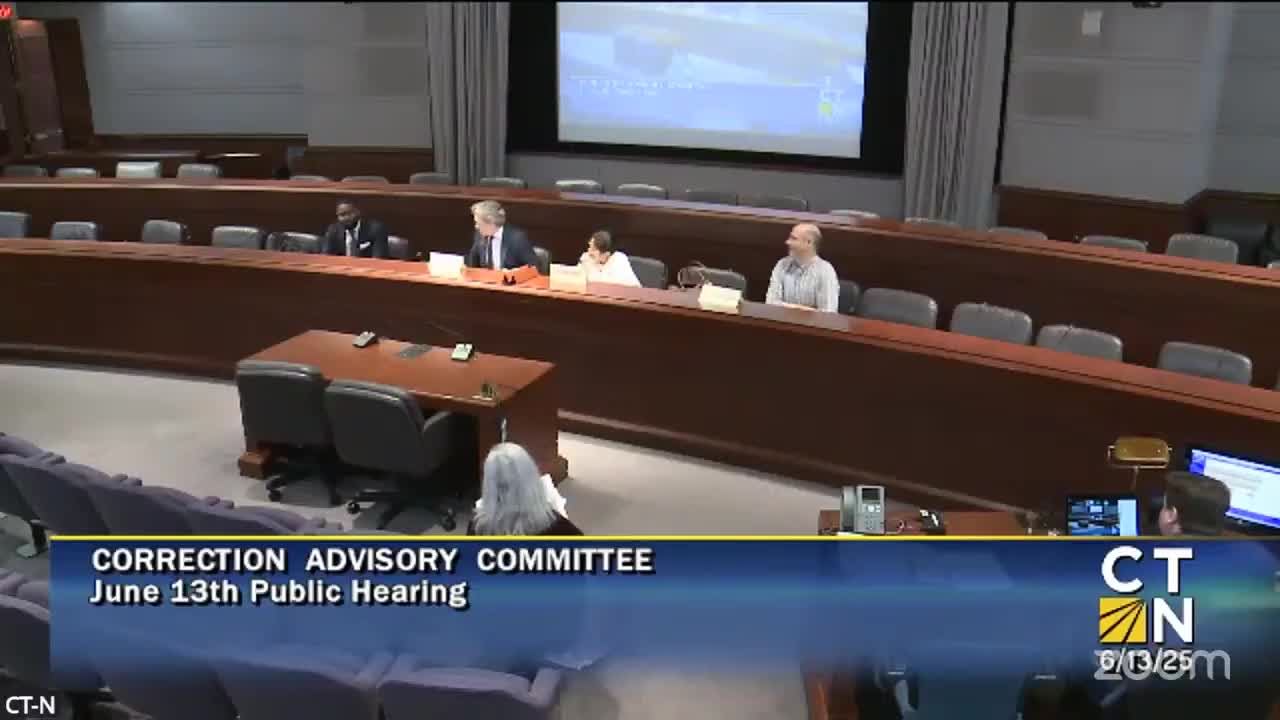
Summary
Attorney Ward, interim correctional ombuds, told the Advisory Committee on June 19, 2025, that the office processed 196 complaints received from incarcerated people since late September 2024 but faces a large unreviewed mail backlog, limited staff and an absence of case‑management software.
Attorney Ward, interim correctional ombuds, told the Advisory Committee at a semiannual public hearing on June 19, 2025, that the office has “formally processed a 196 complaints submitted by incarcerated individuals” since his interim appointment and is facing a substantial backlog of unreviewed mail complaints and limited staffing.
The report to the committee and members of the public summarized operations from Sept. 30, 2024, through May 19, 2025, and identified three immediate constraints: insufficient staff (Ward was the sole full‑time employee for most of the period), restricted access to nonpersonnel operating funds, and the absence of a case‑management system. Ward said the office had 189 mailed complaints that remained unreviewed and a separate backlog of roughly 100 pieces pending intake review.
Why it matters: the ombuds office is tasked by statute to receive and investigate complaints from people in Department of Correction (DOC) custody and to make recommendations on systemwide problems. Its ability to respond quickly affects incarcerated people and their families statewide.
Ward told the committee the office engaged in more than 30 stakeholder meetings during the reporting period with DOC leadership and divisions (health services, security, food services and reentry), the governor’s office, the Office of Policy and Management, the Office of the Child Advocate, and advocacy organizations including Disabilities Rights CT and the Yale Medical‑Legal Partnership. He said the office conducted site visits to all correctional institutions in Connecticut and made 13 site visits specifically called out in the written report.
On access to records, Ward said the office initially encountered a policy at DOC that required a signed release for each inquiry — security and medical records alike — but that discussions with other states’ ombuds offices and legal review led to a change. "Roughly 2 weeks ago, we were able to come to an understanding, that that the statutory authority and Connecticut general statute, as well as the audit and exemption functions in HIPAA, allow the office to access those records without having, having to obtain a signed release," Ward said.
Budget and operations: Ward described how startup funding and accounting rules limited purchases. The enacted biennial appropriation nearly doubled the governor’s original request: the office’s budget was listed in the final bill as $790,799 for fiscal year 2025–26 and $763,692 for 2026–27 (the office had initially been proposed at $400,000). The earlier $400,000 appropriation placed most funds in a personnel services (PS) line and left only $6,000 available for operating expenses (OE) during the prior cycle. Ward said that constraint prevented purchase of a case‑management system and other operating needs, but the new line item and separate OE authority should allow the office to acquire software and additional staff beginning July 1.
Legislative changes: Ward summarized two pieces of legislation that passed both chambers and await the governor’s signature. House Bill 7287 created a clearer mandate for the ombuds office to evaluate health‑care services in DOC facilities, authorized the office to employ or contract with licensed health‑care professionals for reviews, and required systemwide metrics (appointment wait times, mental‑health access, medication continuity, hospitalizations and mortalities) to be collected and reported. The bill also bans use of ‘‘nutriloaf’’ and other diet‑based punishment and requires DOC to provide standardized forms for incarcerated people to designate emergency contacts (sections cited by Ward included 282, 284, 288 and 289 of the enacted bill text).
Ward said Senate Bill 1541 — the bill he drafted and lobbied for — extends the ombuds term (effective with the next gubernatorial term), clarifies that calls to the office are free of charge, expressly authorizes unannounced site visits (including during lockdowns and emergencies), authorizes surveys of incarcerated people, allows the ombuds to present a budget request directly to the legislature, and grants subpoena authority to compel witnesses and documents for investigations. Ward said the bill also standardizes the investigative process and requires DOC to provide a public response within an agreed timeframe to the office’s recommendations after investigations.
Operational priorities and limits: Ward said the office will prioritize complaints by severity, using a model similar to New Jersey’s. Safety, security and urgent medical complaints will receive the highest priority; lower‑priority matters such as nonurgent property claims and routine programming access will likely wait while the office builds capacity. Ward said the office aims to provide at least an initial response to newly filed complaints within 45 days indicating whether the matter will be accepted for investigation.
Staffing timeline and hiring constraints: Ward said the office posted an office assistant position in April that drew more than 200 applications and that the pool had been narrowed to 41 candidates, but a statewide hiring freeze and state personnel processes delayed progress. He projected the office would not reach full staffing capacity until the second quarter of 2026 and said the newly enacted budget should allow more aggressive hiring starting July 1.
Case management and backlog: Ward said he has tracked complaints in spreadsheets but that a commercial case‑management product (comparable to tools used by legal practices) is required to manage intake, triage and investigations. The office could not buy a license in the prior budget year because funds were restricted to personnel; Ward said he expects to be able to acquire a case‑management system in July after the new budget year begins.
Public comment underscored persistent facility problems. Multiple family members and advocates gave examples of medical delays, missing or withheld personal property, limited access to necessary medical devices, lockdowns that prevent regular outdoor time and inconsistent notification of deaths and critical incidents. Barbara Fair of Stop Solitary CT read correspondence from a family member who wrote: "My husband has drop foot and requires a leg brace... Today, he fell, chipped a tooth due to not having his brace." Several public commenters said they had filed facility grievances that did not resolve the underlying problem and asked the ombuds office to press facilities for timelier action.
Committee discussion: Advisory committee members praised Ward’s legislative and outreach work but repeatedly expressed concern that the increased statutory responsibilities — particularly the requirement to evaluate DOC health care on a tight timeframe — may outpace the office’s current staff and resources. One committee member who is a physician warned the health‑care evaluation mandate will be difficult to complete with limited funding and asked Ward to prioritize a feasible scope for the December and February reporting deadlines.
What happens next: Ward said DOC must file a separate report on its health‑care evaluation by Oct. 1, 2025; the ombuds office’s statutorily required report on health‑care access and quality is due Dec. 1, 2025. The office expects to continue site visits, expand academic partnerships and pursue purchase of case‑management software and the hiring of clinical staff (Ward said he hopes to hire an advanced nurse practitioner to assist clinical review).
The hearing included a series of requests from advocates for clearer and faster notification to the ombuds office of deaths, attempted suicides and other critical incidents; Ward acknowledged DOC has not consistently notified the office and said he will seek changes to administrative directives to require such notice.
Ending note: Advisory committee members and public speakers urged patience while also pressing for quicker results; Ward asked advocates to continue providing information and to participate in volunteer, internship and academic collaborations to expand the office’s capacity while state hiring and procurement processes proceed.