Get Full Government Meeting Transcripts, Videos, & Alerts Forever!
Get email alerts on the Community Facilities Districts topic
No spam. Unsubscribe anytime.
Oxnard staff seeks changes to CFD 9 for North Shore at Mandalay Bay, sets July hearing
Summary
City staff recommended modifying Community Facilities District No. 9 to add a state park maintenance tax, increase certain special taxes and raise the district's bonding cap from $22.5 million to $40 million; staff also requested council adopt a deposit and reimbursement agreement and set a July 15 public hearing.
Anthony Miller, special districts manager with the City of Oxnard Public Works Department, asked the Oxnard City Council on June 26 to begin formal proceedings to modify Community Facilities District No. 9 (CFD 9), North Shore at Mandalay Bay, including adopting a deposit and reimbursement agreement and setting a public hearing for July 15, 2025. "Recommendation. That the city council, acting as a legislative body of the city of Oxnard Community Facilities District Number 9, North Shore At Mandalay Bay, adopt the following resolutions," Miller said.
The modification request, filed by the landowner Fifth Harbor Owner, LLC, would increase some facility and services special taxes, add a new special tax for state park maintenance services at Mandalay State Beach, and raise the district's maximum bonded indebtedness from $22,500,000 to $40,000,000. Staff said the changes maintain an average effective tax rate of about 1.8% and apply to an approximately 90-acre project currently planned for 292 single-family residences near the northeast corner of West Fifth Street and Harbor Boulevard.
Why it matters: CFDs are a common California tool for funding infrastructure and services in new developments by levying special taxes on properties within the district; they require specific proceedings under state law and, in many cases, a landowner election. The recommended changes would expand the district's ability to finance facilities, ongoing services, state park fees, and remediation work tied to Department of Toxic Substances Control (DTSC) requirements.
Details presented to the council said CFD 9 already includes three special-tax categories: a facilities special tax to pay debt service on bonds or finance facilities, a services special tax for ongoing services in perpetuity, and an environmental special tax for remediation, operation and maintenance required by DTSC. The landowner's petition would leave the environmental special tax unchanged in amount but add a state park maintenance services special tax that would be collected annually and turned over to the state under a forthcoming agreement. The environmental special tax would continue to be collected until DTSC issues a certificate of completion for remediation work.
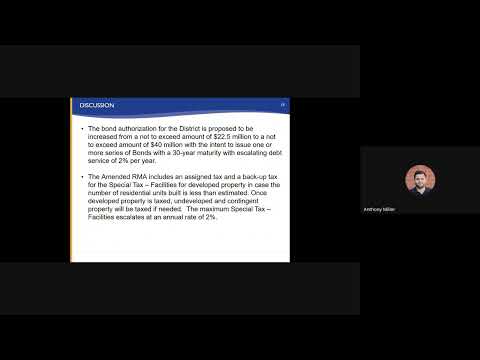
Staff recommended increasing the district's facility bond authorization to a not-to-exceed $40,000,000, with the expectation bonds would be issued in one or more series with up to 30-year maturities and an assumed 2% annual escalation in debt service. The amended rate and method of apportionment (RMA) would include assigned and backup taxes for developed property in case fewer units are built than estimated, and undeveloped or contingent property could be taxed later if needed. The maximum facilities special tax was described as escalating at 2% annually; the maximum services special tax would escalate by the greater of 2% or CPI but not exceed 5% annually; the newly titled state park maintenance services special tax has a maximum escalator of 5%.
The packet attachments described an estimated budget for facilities, services and state park fees, and noted the environmental special tax would be collected by the CFD and turned over to the North Shore Environmental Conservancy (NEC), a newly formed nonprofit that would pay for remediation budgets approved by DTSC. Staff also said a deposit of $27,000 has been made by the landowner toward the city's costs to process the modification, with formation and modification costs the responsibility of the landowner and reimbursable from bond proceeds if bonds are issued.
Process and next steps: Miller outlined a two-step approval path under California Government Code section 53311. On June 26 the council was asked to adopt (1) a resolution approving the form of a deposit and reimbursement agreement and (2) a resolution of consideration declaring intent to modify the RMA and setting a public hearing for July 15, 2025. If the council proceeds on July 15, and provided there is no majority protest, the city would call for an election (mailed ballot), canvass the results, and consider adoption of an amended and restated funding and acquisition agreement. Landowners have reportedly waived certain election timeline requirements so an election could be held on July 15, 2025. If approved by the required two-thirds vote of qualified voters (the landowners in this case), the city may adopt the resolution of change; the CFD would later determine bond issuance amounts.
Financial impact: Staff said there is no direct financial impact to the city's general fund from adopting the resolutions to begin the modification process. Bond issuance, if any, would be considered later when development and facility completion justify selling bonds.
Questions from the council concluded the presentation; no council vote or final action on the resolutions was recorded in the transcript.