Get Full Government Meeting Transcripts, Videos, & Alerts Forever!
Get email alerts on the Housing Funding topic
No spam. Unsubscribe anytime.
HAWK debates flexible housing fund, project pipeline and TIF timing as council deadlines approach
Summary
The commission reviewed the capital improvement plan timeline, discussed a $250,000 flexible housing fund and possible RFP rubric changes, and received updates on multiple housing projects and TIF assistance amounts; members urged more active advocacy to influence council funding decisions.
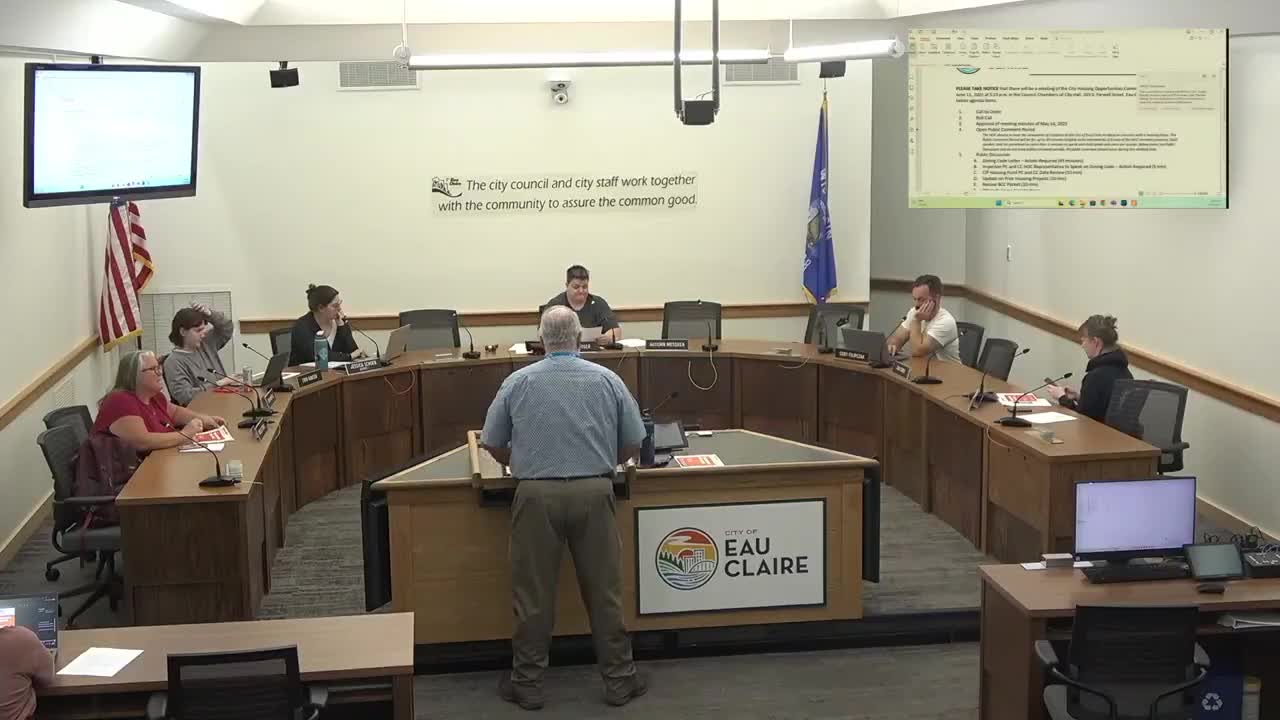
At its June 11 meeting the Housing Opportunities Commission (HAWK) discussed the City of Eau Claire’s Capital Improvement Plan (CIP) timeline, the flexible housing fund, and project updates for several large development efforts in the city.
City staff briefed commissioners that council amendments to the CIP were due June 13 and that adoption was scheduled for June 24. The commission was told a flexible housing fund line item currently includes a minimum allocation of $250,000; that fund has been used in the past to support projects recommended by HAWK but the City Council makes the final award decisions.
Commissioners reviewed last year’s RFP process and scoring rubric and noted that the evaluation matrix used previously assumed LIHTC (Low-Income Housing Tax Credit) project structures, which made non-LIHTC or smaller projects difficult to score competitively. Commissioners asked staff to circulate the previous RFP and matrix for HAWK review and recommended possible rubric revisions to better accommodate non‑LIHTC or smaller-scale proposals.
Staff summarized the last funding cycle: council originally split recommended awards between two projects; one project later declined to sign a contract and council reallocated the full award to a Hmong Association project. The commission discussed whether the flexible fund could be better targeted toward directly producing housing and debated the legal and program constraints on using the money (including fair‑housing and other statutory considerations).
The meeting also included updates on development projects: the Cannery District P& R properties (phase 1 occupancy achieved, phase 2 underway); the Paragon development (groundbreaking underway); the Prairie West project (first phases moving forward); Orchard Hills annexation activity; and residential units planned above the transit center. Staff reported that some projects include income-restricted units: the P&R properties set aside 20% of units at 80% CMI and a subset at 60% CMI; Paragon has about 25% set at 80% CMI and an additional share at 60% CMI. Staff also provided tax-increment financing (TIF) figures for major projects: the P&R project received $5 million in TIF assistance and guaranteed about $50 million in taxable value over 20 years; the Paragon/related projects guaranteed roughly $62 million in taxable value and together the two recent projects had approximately $11 million in TIF assistance (the staff summary said the projects collectively guaranteed roughly $120 million in taxable value over 20 years).
Commissioners asked for greater HAWK visibility in upcoming council and planning discussions, suggested a possible letter to remind council that HAWK exists to advise on housing policy, and proposed a future agenda item to revise the RFP and matrix before a new funding round. Staff agreed to send the prior RFP and scoring matrix to commissioners so the group can discuss changes at an upcoming meeting. Commissioners also discussed city‑owned infill lots that staff is evaluating for potential redevelopment and noted some TID (TIF) districts will reach the end of their term in coming years, which could free incremental revenue for housing if the district plans and statutes permit.
No formal funding awards were made at the meeting; commissioners directed staff to circulate materials and return the RFP/matrix for further discussion at a future meeting.