Get Full Government Meeting Transcripts, Videos, & Alerts Forever!
Get email alerts on the Downtown Development topic
No spam. Unsubscribe anytime.
Jacksonville councilors debate $45 million downtown incentive fund, seek balance with citywide needs
Summary
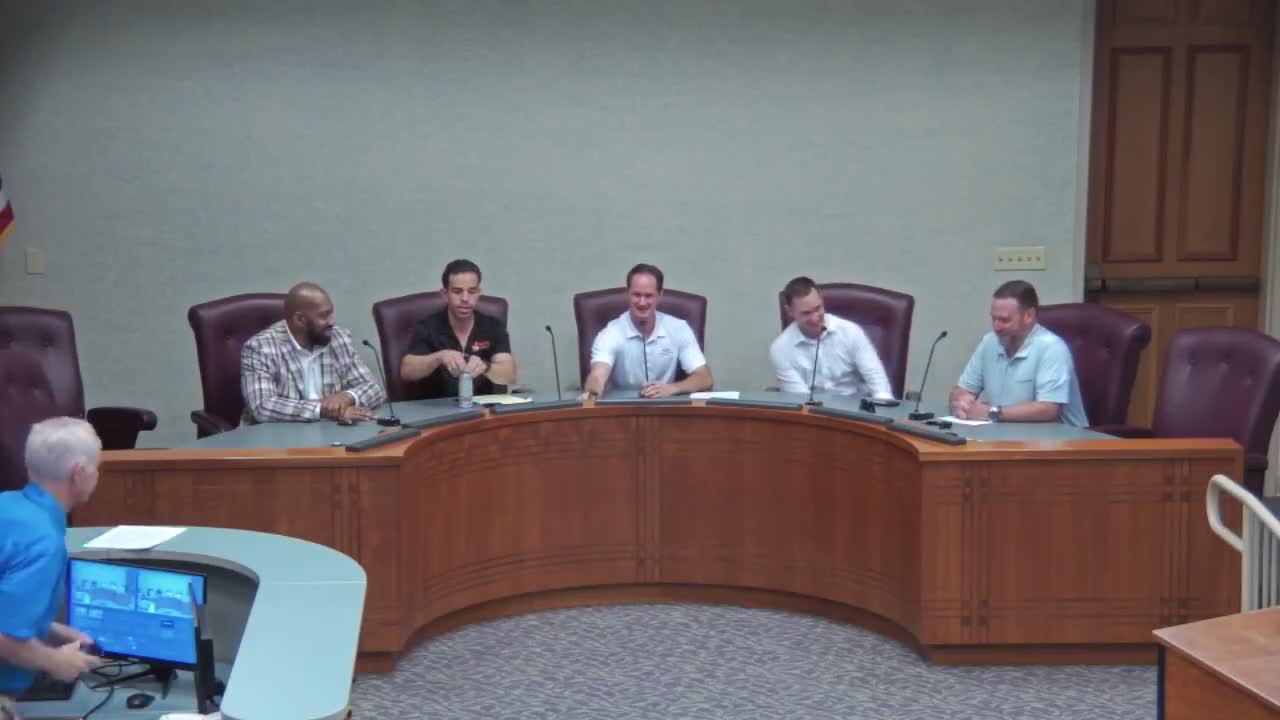
Council members at a Jacksonville City Council meeting discussed a bill to allocate $45,000,000 from a city self-insurance surplus to a Downtown Economic Development Fund to finance incentives for downtown projects, particularly on the riverfront.
Council members at a Jacksonville City Council meeting discussed a bill to allocate $45,000,000 from a city self-insurance surplus to a Downtown Economic Development Fund to finance incentives for downtown projects, particularly on the riverfront. The sponsor said the goal was to lay groundwork for committee consideration next week.
The bill sponsor, Councilman Joe Carlucci (District 5), opened the discussion saying "the goal for this meeting is just to, I guess, you know, talk about the $45,000,000 bill," and to let colleagues weigh in before the item goes to committee. Council members reviewed which downtown parcels would be eligible under a map Carlucci presented and debated whether to expand the geographic boundary to include Hogan Street, Laura Street and parcels near Birkman and the jail.
The proposal draws on a surplus in the city's self-insurance fund. City finance staff explained the fund's actuarial requirement and current balance: "the actuary says we have to have a $160,000,000 set aside for our workers' comp or workers' comp and general liability claims. We have 160,000,000. We are at, like, 220 basically right now," a finance official said, adding the proposed $45,000,000 withdrawal would leave operating cushioning in place and would not require mandatory replenishment. Staff also said investment earnings on the deposited funds would accrue to the Downtown Economic Development Fund.
Downtown Investment Authority (DIA) chief executive Elizabeth Boyer described how the money might be used for incentives. She said high-rise, steel-and-concrete towers of the sort developers have proposed typically require large "completion" grants and offered a ballpark: "the number I gave you, of 15,000,000 about per project is assuming we're Vista Brooklyn," and noted that smaller historic-rehabilitation (DPRP) requests are commonly in the $1 million to $5 million range. Boyer and others said DIA would underwrite projects and that the council would retain approval authority over fund disbursements.
Council members voiced a range of priorities. Some pressed to expand the map to include more of the urban core so existing historic buildings could receive gap financing and be rehabbed more quickly. Councilman Jimmy Peluso (District 7) urged that funds be available for historic core work, saying several parcels already have buildings that "can get work done on them" if incentives are available. Others, including Councilman Rockman Johnson (District 14), argued some funds should be reserved for citywide needs such as trade workforce development and community college facilities. Council members discussed earmarking parts of the $45 million for specific purposes: examples raised included a $10 million affordable housing fund, modest replenishment of a sports-and-entertainment trust fund, and multi-million-dollar awards to local institutions (FSCJ and JU) for workforce and catalytic projects.
On process, councilors and DIA staff agreed the typical sequence would require projects to first seek available TIF (tax increment financing) and DIA rev grants; if that funding proved insufficient, the completion grants from the proposed downtown fund would be considered. As Boyer put it, DIA money often covers "singles and doubles," while larger "home run" projects may need general-fund completion grants.
Council members also discussed alternatives to the $45,000,000 figure. Several suggested lowering the downtown allocation to around $30,000,000 and reserving $15,000,000 for countywide or other initiatives (workforce, DPRP, education). Councilman Carlucci said he would solicit specific amendment preferences and send a one-way communication summarizing the group's discussion to committee ahead of his absence.
Public comment included resident Wayne Wood, who urged attention to Laura Street, calling it "our new main Street," and urged councilors to devote funds to activating the historic core rather than only vacant riverfront parcels.
The sponsor indicated the bill will advance to committee next week (Neighborhoods; Finance; Rules) for more detailed consideration. No formal vote was taken at the meeting.