
Spring Hill staff proposes temporary halt on new sewer capacity letters amid plant limits
Get AI-powered insights, summaries, and transcripts
Subscribe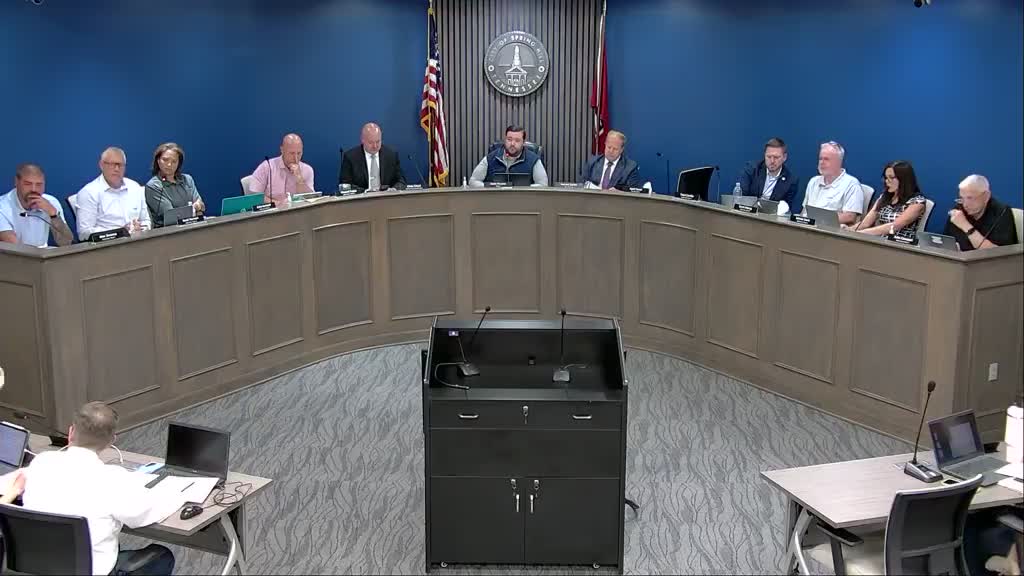
Summary
City staff presented a draft ordinance to temporarily stop issuing water and sewer capacity letters and require on-site alternative treatment for new by-right development while the city expands its water reclamation infrastructure.
Spring Hill Assistant City Manager and Spring Hill Water General Manager Dan Allen told the Board of Mayor and Aldermen on June 16 that staff is proposing a draft ordinance to suspend issuance of new water and sewer capacity letters until additional treatment capacity is available.
Allen said the city’s monthly influent flow analysis suggests the water reclamation facility is operating near capacity and that nearly 1,600 residential units currently under construction could add roughly 300,000–385,000 gallons per day of flow over the next 12 months. “We no longer are able to operate as staff to do the things that we feel need that we need to do because we don't have the appropriate authority in place to do it,” Allen said.
The proposed ordinance would: temporarily stop new sewer connections for projects that are not vested; set an outside date for the restriction through Jan. 1, 2030 (or earlier if specified infrastructure is completed); exempt one hospital facility deemed critical under state law; require by-right developments to use state-approved decentralized or on-site alternative sewer treatment systems that do not add effluent to the city plant; and direct staff to develop specifications and a stakeholder process within a 90-day timeline.
City Attorney Carter (referred to in the meeting as Mister Carter) and staff described the components that must be completed before reopening connections: expansion of the existing water reclamation facility, construction of an advanced purification facility and construction of a reservoir facility. When asked whether those three projects would be completed by Jan. 1, 2030, Allen said the city has a realistic plan and timeline based on recent property acquisition and design work but noted funding and scheduling remain variables.
Developers and local builders at the meeting warned of the financial stakes. Danny Claus, division president for D.R. Horton and part owner of Harvest Point, said many projects rely on existing capacity and that a sudden cutoff could strand millions of dollars of investment. “It affects a lot of jobs and a lot of businesses,” Claus said, urging the board to protect properties with vested rights.
Staff said they plan to protect vested and active projects that are in compliance and actively pursuing construction, and to identify projects that may be nearing expiration to determine whether previously allocated sewer or water capacity might be returned to the pool. Allen acknowledged some wording in the draft is loose and needs tightening to avoid confusion over terms such as “approved,” “vested” and “active.”
On administration and implementation, staff proposed a communications protocol to funnel developer questions through the communications director to avoid overwhelming development services staff, which is short-handed. Allen said staff will propose standardized specifications (likely modeled on neighboring jurisdictions) so the city does not face dozens of different on-site systems to maintain.
The board asked several procedural and policy questions: whether city projects would be subject to the ban (staff said the ordinance, as written, would apply to the city unless an exemption is added), whether alternative systems would later be connectable to the public system (staff said state law requires designs that allow future connection), and how costs to connect later would be allocated (staff said that would be addressed in project-specific agreements and that multiple financial tools exist).
The board did not vote on the draft during the work session; staff said they will refine the language, develop specifications and return with recommended standards and a stakeholder engagement plan.