Get Full Government Meeting Transcripts, Videos, & Alerts Forever!
Get email alerts on the Budget topic
No spam. Unsubscribe anytime.
Las Vegas Stadium Authority adopts FY 2026 budget, approves FY 2025 amendment and five‑year capital plan
Summary
The board adopted its fiscal year 2026 budget, approved a FY2025 budget amendment to reorganize room-tax flows and reserves, and accepted a nonbinding five‑year capital plan for football and baseball projects.
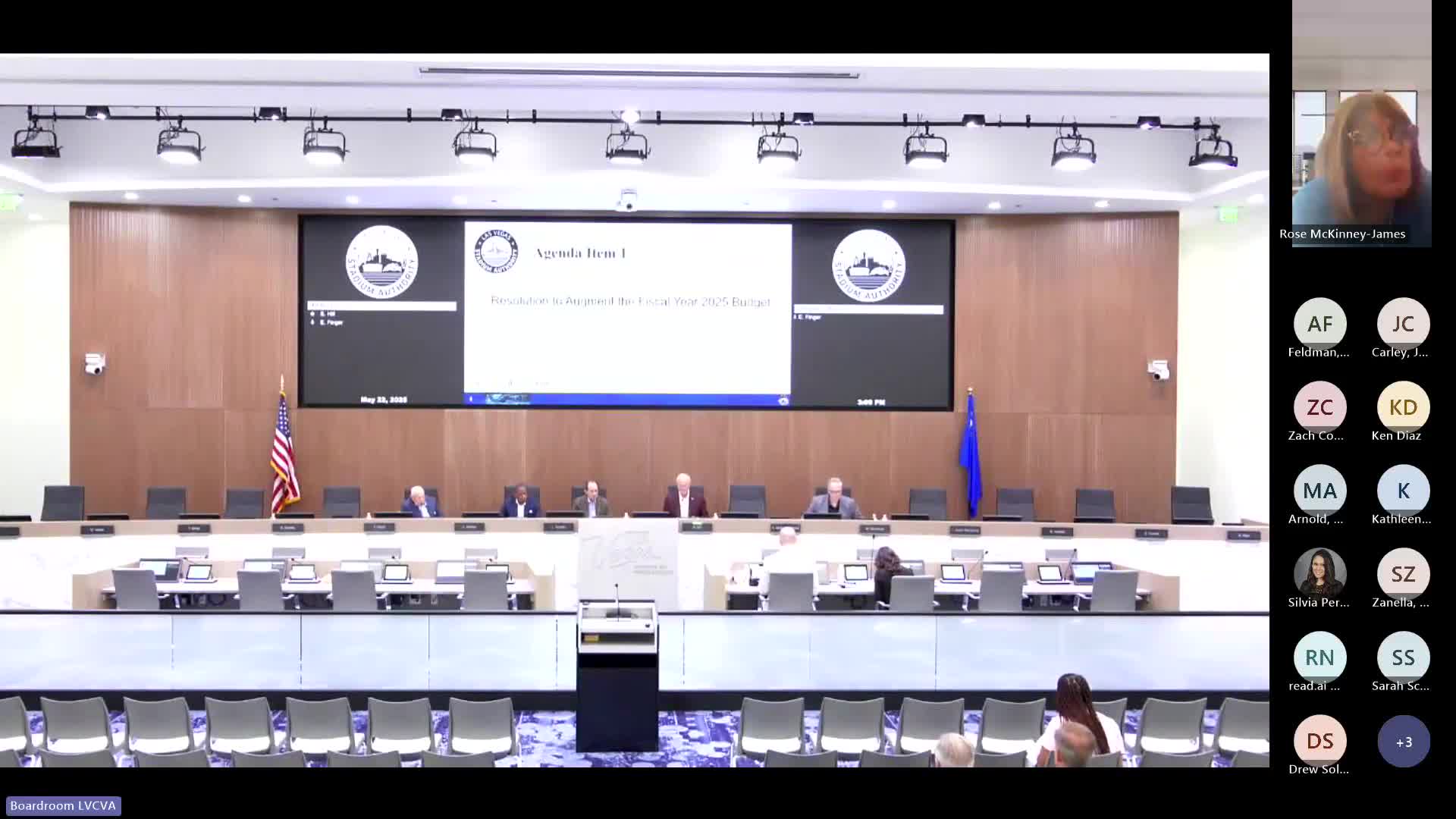
The Las Vegas Stadium Authority board on May 22 adopted its fiscal year 2026 budget, approved an amendment to the FY2025 budget and accepted a five‑year capital plan that lays out projected public contributions for the football and baseball stadium projects.
The actions set how room-tax and stadium-related revenues will flow through separate football and baseball accounts, reconfirmed a strategy to retain waterfall reserves for capital and debt, and established nonbinding multiyear capital projections for both Allegiant Stadium (football) and the planned baseball stadium.
Staff presented the budgets and the amendment. The FY2026 budget projects $62,000,000 in room-tax revenue for the football stadium stream and anticipates adequacy to meet debt-service transfer needs, roughly a $38,000,000 annual transfer for debt, authority operations and other statutorily allowed allocations. The staff presentation said room tax was down from a 2024 peak of $66,500,000 but performing above budget year to date.
The board approved a FY2025 amendment intended to simplify accounting: routing room-tax receipts and transfers into distinct funds (football debt service, UNLV transfers, capital, residual waterfall). That amendment also shifted accumulated reserves back into the waterfall residual fund so available balances are clearer for future capital or debt uses. Staff said the amendment also formalizes catch‑up payments to UNLV for timing shifts caused by COVID‑era cash flow, and budgets for initial baseball formation costs that the football fund has fronted.
On baseball, staff described the statutory waterfall for pre‑ and post‑bond SCID (Sports and Entertainment Improvement District) revenues. Staff estimated potential SCID receipts in the coming year of about $12,000,000 (described as “TBD” and dependent on several variables) and said the county chief financial officer would determine the eventual bond sizing based on projected SCID revenues and coverage requirements; staff noted a working bond-size estimate in the “ballpark” of $120,000,000, subject to interest-rate conditions. The presentation repeated previously stated figures: an overall baseball stadium project cost of $1,750,000,000 and a maximum public contribution capped at $380,000,000 under current law, with $180,000,000 in state transferable tax credits coming in up to five tranches tied to construction milestones.
Staff opened and closed the statutorily required public hearing on the FY2026 budget with no public speakers. The board voted to adopt the FY2026 budget and approve the related FY2025 amendment and five‑year capital plan as presented.
Board members asked clarifying questions about the bond-placeholder estimates, reserve levels and the accounting flows. Staff said the two‑times debt-service reserve requirement should be reached and that, if the board later approves use of the waterfall residual fund, staff would return with amendments to reflect that use.
The adopted FY2026 budget and the FY2025 amendment are intended to provide clarity in financial statements, maintain required debt reserves and preserve capacity for future capital projects tied to stadium operations.