Get Full Government Meeting Transcripts, Videos, & Alerts Forever!
Get email alerts on the Electric Vehicle Batteries topic
No spam. Unsubscribe anytime.
Assembly committee advances bill to require management, tracking and recycling of end‑of‑life EV batteries
Summary
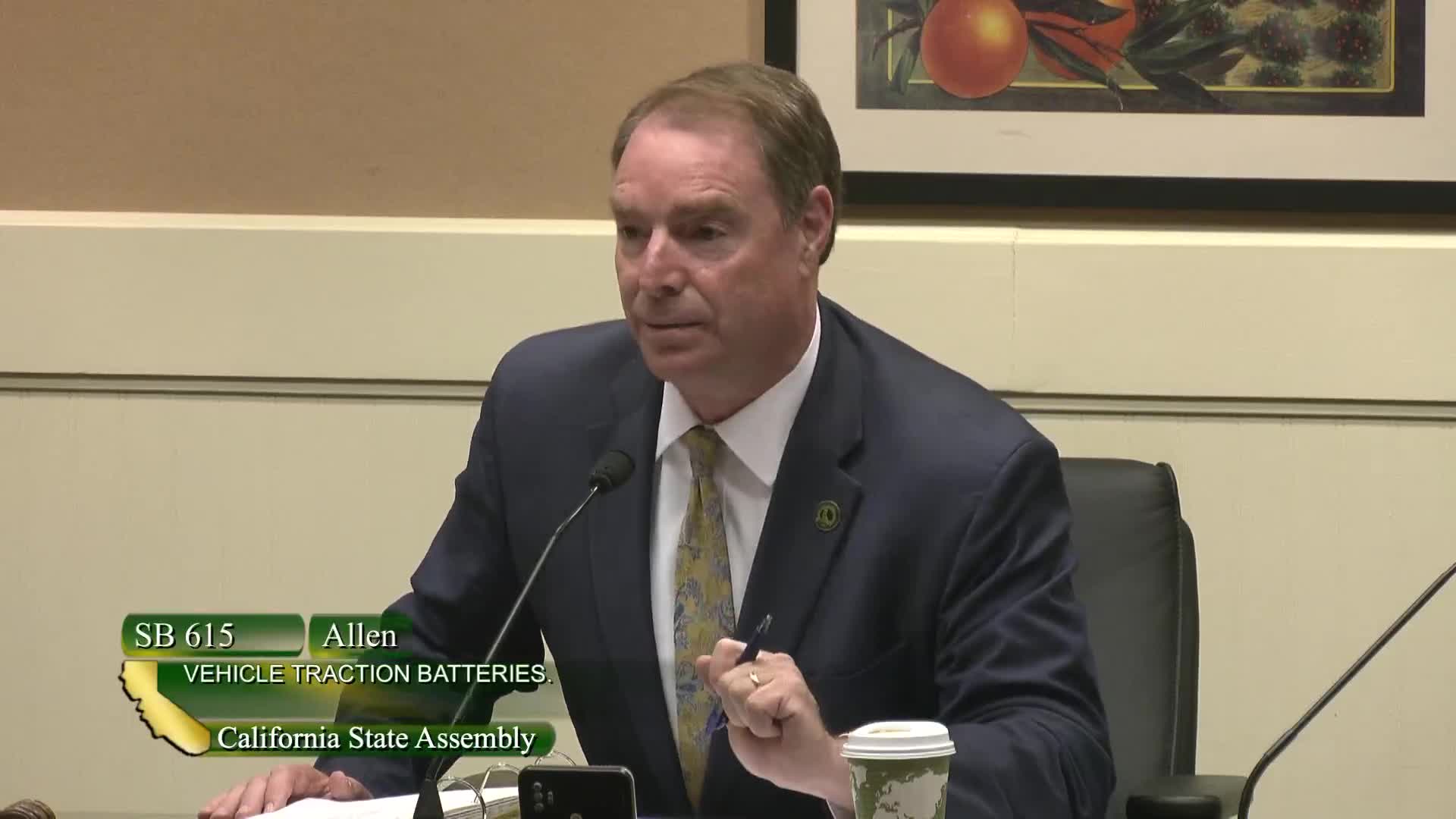
The California State Assembly Environmental Safety and Toxic Materials Committee on Monday voted 5–1 to send SB 615 to the Committee on Natural Resources, advancing legislation to create a state program for the collection, tracking, certification and recycling of end‑of‑life electric vehicle traction batteries.
The California State Assembly Environmental Safety and Toxic Materials Committee on Monday voted 5–1 to send SB 615 to the Committee on Natural Resources, advancing legislation that would establish a state program to manage end‑of‑life electric vehicle traction batteries.
The bill, presented to the committee by Senator Allen, would direct the Department of Toxic Substances Control to implement a program that emphasizes reuse, repurposing and recycling of EV batteries; require extended producer responsibility for battery suppliers; institute tracking and reporting requirements; and require DTSC certification of recyclers and standards for entities that remove batteries from vehicles.
Supporters said the law aims to head off an emerging hazardous‑waste problem as large numbers of electric vehicle batteries reach end of life. Daniel Bridal, speaking for the Union of Concerned Scientists, said SB 615 is meant to “get ahead of that wave” of battery retirements and praised three features in the bill: extended producer responsibility, tracking and reporting to prevent batteries “slipping through the cracks,” and DTSC certification of recyclers. Bridal said California’s EV market growth makes action urgent.
Jordan Wells of the California State Association of Counties said the state had more than 1,200,000 registered electric vehicles in 2023 and that household hazardous‑waste (HHW) facilities operated by local jurisdictions have begun receiving EV batteries. “The significant management costs of HHW continue to rise and are borne by local jurisdictions’ budgets and ratepayer fees,” Wells said, adding that when HHW facilities cannot accept materials due to lack of funding or infrastructure, it can lead to improper disposal including illegal dumping.
Senate staff and witnesses described how the bill would assign responsibility to producers and to entities that remove batteries from vehicles (for example, auto shops or dismantlers), while giving flexibility for batteries to be returned to manufacturers, sold for stationary‑storage reuse, or sold to certified recyclers. Senator Allen said the structure is intended to preserve reuse and repurposing when feasible while creating a producer responsibility backstop if market conditions change.
Industry and business groups voiced concerns. Representatives for Tesla, Rivian, the California Manufacturers and Technology Association and the California Chamber of Commerce registered opposition or “respectful opposition,” citing reasons outlined in written letters and concerns about burdens on smaller operators. Kasia Hunt of Nossaman said motorcycle and powersports businesses “are much smaller entities and therefore can’t take on the burden” proposed by the bill. Ford Motor Company and several recycling and environmental organizations testified in support.
Committee members questioned current recovery rates and practical distinctions between reuse, repurposing and recycling. During the hearing a committee member noted a low existing recovery rate, stating that roughly 15% of EV batteries are being recycled in California today. Supporters and the author said the bill’s tracking, reporting and certification provisions are intended to raise that rate while protecting workers and communities where recycling occurs.
Committee discussion also touched on the role of a producer responsibility organization (PRO). Senator Allen and members said they plan further conversations with the governor’s office and industry to refine the bill’s PRO provisions and implementation details. The committee also noted the bill does not contain an urgency clause.
The committee recorded a final vote of 5 yes and 1 no to pass SB 615 to the Committee on Natural Resources; the record shows Assemblymember Connolly, Assemblymember Bauer‑Kahan, Assemblymember Lee, Assemblymember McKinner and Assemblymember Pappen voting aye and Assemblymember Castillo voting no. The committee left the role open for absentee members and indicated additional conversations with stakeholders and the governor’s office would continue before further action.