Get Full Government Meeting Transcripts, Videos, & Alerts Forever!
Get email alerts on the Homelessness topic
No spam. Unsubscribe anytime.
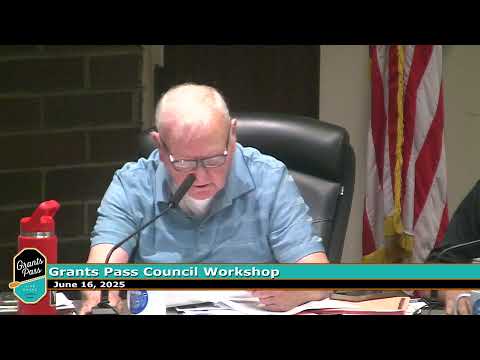
Grants Pass council sets 150‑bed minimum, narrows grant language and sets $1.2M ceiling for homelessness program
Summary
Grants Pass council on Monday set core parameters for a homelessness grant program intended to support a managed, low‑barrier shelter: a 150‑person minimum capacity (managed 24/7), ADA compliance at full operation, a five‑year plan horizon and a practical funding ceiling of roughly $1.2 million, with council reserving discretion to consider larger awards in exceptional cases.
Grants Pass City on Monday refined a draft homelessness grant program, setting program requirements and evaluation criteria designed to help replace unsanctioned “resting sites” with a managed, low‑barrier shelter capacity.
What the council decided: Councilors landed on a minimum operational shelter capacity of 150 people, to be managed 24/7 with ADA accessibility requirements met at the point the shelter is “fully operational.” Council removed a hard maximum capacity from the grant language but asked applicants to explain any higher capacity requests. The council also directed staff to keep low‑barrier language in the documents but to avoid an overly prescriptive definition; applicants who provide optional on‑site programming or concrete referral partnerships (housing assistance, addiction recovery, mental‑health services, employment services) will score higher in the selection rubric.
Why it matters: The program is intended to create an organized, monitored alternative to informal camps and sleeping sites in the city and to provide a pathway into services. Council emphasized minimizing city operational involvement while requiring reporting, accountability and contract provisions that allow the city to recoup funds or take property interest if award conditions are not met.
Key program details and council direction - Minimum capacity: Council set 150 as the minimum capacity the city expects the funded project to serve. That number was tied in the discussion to a judicial requirement referenced by staff as part of closure planning for existing sites. - ADA compliance: Applicants must demonstrate ADA accessibility at the time the site is fully operational (staff recommended verification upon full operation rather than as an early milestone). - Low‑barrier site: The grant will expect “low‑barrier” entry (no requirement for ID, credit checks or sobriety to enter) but the program will not prescribe detailed operational rules; shelters may adopt conduct or sanitation rules and will be scored higher if they provide on‑site services or formal referral partnerships. - Location/zoning: Council removed a strict limitation to specific city zoning districts and agreed not to preclude sites that meet state statutory criteria. Applicants must disclose site zoning and explain how the location takes into account reasonable separation from sensitive uses (schools, day‑cares, playgrounds, residential neighborhoods and the Central Business District), access to supportive services (transit, food, medical) and avoidance/protection plans for environmentally sensitive areas. - Timeline and procurement: Key dates in the draft program include a final posted responses date for questions (July 14), an “intent to award” and protest period (7 days), and execution of the final grant agreement targeted for Aug. 15. Council confirmed a maximum of six months to become fully operational is the cap in the documents but that faster startup should receive higher scores. - Planning horizon: Applicants should provide a five‑year operational plan (council reduced the earlier 10‑year request to five). - Scoring and evaluation: Staff presented a scoring rubric where narrative responses form 60 points of the review, budget and financial information 15 points, memoranda of understanding 10 points and letters of experience 15 points. Location‑related questions were given additional weight in the revised draft. - Funding ceiling: Council chose a hybrid approach: staff will include an illustrative ceiling in the RFP to guide applicants and set approximately $1.2 million as a practical ceiling for initial awards, with language that council may consider larger requests under exceptional and well‑justified circumstances. Staff said the figure was informed by recent operating costs the city had incurred for temporary resting sites and the desire to provide a realistic procurement target.
Legal/authority note: Staff read ORS 197.783 aloud and advised council that state law provides for a statutory pathway allowing emergency shelters to operate in additional zones if certain operator qualifications (experience, partnerships, public/nonprofit status) are met. Council instructed staff that the grant should be framed to require applicants to demonstrate compliance with local and state requirements.
Next steps: Council scheduled formal action on the grant program for the council meeting on June 18 and directed staff to post the revised draft grant documents, publish a question/answer appendix (with answers posted by July 14) and return with final contract language that includes monitoring, reporting and recoupment provisions.
Ending: Staff will incorporate council edits, publish the revised RFP and return with the final contract and scoring materials for council consideration on the June 18 agenda.