
Residents urge Arlington to cut ties with Virginia Israel Advisory Board; board says state-level decision
Get AI-powered insights, summaries, and transcripts
Subscribe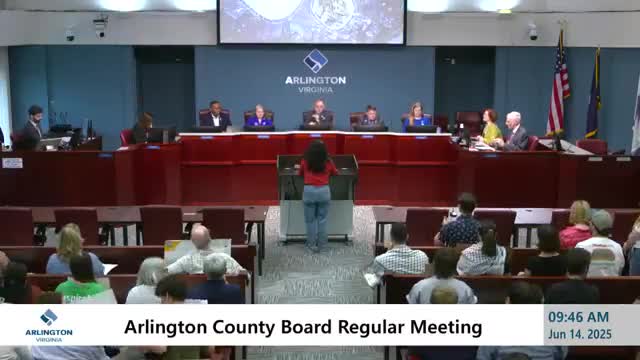
Summary
Dozens of residents used the Arlington County Board public-comment period on June 14 to urge the county to stop doing business with the Virginia Israel Advisory Board (VIAB) and to investigate ties between local economic development efforts and Israeli companies.
Dozens of residents used the Arlington County Board public-comment period on June 14 to urge the county to stop doing business with the Virginia Israel Advisory Board (VIAB) and to investigate ties between local economic development efforts and Israeli companies.
Speakers repeatedly said VIAB directs taxpayer-supported investment to Israeli companies, including those tied to weapons manufacturers and settlements, and asked the board to prioritize local programs instead. "Israel is a foreign country. Israel is the only foreign country that has an advisory board here in Virginia that is taxpayer funded," said Kishore Mahulikar. "This means that taxpayer money either directly or indirectly is diverted away from Virginians and Arlingtonians to fund Israeli business interests and lately their weapons interests."
Why it matters: Speakers linked VIAB and some private companies to military contractors and urged the county to stop public partnerships that, they said, channel public funds to firms implicated in human-rights abuses in Gaza. Alex Ortiz, an atmospheric scientist, said the spending conflicted with Arlington's climate goals: "How can we claim to be a national leader in responding to climate change when our city funds the very entities that destroy our environment?" Several speakers also connected Arlington Economic Development (AED) programs and individual company contracts to companies with Israeli ownership or partners.
County response: Chair Takis Karantonis told speakers that VIAB is a state-level body and that action on its funding lies with the Virginia General Assembly and the governor. He said Arlington engages with many international economic-development partners and does not apply a political filter when promoting local investment. "This is an issue that, you have to take with other members of the general assembly, the governor of Virginia, etcetera," Karantonis said. "I have an opinion as a person, but not as an elected official in Arlington." County staff and the county manager also noted that economic-development staff operate under the county's ethics rules and that complaints about individual staff conduct can be reported to a fraud, waste and abuse hotline.
Calls for oversight and transparency: Speakers asked for clearer disclosure of AED's vetting and community input processes, and for a mechanism to flag county contracts that have ties to foreign entities whose activities residents deem objectionable. One commenter who identified concerns about a school-system solar contract asked the county to examine vendor relationships: "I do urge going forward that the county more closely examine the relationships the businesses or the companies it does business with have with foreign entities," said a speaker identified as Ryan N.
Board next steps and limits: Board members and staff told speakers the county can review its own contracting and engagement practices and invited specific, named concerns for staff to investigate. But they reiterated that state-level policies and the existence or funding of VIAB are outside county control. The board liaison to AED offered to meet with speakers who asked for greater transparency.
Ending: Residents pressed for immediate policy changes and for the county to prioritize local services and programs over the economic relationships they criticized. Board members encouraged petitioners to provide specific evidence and cited the standard channels — Open Door Monday, written submissions and formal complaints — for follow-up.