Get Full Government Meeting Transcripts, Videos, & Alerts Forever!
Get email alerts on the Higher Education Scholarships topic
No spam. Unsubscribe anytime.
Committee hears overview of Hathaway, Wyoming Works and Wyoming’s Tomorrow scholarships
Summary
LSO and Department of Education staff briefed the Joint Education Committee on Hathaway scholarship tiers and funding structure, and on Wyoming Works and Wyoming’s Tomorrow program rules, eligibility, and recent appropriations. Members requested further data on coverage of tuition and fees and asked departments for follow-up reports.
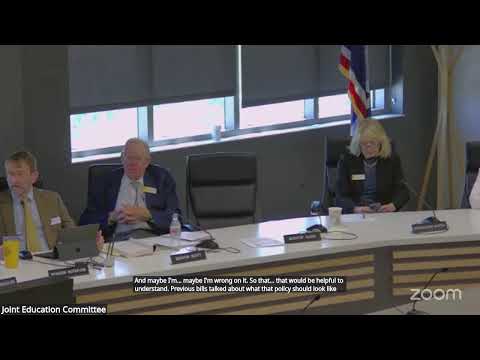
Legislators at the Joint Education Committee on May 29 heard a statutory and program overview of Wyoming’s higher-education scholarship programs, including the Hathaway Scholarship, the Wyoming Works grants and the Wyoming’s Tomorrow endowment-backed scholarship.
Ashley Phillips, legislative editor with the Legislative Service Office, told the committee, “Today, we will be giving you a brief overview of the Hathaway program, the Wyoming Works program, and the Wyoming's Tomorrow program,” and then reviewed scholarship tiers, funding sources, and eligibility rules.
The Hathaway program remains structured around four merit tiers—honors, performance, opportunity and provisional opportunity—with awards paid for up to four semesters at the originally enacted per-semester award levels and a statutory need-based supplement. Bradley Barker of the Department of Education told the committee the highest Hathaway award now covers “right around 62%” of university tuition and fees under current tuition levels.
Phillips summarized Wyoming Works student and programmatic grants and their dollar limits relative to Hathaway tiers, and described Wyoming’s Tomorrow as an endowment-funded scholarship for adult learners age 24 and older with a $50 million endowment threshold that was reached in 2024. She noted temporary “Kickstart Wyoming’s Tomorrow” appropriations used while the endowment reached its threshold.
Committee members pressed for follow-up data. Senator Scott asked for the percentage of tuition and mandatory fees covered by the honors level compared with earlier years; Senator Office asked that staff calculate the scholarship’s coverage of tuition plus mandatory fees rather than tuition alone. Barker said the Department could supply figures quickly. Members also asked the Community College Commission to provide enrollment and award-volume figures for the Wyoming Works and Wyoming’s Tomorrow awards when they present later in the interim.
The presentations highlighted that Hathaway award amounts have risen only infrequently since the program’s start, while tuition and fees have climbed, and lawmakers asked LSO and agency staff for analyses showing: (a) current scholarship coverage as a percent of tuition plus mandatory fees, (b) historical coverage comparisons to the program’s early years, and (c) the effect of allowing more flexible use of scholarship dollars across credit loads and time windows.
Ending: Committee members asked staff to return with the requested coverage and utilization data and the Community College Commission to provide additional enrollment and award-volume figures at a later presentation.