Get email alerts on the Vhr Code Of Conduct topic
No spam. Unsubscribe anytime.
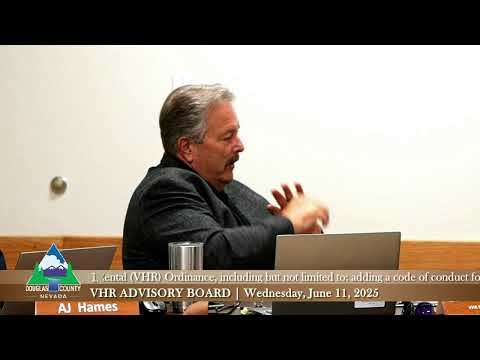
Douglas County panel debates VHR code of conduct language, enforcement and posting rules
Summary
Members of the Douglas County VHR advisory group debated a proposed code of conduct for short-term rental permit holders, focusing on smoking (including marijuana), outdoor fire pits, who must post the rules, and how enforcement would work via owners, property managers and county staff.
The Douglas County VHR Advisory Board discussed a draft code of conduct for vacation/home rentals that would require permit holders to post household rules, limit behavior that negatively affects neighbors, and clarify enforcement responsibility among owners, property managers and county code enforcement.
Board members and staff said the code would be intended as a tool to reduce nuisances such as smoke, noise and unsafe fire use while preserving owners' discretion over house rules. Douglas County staff described the draft as an example that permit holders could adapt for each property rather than a single county-authored document.
“This was born out of a conversation with a commissioner, related to past comments ... about inappropriate hats, urination off decks, pot smoke, wafting around properties and to name a few things,” Douglas County staff member Ernie Strehlow said, explaining the ordinance language's origin and the enforcement challenges that prompted the board to consider a formal code.
Members debated precise wording. Several said the county should target behavior that actually harms neighbors rather than broadly banning particular lawful activities. “To me, the specificity of that 1 ... smoking of anything,” board member Lauren Romaine said, “because it could be a cigar. It's people are out there having a cigar party, and the neighbor thinks that that's obnoxious. So I don't think we should limit it to 1 specific thing.”
On marijuana, the board moved away from wording that would have prohibited “consuming marijuana” inside a rental and instead focused discussion on the effect of smoke or odor on nearby residents. “So smoking of anything,” Romaine said, summarizing the shift in language the group favored.
Fire safety and outdoor fire pits drew sustained questioning from members and the fire district. Fire representative Bryce told the group that wood- or charcoal-burning pits require permits and inspections in the Tahoe area and are often disallowed for VHRs; by contrast, propane appliances listed to UL standards typically have different rules. He said open flames also trigger heavy public concern on high fire-danger days and can prompt fire department responses.
Board members also discussed how enforcement would operate in practice. Staff said the code of conduct would be a tool the county would use along with existing penalty provisions: the owner or property manager would be expected to supply and enforce a posted code of conduct and to make a “best effort” to ensure renters know and follow it. Strehlow described a likely procedure: a neighbor files a complaint, code enforcement contacts the permit holder or manager and asks to see the posted code of conduct and proof renters received it.
Patty Graff warned that mandating a county-drafted code could shift enforcement burden from property managers and owners to county staff. “It seems like if we put this in, we're taking responsibility out of the homeowner and the property management company to enforce it and putting the enforcement on you, the code enforcement,” Graff said.
The board discussed several compromises. One option advanced by members would require permit holders to maintain a locally tailored code of conduct, post it prominently near the property's permit, and consider certain items (for example, rules on smoke and fire) rather than strictly mandating every listed prohibition. Strehlow noted that posting the permit and any code near the entrance helps sheriff deputies and code officers confirm compliance during inspections.
The board directed staff to rework the code of conduct language to reflect members' input and return with a revised draft. Strehlow and staff said they would prepare a revised version for the board's next meeting that narrows language on smoke, clarifies fire-pit rules to align with fire district practice (distinguishing permitted propane appliances from wood or charcoal fires), and sets a posting requirement near the permit.
The revised draft will be reviewed by the advisory board before the county presents ordinance language to the Board of County Commissioners.
AI generated
The text on this page is AI generated. Summaries, highlights, analysis, and video transcripts are all produced from the original source material.
AI can make mistakes, so if you spot one, and we will fix it for everyone.
Note: the source content is unaltered by us. Any content source we link to, be it a video, an audio recording, or a document, is presented exactly as its publisher released it. That publisher is usually a government body, sometimes an individual official or another organisation.