Get Full Government Meeting Transcripts, Videos, & Alerts Forever!
Get email alerts on the Environment And Natural Resources topic
No spam. Unsubscribe anytime.
Minn. House passes environment, natural resources appropriation after rejecting aquifer exemption amendment
Summary
The Minnesota House passed Senate File 3, an environment and natural resources appropriations and policy bill, 105-26. An amendment to allow limited new irrigation permits from the Mount Simon–Hinckley aquifer outside the seven-county metro failed 41-87.
The Minnesota House of Representatives passed Senate File 3, an environment and natural resources appropriation and policy bill, on a 105-26 roll-call vote after rejecting an amendment that would have allowed limited new agricultural irrigation permits from the Mount Simon–Hinckley aquifer outside the seven-county Twin Cities metropolitan area.
Representative Nisga moved to suspend the rules under Article IV, Section 19 of the Minnesota Constitution so Senate File 3 could receive additional readings and be placed on final passage; that motion prevailed by voice vote. The clerk then read Senate File 3, described in the roll as "an act relating to state government, appropriating money for environment and natural resources."
The bill combines appropriations to the state agencies that handle parks, water, pollution control and soil resources with policy changes, including a large permitting-reform package and a mix of general‑fund and dedicated environmental fund spending. Representative Purcell, the co-vice chair (acting co-chair) of the House Environment Committee, described the measure as a bipartisan, bicameral compromise, saying, "when you compromise, that means everyone's unhappy," and urging members to support funding to keep the Department of Natural Resources, the Minnesota Pollution Control Agency and the Board of Water and Soil Resources running.
Representative Heintzeman, the committee co-chair, also credited conferees and the Senate author for work on permitting reform and said the package reflected months of negotiation. Heintzeman highlighted provisions members supported, including community grant language, extended crossbow use for another year with an accompanying study, a veterans hunting and fishing license fee reduction for certain veterans and changes addressing abandoned watercraft.
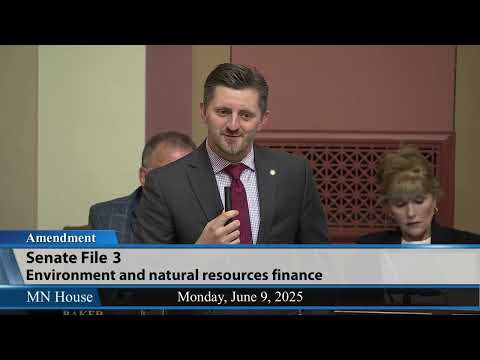
Members debated floor amendments. Representative Gordon offered Amendment A3 to allow the Department of Natural Resources (DNR) to make exceptions to a 2021 prohibition on new water‑use permits from the Mount Simon–Hinckley aquifer for agricultural irrigation outside the seven‑county metro when no other feasible water source exists and when the applicant presents a water‑conservation plan. Gordon said the change was needed so a multigenerational Christmas tree farm in her district could irrigate newly planted areas.
Representative Heintzeman said the aquifer provision was not part of the global conferee agreement and asked members to vote no on the amendment. Representative Schultz urged support for Gordon's amendment, saying the 2021 change had unintended consequences for multiple parts of the state and that the amendment would "help ensure more trees for the state of Minnesota." Representative Purcell asked members to defer the change to a future year and vote no. The roll call on Amendment A3 closed at 41 ayes and 87 nays; the amendment was not adopted.
On the underlying bill, Representative Schultz—who opposed final passage—said he supported portions of the package such as permitting reforms but opposed the bill because it contains fee increases he said would disproportionately affect small family farmers who hold water permits. Schultz said those producers told him the changes could mean "hundreds of dollars of increases for the smallest producers" and that the DNR had not explained corresponding benefits for those permit holders.
The clerk closed the final roll call at 105 ayes and 26 nays, and the bill passed; the clerk also recorded that the bill's title was agreed to. Following passage in the House, Senate File 3 will proceed through any remaining steps required under the Legislature's process toward enrollment and transmittal to the governor.
Votes at a glance
- Amendment A3 (Gordon): failed 41–87; would have allowed DNR exceptions to the Mount Simon–Hinckley aquifer prohibition for agricultural irrigation outside the seven-county metro when no feasible alternative water source exists and with a required water conservation plan. - Senate File 3 (environment and natural resources appropriations and policy): passed 105–26; includes appropriations to DNR, Minnesota Pollution Control Agency and Board of Water and Soil Resources, permitting reform, community grants, changes to hunting/fishing rules and other policy provisions.