Get Full Government Meeting Transcripts, Videos, & Alerts Forever!
Get email alerts on the K12 Education Finance topic
No spam. Unsubscribe anytime.
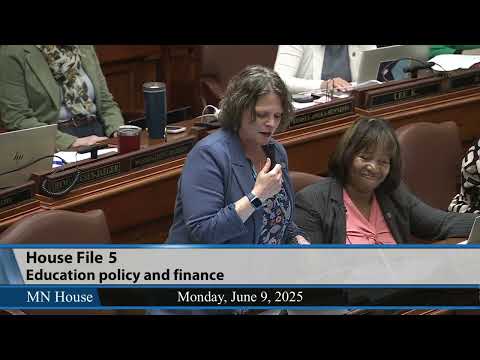
Minnesota House passes K-12 education finance and policy bill, House File 5
Summary
The Minnesota House passed House File 5 on a 97-36 roll call, approving changes to K–12 finance and policy that index the general education formula to inflation and include program changes and targeted reductions to meet a joint budget target.
The Minnesota House passed House File 5, a K–12 education finance and policy bill, by a 97-36 vote after members suspended House rules so the measure could receive final consideration.
The bill, described on the House floor as a product of a bipartisan, bicameral working group, indexes the general education formula to inflation — providing a 2.74% increase in 2026 and 3% in 2027 — and includes a mix of program investments, one-time grants and targeted reductions to meet the Legislature’s joint budget targets.
“This is a K through 12 education finance and policy bill that we’ll be considering today,” Representative Yu Hakim, the bill’s author, told members as he described the package as the result of multi-day negotiations. He said indexing “really brings stability to our school districts’ budgets” and noted the bill preserves several House priorities while accommodating spending targets agreed with the Senate.
Why it matters: lawmakers said the bill provides two years of funding certainty for school districts while also reflecting difficult budget tradeoffs. Sponsors repeatedly framed the measure as an effort to protect classroom spending where possible while meeting a requirement to reduce projected spending in later years.
Key provisions - Indexes the general education formula to inflation, raising the formula by an estimated 2.74% in 2026 and 3% in 2027. - Preserves investments the sponsors highlighted: consolidation aid, compensatory revenue measures, inclusion of roofs in long-term facilities maintenance levies, nonpublic pupil aid, a special education teacher apprenticeship program (at reduced dollar levels), and one-time grants included under the READ Act. - Adds appropriations to cover Minnesota Department of Education (MDE) legal costs and fraud-detection efforts, and accepts several Senate-origin items brought into the working group, including compensatory revenue hold-harmless provisions, electronic library grants and grants for school cardiac emergency response plans. - Creates two working groups transferred from the Senate: one to study when students should receive developmental services and another to examine exemptions to the ban on seclusion for K–3 students; it also establishes an advisory committee on dual-language immersion within the READ Act.
Cuts and tradeoffs Lawmakers said the package was negotiated to meet joint targets that required reductions in later years (“in the tails”). Sponsors described roughly $420 million in “tails” cuts the working group absorbed to secure agreement. They said reductions include: - A roughly $350 million reduction concentrated in special education-related spending if the new Blue Ribbon Commission does not identify equivalent savings before the 2028–29 biennium; sponsors said the commission’s charge accounts for about $250 million of the cuts in the tails. - Immediate reductions totaling about $71 million to other school-related programs, including cuts to student support personnel aid, decreased special education transportation reimbursement (moving toward 90% in 2027, down from prior levels), a reduction in supplemental school lunch aid (from 12.5 cents to 6.25 cents in the tails) and elimination of telecommunications access aid. - A reduction in the charter school tuition billing aid from 10% to 6% of the remaining cost difference between charter and home districts, according to floor remarks.
Policy and accountability changes The bill includes language that sponsors said strengthens grant oversight and allows MDE to terminate grant agreements for nonprofits that fail to meet tax-exempt, reporting or registration requirements while also allowing corrective plans in some cases. Policy provisions in the READ Act portion emphasize foundational literacy and the science of reading as state policy and redirect some contracted curriculum-review work away from the contractor described in the bill.
Lawmakers’ floor debate Supporters described the measure as a compromise that protects core school funding and local control under difficult budget constraints. Representative Kreisha, a co-chair of the working group, said: “This bill is the canary in the coal mine for schools,” urging attention to longer-term fiscal pressures including rising special education costs.
Critics on the floor warned the cuts will be felt in classrooms. Representative Bakeberg said the reductions will lead to fewer teachers and services and that some school employees already face layoffs; he said agencies are receiving increased operating adjustments while districts face cuts.
Formal action The House first agreed to suspend the rules under Article 4, Section 19 of the Minnesota Constitution so the bill could receive all readings and final passage the same day. After discussion and floor debate, the clerk closed the roll and announced the bill passed 97–36. The clerk then reported the bill’s title agreed to.
Next steps The House vote completes the chamber’s passage of House File 5; the bill’s subsequent procedural path is not recorded in the provided transcript.
Ending The bill’s sponsors urged swift implementation and additional work next session to address mandate relief, funding flexibility and special education cost growth; on the floor, members also thanked staff and negotiators for the working-group process.