Get Full Government Meeting Transcripts, Videos, & Alerts Forever!
Get email alerts on the State Tax Policy topic
No spam. Unsubscribe anytime.
Minnesota House passes 2025 tax bill, House File 9, 93-39
Summary
The Minnesota House of Representatives passed House File 9 on final passage by a roll call of 93 ayes and 39 nays after suspending rules to advance the tax bill for immediate second and third readings.
ST. PAUL — The Minnesota House of Representatives passed House File 9, a 2025 tax bill, on final passage by a roll call of 93 ayes and 39 nays after the body suspended its rules to permit immediate second and third readings.
Representative Greg Davids (R-Fillmore), author of the bill, described the package on the floor and urged support. "The moment you've all been waiting for, the 2025 tax bill's name is from a Beatles song, we can work it out. And we were very, very successful in that quest. We we did work it out," Davids said as he summarized major provisions.
The bill makes several revenue and policy changes highlighted by the authors and committee chairs: repeal of a sales-tax exemption for electricity sold to data centers (estimated to raise about $125 million), an increase in the gross-receipts tax on cannabis from 10 percent to 15 percent (estimated at $146 million), establishment of a refundable research-and-development (R&D) credit (budgeted at about $80 million), and a technical correction for sustainable aviation fuel that permits carry-forward of some funds. Sponsors said the bill did not reduce local government aid (LGA), county program aid (CPA) or payments in lieu of taxes (PILOT/PILT).
"I think it was a good choice for us to repeal the electricity exemption for data centers," said Representative Fuea Gomez (D‑Hennepin), co-chair of the tax committee, who also warned that making an R&D credit refundable is a risky design choice and said the committee limited its growth.
Lawmakers also described smaller or targeted changes: a cut to aquatic invasive species aid and a 10 percent reduction to sustainable forest initiative payments (sponsors said the reduction should not break existing contracts with landowners), forgiveness of an LGA penalty for the city of Stuart, and a provision tied to employer student-loan repayment for certain critical access dental clinics. Representative Davids and chair Gomez said the bill contains a fraud restitution fund provision developed by Representative Lee Kaye (D‑Ramsey) intended to compensate Minnesotans scammed by fraudsters; Lee Kaye referenced estimates that Minnesotans lost at least $120 million to fraud last year.
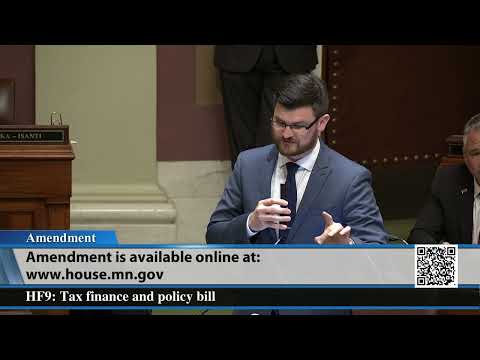
Representative Tim West (R-Anoka) offered an amendment (825-0098) that would have placed a sunset on the 50 percent increase to the cannabis tax, arguing higher taxes encourage an illicit market and harm businesses selling THC beverages and related distributors. West withdrew the amendment on the floor, saying he had concluded it would not pass this year.
Debate reflected the chamber's partisan split. Several Republican speakers framed the bill as a restraint on tax increases and emphasized fiscal discipline and reduced government spending; Representative Niska (R-Anoka) moved to suspend the rules to advance the bill and urged members to support it so the House could finish work. Representative Robbins (R-Hennepin) and Representative Weiner (member from Tod) said the package missed opportunities to deliver tax relief to small businesses, seniors and veterans.
Democratic members said the bill contained useful provisions but criticized refundable corporate tax benefits and said the Legislature could have raised more revenue from large corporations to fund services such as property-tax relief and direct taxpayer assistance. Representative Lee Kaye said she supported the bill despite flaws, noting the fraud restitution fund and other district-specific provisions, but said she was disappointed the bill did not raise more revenue from wealthy corporations.
Procedural steps included a motion by Representative Niska (R-Anoka) under Article IV, Section 19 of the Minnesota Constitution to suspend the rules so House File 9 could receive immediate second and third readings; the motion prevailed by voice vote and the clerk reported the bill for second reading. After debate and the withdrawal of the West amendment, the clerk called the roll for final passage; the clerk announced, "There being 93 ayes and 39 nays, the bill is passed and its title is agreed to." A recorded remote vote by a member identified as Olsen was logged as "aye" in the record during the roll call sequence.
The bill returns to the enrolling process and then to the governor for signature or veto. The House discussion cited House File 1, taken up earlier in the special session, during debate as context for tax and budget decisions but House File 9 is a separate measure.
Votes at a glance
- House File 9 — Final passage: Passed 93–39 (roll call).