Get Full Government Meeting Transcripts, Videos, & Alerts Forever!
Get email alerts on the Energy Policy topic
No spam. Unsubscribe anytime.
Minnesota House passes energy bill after debate over weatherization cuts and clean-energy priorities
Summary
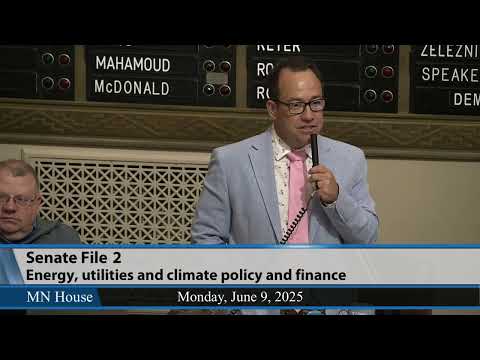
The Minnesota House passed Senate File 2, an energy omnibus bill, on a 90-41 roll call after members debated weatherization funding cuts, additions for securitization and data-center provisions, and broader clean-energy strategy.
The Minnesota House of Representatives passed Senate File 2, an omnibus energy bill, by a 90-41 roll call after about 30 minutes of debate that centered on a $4 million biennial cut to weatherization funding and the scope of state support for renewable and alternative energy strategies.
Representative Emma Acum, the bill author from Hennepin County, told the House that the bill "did include some bipartisan and noncontroversial policy provisions," and said conference committee changes preserved many prior gains while also requiring a budget cut that reduced weatherization funding by $4,000,000 per biennium.
The bill includes provisions to appropriate and transfer money for energy and renewable development accounts, extensions for previously appropriated projects (including a Saint Thomas microgrid and a rooftop solar array at the National Sports Center), changes to program definitions such as low-income eligibility for the Home Energy Assistance Program, and additions to make tribal nations eligible for geothermal planning grants. The bill also incorporates a securitization provision intended to let utilities spread extraordinary costs over time to reduce immediate rate shocks.
Opponents and supporters framed the measure differently. Representative Joe Swazinski of Lyon County said the legislature "swung and missed an opportunity" to let markets drive clean-energy investment and criticized the bill for not removing what he called barriers to market-led energy solutions. Representative Andrew Quam of Olmsted County said the bill "doesn't" reflect long-range planning for siting solar and argued for investment in hydrogen; he concluded, "I'm voting no." Representative Sarah Kraft of Hennepin defended the bill as "simple" and said it defends Minnesota's 2040 clean-energy law while lamenting missed opportunities for larger investments in green hydrogen, geothermal and other projects.
Representative Mark Igoe of Itasca highlighted a technical change in the bill to the state Competitiveness Fund intended to allow the fund to be used to secure federal dollars, a change he said could help Minnesota pursue federal energy investments. Other members discussed data-center policy, biomass as a forest-management tool, and the role of nuclear and natural gas in meeting baseload needs.
There was no amendment offered on the floor. Following debate, the clerk called the roll for the final passage vote; the clerk reported "There being 90 ayes and 41 nays, the bill is passed and its title is agreed to." The bill's title as reported by the clerk describes it as "an act relating to energy; appropriating and transferring money for energy and renewable development accounts."
The House record shows the motion to suspend the rules and take the bill up for final passage, the bill report and explanation on the floor, the floor debate summarized above, and the roll-call passage. The transcript does not specify who formally moved the suspension of the rules (the initial transcript text reads "NSCA moves"), nor does it record a second for that procedural motion.
Votes at a glance Senate File 2 — Final passage: Passed, 90 ayes, 41 nays.
What remained unresolved on the floor were broader policy disputes members raised: several speakers described the bill as a constrained, consensus product of a divided government that preserved prior statutory goals but did not incorporate larger, more ambitious investments or market-oriented deregulatory changes some members sought. The bill now proceeds according to the legislative process (the transcript does not specify subsequent steps or an effective date).