Get Full Government Meeting Transcripts, Videos, & Alerts Forever!
Get email alerts on the Neighborhood Assistance Act topic
No spam. Unsubscribe anytime.
Hartford holds public hearing on Neighborhood Assistance Act tax credits; two local projects seek $150,000 each
Summary
At a June 11 virtual public hearing, Hartford officials reviewed the Neighborhood Assistance Act (NAA) program and heard two nonprofit proposals seeking the maximum $150,000 tax-credit-backed donations for energy, safety and equipment upgrades.
Hartford City Councilman Amirica Hernandez opened a virtual public hearing June 11 on the Neighborhood Assistance Act tax credit program and heard presentations from nonprofit representatives seeking NAA-backed donations for two local energy and safety projects.
The Neighborhood Assistance Act is administered by the Connecticut Department of Revenue Services and provides corporate business tax credits to businesses that make cash contributions to qualifying nonprofit organizations. Damaris Diaz, the city's NAA liaison, told the council the program “is not a grant program” and described the application and timeline for the 2025 cycle.
Why it matters: The statewide annual cap for NAA tax credits this fiscal year is $5,000,000, and a contributing business can receive up to $150,000 in tax credits. Diaz told the council the city received 49 applications this year requesting a total of $5,200,000, meaning the Department of Revenue Services is likely to prorate approvals among applicants.
Key details from the presentation: Diaz said participating municipalities must manage the local process and submit approved proposals to the Connecticut Department of Revenue Services on or before July 1. By statute, DRS issues a list of approved NAA programs on or about Sept. 15 each year; contributors must file NAA-2 forms in the window that Diaz gave as Sept. 15 through Oct. 1, 2025.
Two local projects presented during the hearing each requested the full $150,000 allocation a single contributing business could claim. Angela Harris, chair of the health ministry at Phillips Metropolitan (presentation referenced the church and related nonprofit housing), described two projects: an HVAC and lighting upgrade at Phillips Metropolitan’s facility at 2500 Main Street and lighting for an adjacent blue‑light parking lot at 2550 Main Street. Harris said the work would serve nonprofit tenants and the public and asked the council for a favorable recommendation.
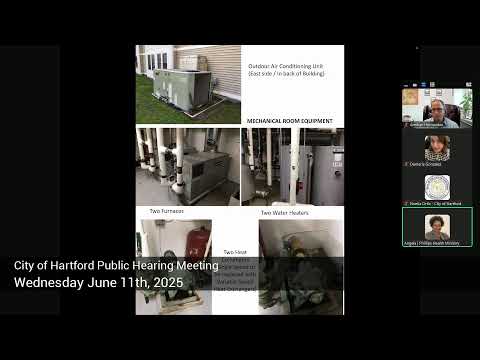
Harris also presented an energy-conservation project for Ida B. Wells Apartments, owned and operated by Ida B. Wells Inc., at 100 Coventry Street. She said the building, opened in February 2005, has original mechanical equipment that the nonprofit seeks to replace with variable-speed heat exchangers, new furnaces and water heaters so tenants—many of them seniors—can remain in subsidized housing with stable rents.
Harris said the projects repeatedly seek NAA funding year to year until all equipment is replaced, and that individual projects must raise donations from businesses directly. “We would be appreciative of a favorable recommendation for us receiving these funds,” she said.
Councilman Hernandez and other council members asked no substantive follow-up questions during the hearing, and no members of the public registered opposition. The hearing closed after the presentations.
What the hearing did not decide: The council did not vote on program approvals at this hearing. Diaz described the local submission and state review process; final approvals and determinations of how much each approved project will receive depend on the Connecticut Department of Revenue Services’ allocation and any prorating among applicants.
Next steps: The city will consider the public hearing testimony as part of the required local process; approved municipal recommendations must be submitted to DRS by the city on or before July 1, per the timeline provided at the hearing.