Get Full Government Meeting Transcripts, Videos, & Alerts Forever!
Get email alerts on the Affordable Housing topic
No spam. Unsubscribe anytime.
Planning Commission hears update on Housing Albemarle; staff outlines voucher limits, funding and next steps
Summary
Albemarle County housing staff told the Planning Commission on a work session that local rents and limited federal funding are constraining affordable housing supply, while recent policy changes aim to lock in longer affordability periods and increase developer-provided units.
Albemarle County housing staff told the Planning Commission on a work session that local rents and limited federal funding are constraining affordable housing supply, while recent policy changes aim to lock in longer affordability periods and increase developer-provided units.
"When we talk about affordable housing, we're really talking about housing that an individual or family can afford with the income they have," said Stacy Pethea, assistant director of housing, during a presentation that summarized Housing Albemarle (the county's housing policy adopted in July 2021), recent program activity and funding priorities.
Pethea said the U.S. Department of Housing and Urban Development (HUD) set the 2025 fair market rent for a two-bedroom at $1,729; the county currently sets its Housing Choice Voucher payment standards at 110% of HUD's figure because local market rents are higher. "Because the rents are so high, families are having difficulty finding places to use their vouchers," she said.
Why it matters
Pethea framed the update as both a status report and a briefing on implementation steps since the board adopted Housing Albemarle in 2021. Commissioners asked for the data and the staff’s view of where to prioritize limited county resources. Several commissioners raised preservation of existing affordable single-family housing in rural parts of the county, and the tension between preserving affordability and adding public services that can raise property values.
Most important details
- Scope and measurement: Pethea reviewed HUD definitions (30% of gross income as the conventional affordability benchmark), HUD fair market rents and the concept of a "housing wage." Using HUD's 2025 fair market rent, she said a single worker would need to earn about $33.25 per hour (a 40-hour week) to afford a modest two-bedroom at HUD's FMR without paying more than 30% of income.
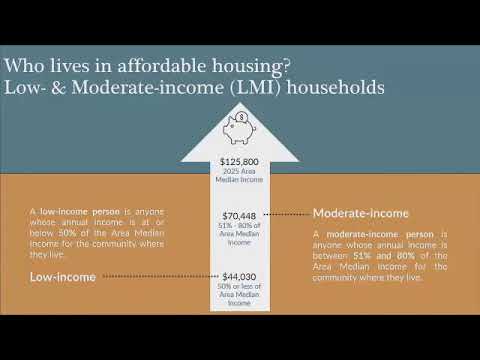
- Area median income (AMI): Pethea said the Charlottesville metro AMI rose to $125,800 (for a 4-person household) and that HUD income bands define low income (50% AMI) and moderate income (80% AMI). Using those figures, 80% AMI for a family of four is about $100,650 and 50% AMI is about $44,000.
- Program scale: The county's Housing Choice Voucher program currently serves about 345 households; 30 of those vouchers are project-based. Pethea said demand exceeds supply: when the county recently opened its waiting list, about 1,500–1,700 people applied and staff drew a random sample of 800 applications to process because resources to certify applicants are limited.
- Preservation and nonprofit partnerships: Staff described continuing work with the Albemarle Housing Improvement Program (AHIP) on owner-occupied rehabilitation and with nonprofits on preserving or acquiring at-risk rental buildings. The Piedmont Community Land Trust and Piedmont Housing Alliance were cited as partners that have acquired or will acquire developer-built proffered units to keep them affordable in perpetuity.
- Implementation progress: Housing Albemarle contains 12 objectives and 93 strategies. Pethea reported staff has implemented 20 strategies (about 22%), is actively working on 43 (about 46%), and 30 have not started — often because additional prerequisites or funding are required.
- Proffers and affordability requirements: Pethea summarized changes adopted in the Housing Albemarle implementation: the proffer (inclusionary) requirement for rezonings was increased from 15% to 20% of total residential units; target affordability for rental proffers is 60% AMI; affordability periods were extended (rental affordability from 10 to 30 years, for-sale from sale-only terms to 40 years). Staff said these changes are intended to reduce the county’s need to "chase" units every 10 years.
- Incentives and the Albemarle Rental Housing Incentive Program (ARHIP): Because longer affordability periods and higher proffer shares can widen the private financing gap, staff described ARHIP (a county incentive program aimed at rental production) and the county’s developer incentive program as tools to close that gap. Pethea said the county expects to use a mix of grants and low-interest loans to support nonprofit developers or fully affordable projects.
- Housing fund / trust fund proposal: Staff proposed formal guidelines for an affordable housing trust fund that would combine cash-in-lieu payments (developer payments instead of on-site units), a portion of property tax revenue designated by the board, and other sources into an annual competitive fund. Pethea said the draft envisions a combination of grants (targeted to nonprofits or fully affordable projects) and low-interest loans, a reserved portion for emergent needs (for example, nonprofit bids to acquire an at-risk property), and an oversight/review committee that would recommend awards to the Board of Supervisors.
- Funding and federal risk: Pethea said the county has invested nearly $20 million in affordable housing over the last four to five years (including American Rescue Plan Act funds), and that federal funding streams matter. She warned that in the proposed federal budget the Community Development Block Grant (CDBG) and HOME Investment Partnerships programs were at risk; staff described local nonprofit and municipal coordination to plan for reduced federal funding.
- Pipeline and production: Staff reported about 2,200 existing known affordable units in the county (a combination of subsidized rental stock, proffered or bonus-density units and preservation work) and roughly 3,000 subsidized rental units in the pipeline plus about 2,100 proffered units approved through rezonings. Pethea cautioned that proffered units represent maximums tied to rezonings and do not guarantee final construction counts or timing.
Commissioner questions and staff responses
Commissioners pressed staff on vacancy rates (Pethea said vacancy is low, around 2–3 percent), measures of cost burden (Pethea cited 2021 HUD data showing widespread cost burden for low- and moderate-income households and projections that cost burdens will increase by 2040), and how the county is prioritizing the 93 strategies (Pethea said staff prioritized building program foundations: developer incentives, a more sustainable housing fund and systems to coordinate developers, nonprofits and property managers).
Several commissioners asked about preserving rural single-family affordable homes and the paradox that adding infrastructure can raise assessments and risk displacement; Pethea said preservation work is underway largely through AHIP and nonprofit acquisition but that large-scale preservation requires steady funding and competitive grants.
Votes, motions and meeting actions
- Adopt consent agenda: A motion to adopt the consent agenda was made and approved by roll call during the meeting (present commissioners recorded in the roll call voted yes).
- Calendar change: The commission moved and approved cancelling the June 24 meeting and rescheduling the planned work session for July 8 with a 6:00 p.m. start time. Roll-call votes in the meeting record show the motion carried among commissioners present.
- Adjournment: The commission adjourned until July 8 at 6:00 p.m.
What the presentation leaves open
Staff said updated housing needs-assessment data (the Central Virginia Regional Housing Partnership and its consultant were preparing new tabulations) will inform any substantive revisions to Housing Albemarle; Pethea said staff will not proceed with a full policy rewrite until that updated data is available. She said planning-district and university data access will expand staff ability to update needs information more frequently than the prior multi-year cadence.
Next steps and takeaways
Staff recommended building the housing fund/ trust fund structure, advancing ARHIP to close the developer financing gap for rental projects, continuing partnerships with Piedmont Housing Alliance and the community land trust to secure perpetually affordable homeownership units, and preparing additional detail for Board of Supervisors action on incentives and trust-fund guidelines. Commissioners asked for further tracking of proffered units (how many approved units actually reach construction) and for clearer preservation metrics for rural and older single-family housing.
Quotes used in this article come from the meeting transcript and are attributed only to speakers who appear in the commission record.